
Vandaag of morgen in huis

Kwaliteit gegarandeerd

Welkomstaanbiedingen ontgrendelen: GRATIS bezorging | Tot 80% korting | Gratis 30 dagen JoyPlus-proefperiode
Download de app
Solar outdoor lighting with a motion sensor may seem straightforward: charge during the day and switch on automatically in the evening. In practice, some lights disappoint because of an undersized solar panel, limited detection range or insufficient protection against rain. So if you want to illuminate a driveway, entrance, patio, balcony or garden, it is worth looking beyond the number of LEDs or the price alone.
A high lumen figure attracts attention, but it does not indicate how broadly or evenly the light is distributed. A bright lamp with a narrow beam may illuminate a path well, but be less suitable for a large garden or driveway. You should also consider:
For an entrance, 300 to 1,000 lumens is often enough for functional lighting. For a wide façade, garage or driveway, a more powerful model with multiple light heads may be more practical.
An outdoor light with a motion sensor may detect movement directly in front of the sensor differently from someone walking past from the side. Always check the stated range and detection angle. Walls, shrubs and parked cars can also limit the range.
A lamp with only a motion sensor does not always switch on exclusively when someone walks past. An outdoor light with a dusk sensor combines light measurement with motion detection. This means the lamp can, for example, respond only after sunset.
The IP rating indicates the conditions against which the housing is protected. IP44 means protection against splashing water and solid objects larger than 1 millimetre. IP65 provides greater protection against dust and water jets from different directions. Neither rating means that the lamp can be placed underwater.
For a sheltered wall, an IP44 solar wall light may be suitable. For an exposed façade, shed or driveway, IP65 is a sensible specification to look for. Also check that the solar panel has an unobstructed view of the sky.
Lumens indicate the total amount of visible light. Kelvin indicates the colour of that light:
An LED solar-powered outdoor light with integrated LEDs usually does not have a replaceable light source. This makes installation simple, but it also means you should check the stated lifespan and warranty carefully.
The battery determines how much energy is available after a sunny day. Manufacturers sometimes state an operating time under specific conditions. Treat this information as a product specification, not as a guarantee for every season. In the Netherlands, short winter days, cloudy weather and shade can affect charging performance.
A lamp with two modes is practical: softer background lighting can save energy, while the lamp switches to a brighter setting when movement is detected. Clean the solar panel regularly with a soft, slightly damp cloth. Do not use abrasive products and do not attempt to open an integrated battery yourself.
Pay attention to the distance for movement directly towards the sensor and for movement from the side. Mount the lamp securely on a stable wall and do not point the sensor directly at a busy road, tree branch or flag that moves in the wind. This helps to reduce unwanted activation.
With wireless outdoor lighting, no power cable is required, but the installation location remains important. A lamp in deep shade may charge less effectively, even when the model is technically suitable for outdoor use.

Why it suits this profile: This compact solar wall light works without mains electricity and features an integrated motion sensor, two lighting modes and 1,000 lumens.
The specifications clearly state 1,000 lumens and IP44. It should therefore be installed in a sheltered location, and you should not expect protection against submersion.
3000 K warm white light, integrated LED, no wiring and a stated IP44 rating.
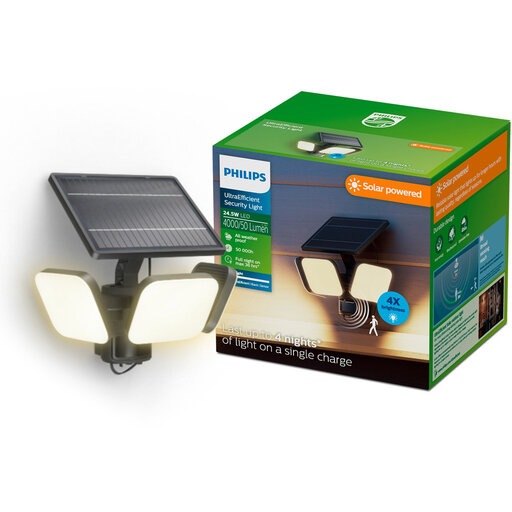
Why it suits this profile: This model is designed to provide broad, powerful lighting for a driveway, façade or entrance.
The stated detection range is 8 metres for direct approach and 16 metres for sideways movement. The lamp head can be adjusted.
4,000 lumens, IP65, dusk sensor and, according to the product description, up to four nights of lighting after a full charge.

Why it suits this profile: The three adjustable light heads are designed to illuminate wider areas such as a garden, garage, patio or driveway.
The product specification states a detection distance of 60 feet, an angle of 180 degrees and three lighting modes. Check beforehand that these values are suitable for your installation location.
3,000 lumens, IP65, three light heads and a stated light spread of 270 degrees.
We have compiled a complete, up-to-date list of products that fully meet these strict selection criteria and the applicable European safety regulations.
Choose a location where the panel receives as much direct sunlight as possible during the day. Do not install the lamp behind glass, beneath a solid canopy or directly below a powerful outdoor light. Point the sensor towards the route people use and take pets, shrubs and traffic into account.
After installation, check that:
An IP44 lamp is splash-proof, but is not intended for direct water jets. An IP65 model provides greater protection, but must not be submerged either.
This depends on the battery, charging conditions, frequency of use and exposure to the weather. Manufacturers sometimes state an LED lifespan or a number of nights per full charge. Actual performance may be lower in winter because of reduced sunlight.
Yes, but the battery will generally charge more slowly on short days and in cloudy or shaded conditions. Position the panel with as clear a view of the sky as possible and clean it regularly. A model with an energy-saving mode may be more practical in these circumstances.
A lamp that operates exclusively via its solar panel and built-in battery does not use electricity from the mains. However, there may be costs for replacing the battery or the lamp when components reach the end of their service life.
