
Vandaag of morgen in huis

Kwaliteit gegarandeerd

Welkomstaanbiedingen ontgrendelen: GRATIS bezorging | Tot 80% korting | Gratis 30 dagen JoyPlus-proefperiode
Download de app
Solar outdoor lighting works without a fixed mains connection, making it a handy choice for gardens, patios, balconies, entrances and driveways. However, simply looking at the number of LEDs or the light output won’t guarantee you choose the right lamp. In the Netherlands, limited sunshine, rain and where you place the lamp all have a major effect on how well it performs.
The most common buying mistakes are:
Light output is measured in lumens. A decorative solar garden lamp often needs only a modest light level, while a solar security light for a driveway or garage needs more.
Also consider the colour temperature:
A high lumen rating doesn’t tell you everything about how a lamp performs in practice. Check the light distribution, whether the head can be adjusted and how many lighting modes it offers. For an outdoor solar wall light, a wide beam angle can illuminate a larger area than a small, forward-facing light source.
A solar outdoor light with a motion sensor will usually switch to a brighter setting only when it detects movement. This can help preserve the battery, but only if the sensor is positioned correctly.
Check:
According to the product specifications, the UME light has a detection range of 60 feet, a sensor angle of 180° and three lighting modes. The same description states that its three light heads can be adjusted to provide coverage of up to 270°. This makes it particularly suitable for larger exterior walls, garages and driveways.
When choosing waterproof outdoor lighting, people often look at the IP code. The first digit indicates protection against solid particles, while the second refers to water. In practice:
So IP65 doesn’t mean you can leave a light in a puddle or pond. Check the battery type and stated run time, too. For example, a product description may give a maximum battery life of 24 hours or several nights. Actual run time depends on sunlight, temperature, the selected light setting and how often the sensor is triggered.
Position the panel where it will get as much direct sunlight as possible, and clean it regularly with a soft, damp cloth. If the solar panel is separate, make sure the cable is long enough to let you mount the lamp on a darker wall and place the panel somewhere brighter.
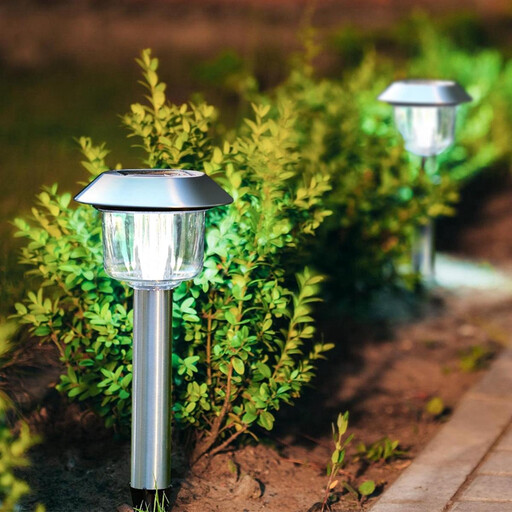
Why it suits this profile: This compact solar garden lamp runs on solar power and can be placed along a border, patio or garden path without any wiring.
The product specifications clearly state its dimensions, material and charging time of 4 to 6 hours. Just check that the stated IP44 protection is suitable for the spot you’ve chosen.
Stainless steel construction, a height of 36.6 cm and solar power. This lamp is designed for decorative path and garden lighting.
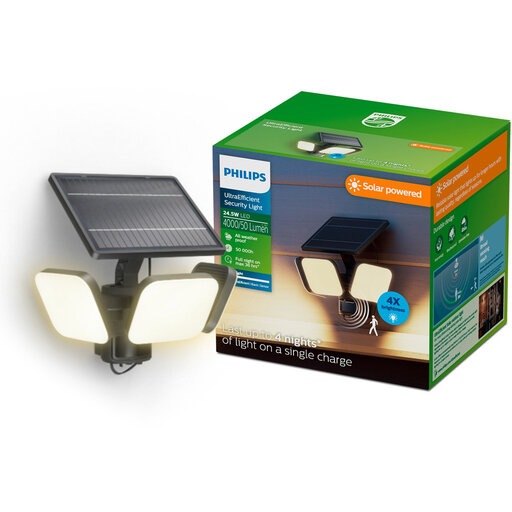
Why it suits this profile: A good choice if you’re looking for a permanent outdoor solar wall light with a clearly specified sensor setup and plenty of light for an exterior wall, entrance or driveway.
The product information lists 4000 lumens, IP65, two light settings and a PIR range of 8 metres when approached directly and 16 metres from the side. This means you can check the key figures before you buy.
Integrated LED, an adjustable light head, a 3000K colour temperature and a stated battery life of up to four nights, according to the product information.

Why it suits this profile: Designed for larger outdoor areas such as a driveway, garage, back garden or patio, where you need a wide spread of light and motion detection.
The stated IP65 rating, three lighting modes and adjustable heads make it easier to see where this light is suitable than models with only a general claim that they’re for outdoor use.
302 LEDs, a stated output of 3000 lumens, a sensor range of 60 feet and wall mounting. The battery capacity is listed as 1800 mAh.
If you’d like to adjust colours and control your lights, consider Aigostar smart solar lighting. According to the product information, the Bluetooth Mesh solar wall light and ground light support RGB and white light settings, and can connect to more than 200 Bluetooth Mesh devices. The stated light output of the 20W models is 200 lumens. That makes them better suited to ambient and accent lighting than illuminating an entire driveway.
A solar ground spotlight or solar path light is ideal for highlighting a border, path or plant. Pay particular attention to the spike length, how securely it sits in the ground and its IP rating. For an exterior wall or entrance, a solar wall light is often more practical than a low-level ground light.
We’ve put together a full, up-to-date list of products that meet these strict selection criteria and the applicable European safety regulations.
Yes, the lamp can still charge after a cloudy day, but it will usually store less energy. Place the panel somewhere as open as possible and avoid permanent shade. In winter, run time may be shorter because there’s less daylight and the panel charges less effectively.
That depends on the battery type, charging conditions, light setting and number of times the sensor is triggered. Product information may state the LED’s lifespan or the maximum battery life; these are different figures. For example, an LED lifespan of 30,000 hours doesn’t tell you how many hours the lamp will stay on each night.
The light runs on energy stored in its battery, so it doesn’t need a fixed mains connection. There may still be maintenance costs over time, for example if the battery loses capacity and needs replacing. Check in advance whether the battery is replaceable and whether replacement parts are available.
