
Vandaag of morgen in huis

Kwaliteit gegarandeerd

Welkomstaanbiedingen ontgrendelen: GRATIS bezorging | Tot 80% korting | Gratis 30 dagen JoyPlus-proefperiode
Download de app
Solar outdoor lighting seems simple: put the light in place, let the solar panel charge and enjoy cable-free lighting in the evening. In practice, models vary considerably in brightness, weather protection and running time. A light that works as a decorative solar garden light won’t necessarily be powerful enough for a driveway or dark entrance.
With this buying guide, you can compare solar garden lights using specifications you can check for yourself. That way, you can avoid disappointment and make a more informed choice between a solar wall light, path lights, a lantern or a solar-powered outdoor light with a motion sensor.
A high number of LEDs doesn’t automatically mean a light will illuminate a large area brightly. Check the luminous flux in lumens and how the light is distributed, too. A decorative solar garden light with 10 lumens per light is designed to mark a path or flower bed. A driveway or exterior wall will usually need more light.
The IP65 rating means a product is dust-tight and protected against water jets under the relevant protection classification. It doesn’t mean the light can be submerged or withstand every weather condition indefinitely. An IP44 outdoor light is splash-resistant and needs a more sheltered position than an IP65 model.
Solar lights charge less efficiently on short, cloudy days or when trees, a wall or a canopy cast a shadow over the panel. So, a stated running time isn’t a guaranteed amount of light every day. Position the panel where it will receive as much direct sunlight as possible during the day, and keep it free of dirt.
Check whether the product information states the battery capacity, charging time and expected running time. These figures depend on the amount of sunlight, the selected lighting mode and the outdoor temperature. An outdoor light with a motion sensor will generally use less energy when it only switches on at full brightness when movement is detected.
Check how the light is operated, too. Some lights have automatic dusk sensors, while others need to be switched on before the first charging cycle. A memory function can be useful for solar string lights with several modes.
For an open garden, exterior wall or driveway, it’s understandable to search for waterproof solar lighting, but always check the specific IP code. Also look for:
Materials such as stainless steel, ABS or plastic can be suitable for outdoor use, but the quality of the construction and the protection of joints and electronics are still important.
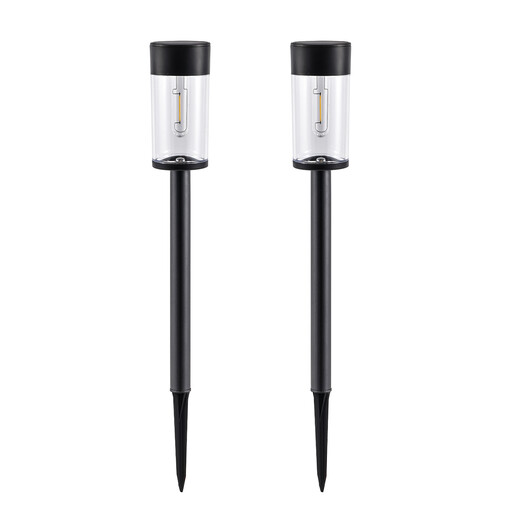
Why it suits this type of buyer: This set is designed for easy placement along a garden path, lawn edge or driveway. There’s no wiring needed, and the two lights are ready to use straight away.
The specifications state 10 lumens per light, making it clear that this is mainly marker and ambient lighting, not a powerful floodlight.
3000 K warm white light, automatic on/off and an IP65 rating, according to the product information.

Why it suits this type of buyer: A natural choice for an exterior wall, patio or entrance where a recognised brand, wall mounting and automatic operation are important.
The IP44 rating is clearly stated. So, don’t place this light where it will be exposed to direct water jets or could be submerged.
400 lumens per light, 2700 K warm white light, two lighting modes and a motion sensor, according to the product specifications.

Why it suits this type of buyer: This model is designed for larger areas such as a garage, back garden, driveway or entrance, where a wide beam and motion detection are useful.
The product information states 3000 lumens, three lighting modes, three adjustable heads and IP65 protection. This makes it better suited to lighting a larger area than a small solar garden light.
A detection range of up to 60 feet and a 180° detection angle, according to the manufacturer. When installing it, check that the sensor isn’t pointing towards a busy road.
We’ve put together a complete, up-to-date list of products that meet these strict selection criteria and the applicable European safety regulations.
It varies by model, battery capacity, brightness and the amount of sunlight. Some products, for example, state a charging time of 6 to 8 hours and a running time of 8 to 12 hours. Treat these as estimates for the product under certain conditions, not as a guarantee for every night.
Yes, but performance may drop due to shorter days, cloudy skies, rain and the lower angle of the sun. Position the panel somewhere as free from shade as possible, and clean it regularly. For essential lighting by your front door, a model with a motion sensor may be more practical than a light that stays on constantly.
Solar lighting doesn’t draw electricity from the mains while in use. The solar panel charges the built-in battery during the day. The light still needs maintenance and enough daylight to work as expected in the evening.
