
Vandaag of morgen in huis

Kwaliteit gegarandeerd

Welkomstaanbiedingen ontgrendelen: GRATIS bezorging | Tot 80% korting | Gratis 30 dagen JoyPlus-proefperiode
Download de app
Solar outdoor lighting seems simple: place the light outside, let the solar panel charge and enjoy illumination in the evening. In practice, some purchases can be disappointing. A light may receive too little direct sunlight, its brightness may turn out to be mainly decorative, or its IP rating may be misunderstood.
With this guide, you can compare solar lights for outdoor use based on features that really make a difference in a Dutch garden, on a balcony or by a front door. You will learn what to look for and which models suit different situations.
A product may list a high lumen rating, but that does not automatically indicate how large an area it will illuminate brightly. 10 lumens, for example, is suitable for subtle marking along a path, but not for lighting a driveway. For ambient lighting, warm colour temperatures such as 2700K to 3000K are generally more pleasant. For functional lighting, cooler white light of around 4000K to 5000K may be more practical.
IP44 and IP65 are not synonyms for completely waterproof. IP44 protects against splashing water and is mainly suitable for sheltered façades, balconies and covered patios. IP65 offers greater protection against dust and water jets, but a light still must not be submerged.
Always check the exact IP rating rather than relying solely on a marketing term such as “all-weather” or “waterproof”.
A solar-powered outdoor light will not work optimally under a canopy, behind a dense hedge or on a north-facing wall with little direct sunlight. The stated operating time depends on factors including hours of sunlight, season, temperature, battery condition and operating mode. Information such as 8 to 14 hours of illumination should therefore be treated as a product specification under certain conditions, not as a fixed daily guarantee.
Brightness is measured in lumens. Use this guideline:
Colour temperature is measured in kelvin (K). Warm white light at 2700K or 3000K is well suited to ambient garden lighting. Light at 4000K to 5000K appears brighter and more functional, which can be useful by a driveway or back door.
When choosing waterproof outdoor lighting, pay attention to the IP code:
So do not install an IP44 solar wall light where rainwater runs directly over the housing or where it may be sprayed with a garden hose.
An outdoor light with a motion sensor only switches on when movement is detected. This can help preserve battery life, but check that the detection range and installation direction suit your situation. An automatic dusk sensor switches the light on when it gets dark; some models also offer a manual “on” setting.
Also consider the installation method:
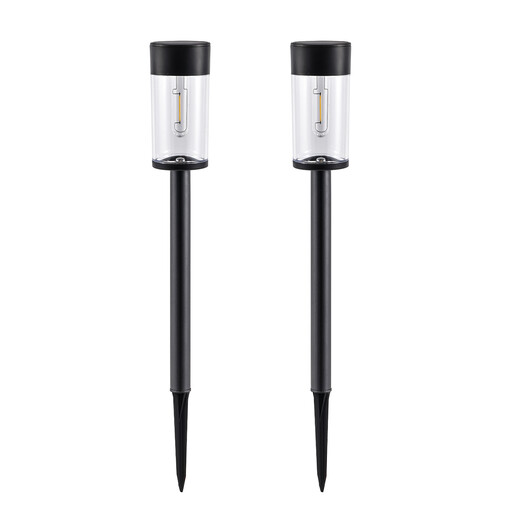
Why it suits this profile: This set is designed for anyone who wants to mark a garden path, border or driveway edge without installing wiring. Each light has a stated output of 10 lumens, with warm white light at 3000K.
The specifications make it clear that this is primarily path and ambient lighting, rather than a powerful light for a dark driveway. The included ground stakes make installation easier.
Set of two, automatic dusk function and IP65 rating according to the product details. The stated charging time is 6 to 8 hours of sunlight.
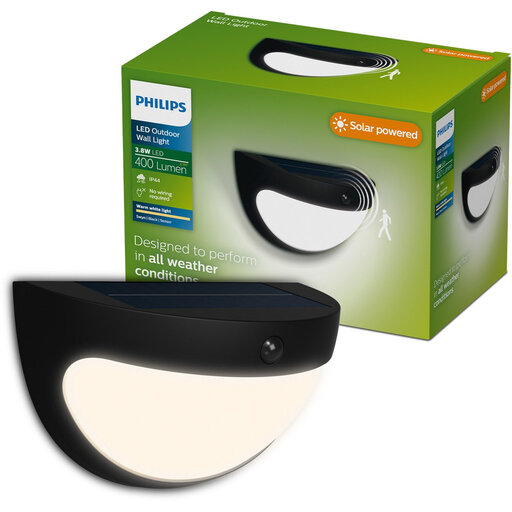
Why it suits this profile: This solar wall light is suitable for an entrance, façade or patio where automatic lighting is preferred. It has two lighting modes, a motion sensor and a stated output of 400 lumens.
The combination of dusk and motion detection prevents the light from staying on continuously when it is not needed. However, IP44 means that installation in a sheltered location is advisable.
No mains wiring required, integrated LED and a choice between automatic and manual operation.
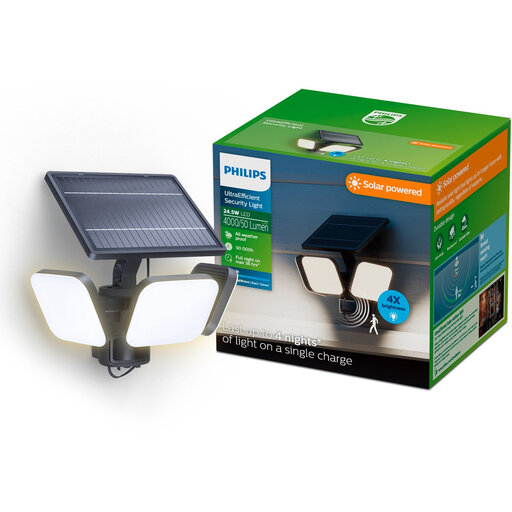
Why it suits this profile: For a driveway, back garden or broad façade where plenty of functional light is needed. The product details state 4000 lumens, IP65, an adjustable light head and a motion detection range of up to 8 metres when approached directly.
The high lumen rating makes this light more suitable for functional illumination than a decorative path light. However, check beforehand that the installation location receives enough sunlight.
IP65 rating, adjustable light head and two lighting modes according to the product description. This model has a colour temperature of 5000K.
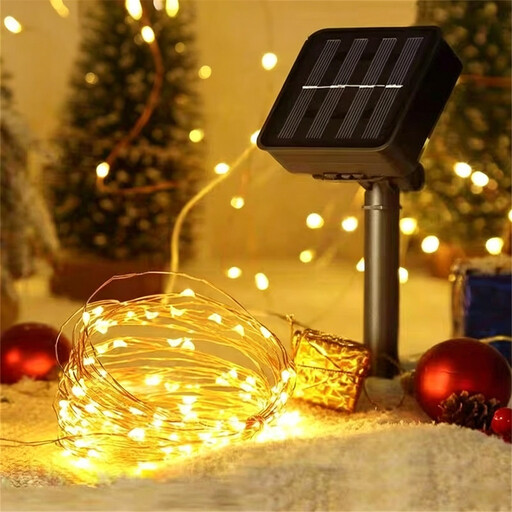
Why it suits this profile: This set is designed to decorate a balcony, patio, tree or pergola. Each string features 75 warm white LEDs spread over 49 ft, with eight lighting modes and a memory function.
The product description positions these lights as decorative lighting, not security lighting. This makes expectations about brightness clearer.
Two strings, eight modes and automatic switching on and off according to the product information. The solar panel must be placed outdoors in direct sunlight.
Place the solar panel where it receives as much direct light as possible during the day. Take shadows from trees, fences and buildings into account. Push ground lights firmly into the soil, but do not press on the light fitting itself. For wall lights, check that the wall plugs and screws are suitable for the façade.
Clean the panel and light housing regularly with a soft, slightly damp cloth. Do not use abrasive cleaners. For models with a built-in lithium-ion battery, do not open or replace the battery yourself if the manufacturer does not permit this.
We have put together a complete, up-to-date list of products that fully meet these strict selection criteria and the applicable European safety regulations.
The lifespan depends on the battery, LED module, housing, exposure to the weather and maintenance. Products in the range may state an LED lifespan of 15,000 or 25,000 hours, but this is not the same as the lifespan of the complete light. The battery may lose capacity sooner.
Yes, but output may be lower because of shorter days, cloudy conditions, rain and the lower position of the sun. In winter, ideally choose a location with a direct view of the sky and clear the panel of dirt or leaves. A motion sensor can help use the available battery capacity more efficiently.
During normal use, a solar light draws energy from the solar panel and built-in battery. It does not need to be connected to the mains. Models with USB charging, such as some portable wall lights, may need additional USB charging when there is not enough sunlight.
