
Vandaag of morgen in huis

Kwaliteit gegarandeerd

Welkomstaanbiedingen ontgrendelen: GRATIS bezorging | Tot 80% korting | Gratis 30 dagen JoyPlus-proefperiode
Download de app
A dark driveway, a poorly lit entrance or a patio without atmospheric lighting does not always require cables and an additional power socket. Solar outdoor lighting uses a solar panel and built-in battery, often making installation easier. However, things do not always work as expected in practice. A light may promise a high output on paper, yet provide fewer hours of illumination in a Dutch winter or barely charge in a shady spot.
The right choice is therefore not just about appearance. Pay particular attention to light output, ingress protection rating, positioning and how the light is operated.
The stated lumen rating indicates how much light a lamp emits according to its product specification. It does not automatically tell you how large an area will be illuminated evenly. A solar floodlight with several light heads distributes light differently from a small solar wall light.
For ambient lighting on a balcony, a modest light output is often sufficient. For a driveway, side passage or garage, you need more targeted lighting. Also check the beam angle and the number of light sources.
Look at the IP rating rather than relying solely on marketing descriptions. IP44 outdoor lighting is protected against solid objects larger than 1 millimetre and splashing water from various directions. This is suitable for many sheltered façades, balconies and patios, but not for immersion or direct water jets.
IP65 outdoor lighting offers greater protection against dust and water jets. IP65 still does not mean that you can place the light in a pond. Also check that all connections and the solar panel have been installed correctly.
A solar panel needs direct daylight to charge the battery properly. A light positioned under a solid canopy, behind a tall fence or facing north may therefore provide fewer hours of illumination. According to product information from various brands, actual operating time depends on sunlight, season, temperature and charge level.
Do not automatically position the panel next to the light. Instead, place it where it receives the most unobstructed daylight during the day. On some models, the panel can be installed separately using a cable.
Colour temperature is measured in kelvin:
A solar pendant light with adjustable colour temperature offers greater flexibility. Check whether the setting is adjusted on the light itself or via a remote control or app.
A larger battery can store more energy, but operating time also depends on the LED output and the amount of sunlight. A stated operating time is therefore a product specification measured under certain conditions, not a fixed guarantee for every night.
Pay attention to the combination of:
Solar lighting with a motion sensor can save energy because the light only becomes brighter when movement is detected. Check the detection angle and range if you want to monitor a driveway or garden path.
A light without permanent wiring is convenient, but it still needs to be secured firmly. Use suitable mounting materials for brick, wood or plastic, and make sure cables do not create a trip hazard. Clean the solar panel regularly with a soft, slightly damp cloth. Dirt, leaves and bird droppings reduce the amount of light reaching the panel.
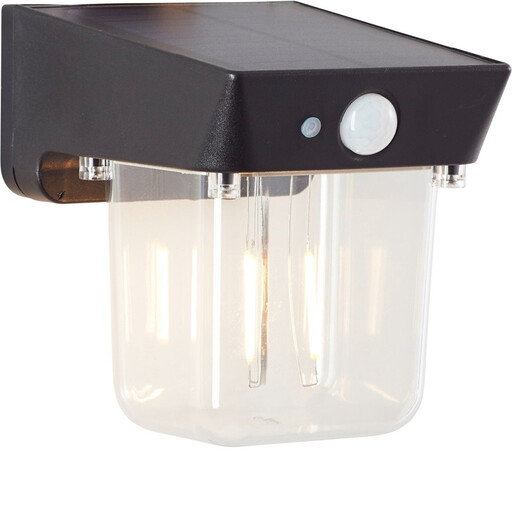
Why it suits this profile: This compact solar wall light is designed for a façade, entrance, garden or patio and has an integrated motion sensor.
The specifications clearly state 180 lumens, 2700K and IP44. This makes it easier to understand that it is primarily accent and entrance lighting, rather than a large floodlight.
Integrated LED, motion sensor, two modes and a compact size of 11.5 × 10 × 11 cm.

Why it suits this profile: Ideal if you are looking for a functional light for the garage, entrance or driveway with a higher stated light output.
The IP44 rating is clearly stated. It is therefore best positioned somewhere exposed to splashing water, rather than where it may encounter direct water jets or immersion.
According to Philips product information, the light delivers 1000 lumens at 3000K and features a motion sensor and two light modes.

Why it suits this profile: This solar floodlight is designed for larger areas such as a driveway, garden, garage or patio.
The product description mentions IP65 and a wide light distribution. Nevertheless, check the installation location and aim the three light heads at the desired area.
According to UME’s own product information: 302 LEDs, a stated light output of 3000 lumens, three modes and a detection angle of 180 degrees.
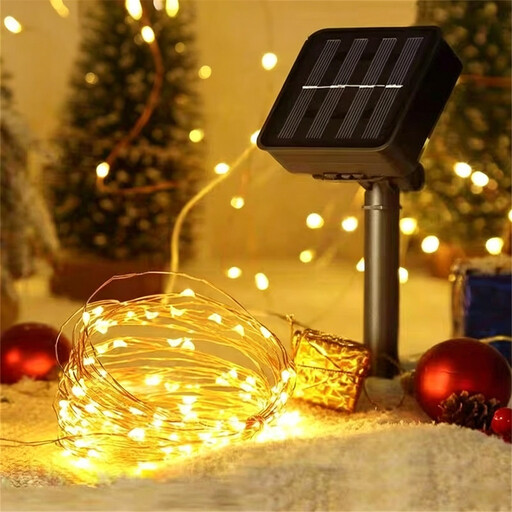
Why it suits this profile: This solar string light is ideal for a balcony, pergola, tree or patio where creating an atmosphere matters more than strong functional lighting.
The length, number of LEDs and light modes are clearly stated. Do not use it as a replacement for lighting that needs to illuminate a path or staircase fully.
Two cables of approximately 4.9 metres, each with 75 warm-white LEDs and eight light modes. The manufacturer states an operating time of 8 to 14 hours under certain conditions.
We have put together a complete, up-to-date list of products that fully meet these strict selection criteria and the applicable European safety regulations.
A solar pendant light is particularly suitable when the panel has an unobstructed view of the sky. Wall lights are more practical for a façade or fence. If you want to control several light sources, you could also consider smart garden lighting. In that case, pay close attention to the difference between solar products and models that still operate at 220–240 volts, such as some app-controlled garden lighting sets.
Yes, but operating time may decrease due to shorter days, cloudy weather and lower charging efficiency. Position the panel as openly as possible and clean it regularly. Using a motion sensor mode can help the stored energy last longer.
According to the product specification, the LED light source can often last for many thousands of operating hours. The battery is a separate component, and its lifespan depends on charging cycles, temperature and usage. Check whether the battery is replaceable before purchasing a model.
During normal use, the light draws its energy from the solar panel and built-in battery. It therefore does not need to be connected to the mains. However, bear in mind the purchase cost, any battery replacement and the fact that light output remains dependent on weather conditions.
