
Vandaag of morgen in huis

Kwaliteit gegarandeerd

Welkomstaanbiedingen ontgrendelen: GRATIS bezorging | Tot 80% korting | Gratis 30 dagen JoyPlus-proefperiode
Download de app
Solar outdoor lighting is a convenient choice for a garden, terrace, driveway or entrance without cables connected to the mains. In practice, however, things do not always go to plan: a light may only stay on for a short time, the motion sensor may react too slowly or the housing may prove less suitable for a wet wall than expected.
As a Joybuy Product Recommendation Officer, I focus mainly on specifications that can be verified. So do not look only at a high lumen count or promises of “years of use”. Positioning, the IP rating, the battery and the lighting mode are just as important.
A lumen rating indicates how much light a lamp produces according to its product specification. It does not automatically tell you how large an area will be illuminated. A narrow beam with a high lumen output may be bright in one spot, while a wide garden is lit less evenly.
For atmospheric lighting along a path, 10 lumens per lamp may be sufficient. A driveway or back door needs more light, for example several hundred lumens. A solar floodlight with thousands of lumens is not always practical on a small balcony.
Check the IP rating rather than relying on a marketing term alone. With IP44, the lamp is protected against solid objects and splashing water. This rating is suitable for many sheltered walls, balconies and terraces, but it does not mean the lamp can be placed under a direct jet of water or in a puddle.
IP65 provides greater protection against dust and water jets. Even a waterproof solar lamp with IP65 must not be submerged unless the manufacturer explicitly states that it can be. Install the lamp according to the instructions and pay attention to openings around cables, buttons and mounting points.
A solar outdoor light with a motion sensor has a specific range and viewing angle. A sensor that mainly detects movement straight ahead may take longer to register someone walking past the wall. Bushes, rain, low mounting or an incorrectly adjusted angle can also affect performance.
Position the lamp where the solar panel receives enough direct sunlight during the day. A north-facing wall, a balcony beneath a canopy or a spot under a tree can significantly reduce charging time. In the Dutch winter, there is also less sunlight available. As a result, the operating time may be shorter than in summer.
Use lumens as your first point of comparison, but also consider the intended use:
The colour temperature determines the overall appearance. 2700K to 3000K gives warm white light and suits a terrace or garden. 5000K to 7000K looks cooler and brighter, which is often chosen for a solar security light. The available Philips solar outdoor light models mainly feature warm white colour temperatures of 2700K or 3000K.
Check whether the lamp has a built-in lithium-ion battery and what capacity is specified. A larger battery can store more energy, but the actual operating time also depends on brightness, sensor activity and the amount of sunlight.
An automatic or dusk sensor switches the lamp on when it gets dark. A motion sensor helps to reduce energy consumption by making the lamp shine more brightly only when movement is detected. Check whether there are several modes, such as dimmed lighting with temporarily boosted maximum brightness.
Choose the IP rating based on the location. IP44 may be sufficient for a sheltered spot; for a wall directly exposed to rain, IP65 is a more suitable choice. Also check:
Clean the solar panel regularly with a soft cloth. Dust, leaves and bird droppings reduce the panel’s light output.
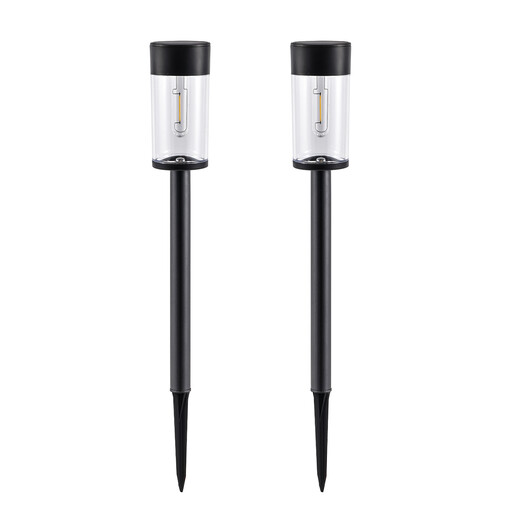
Why it suits this profile: This set is designed for garden paths, borders and driveways. The ground stakes make installation simple, without cables or tools for a permanent connection.
The product specification states 10 lumens per lamp, 3000K and IP65. This makes it clear that it is mainly soft path lighting, not a bright security light.
Set of two, automatic dusk activation, 3000K warm white light and a stated operating time of 8 to 12 hours under the specified charging conditions.

Why it suits this profile: For anyone who wants to combine lighting with camera surveillance at an entrance, back door or garage. This Eufy solar security camera has an integrated wall light.
Its functions are clearly defined: 300 lumens for the light, 2K resolution for the camera, IP65 and a PIR detection range of 7.5 metres. It is therefore not an ordinary ambient light.
Integrated 5200mAh battery, 120° field of view, motion alerts and app control. According to the product information, the internal memory can store up to two months of footage with average use.
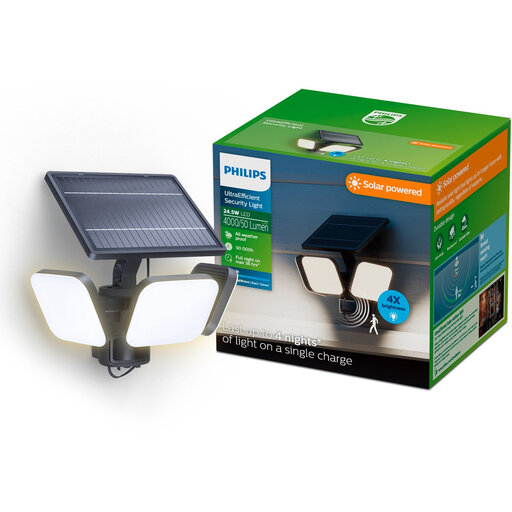
Why it suits this profile: Suitable for a driveway, large garden wall or garage where a broad, cool beam and automatic detection are preferred.
The IP65 rating clearly confirms its suitability for outdoor use. The lamp also has a motion sensor and dusk sensor; however, check whether 5000K suits the look you want.
According to Philips, the stated light output is 4000 lumens and the detection range is 8 metres when approached directly and 16 metres with sideways movement.
We have compiled a complete, up-to-date list of products that fully meet these strict selection criteria and the applicable European safety regulations.
Yes, but the operating time may be shorter because of reduced daylight, a lower sun angle and cloudy conditions. Position the panel as far away from shade as possible and clean it regularly. For security lighting, choose a model with sufficient battery capacity and a motion mode that does not run at full brightness all night.
The lifespan varies depending on the battery, electronics, LED module and exposure to the weather. Manufacturers sometimes state an LED lifespan, such as 25,000 or 60,000 hours. This is not the same as the lifespan of the complete lamp. The battery may wear out sooner. Therefore, check the warranty, maintenance instructions and whether the battery can be replaced.
During normal use, energy from the solar panel is stored in the built-in battery. This means that a permanent connection to the mains is not required. The total cost of ownership does include the purchase price, any maintenance and eventual battery replacement. A lamp with a camera may also be subject to app or storage terms; check these before buying.
For a terrace, balcony or border, 2700K to 3000K is generally calmer and warmer. For a driveway or solar security light, 5000K can provide greater contrast, but this light also looks cooler. Choose the colour temperature based on both the intended function and your surroundings.
