
Vandaag of morgen in huis

Kwaliteit gegarandeerd

Welkomstaanbiedingen ontgrendelen: GRATIS bezorging | Tot 80% korting | Gratis 30 dagen JoyPlus-proefperiode
Download de app
Solar outdoor lighting is ideal if you want to illuminate a garden, patio, balcony, driveway or façade without running a cable to a socket. During the day, the panel charges the battery; at dusk, the light often switches on automatically. However, not every solar outdoor light delivers the same results in practice.
The key differences are not limited to the design or the number of LEDs. Positioning, battery capacity, light output and protection against moisture all determine whether you will still have enough light after a dark, overcast day. The checks below will help you avoid making the wrong purchase.
A solar string light with lots of small LEDs is primarily designed to create ambience. The number of LEDs does not indicate how much light the lamp casts onto a path, façade or driveway. For functional lighting, look at lumens. A wall light producing 180 to 500 lumens is suitable for an entrance or patio; a more powerful solar security light can be considerably brighter according to the product specifications.
So, do not use a string light as a replacement for an outdoor light with a motion sensor. The functions are different: decoration versus focused illumination.
An IP rating consists of two digits. The first indicates protection against solid particles, while the second refers to moisture. IP44 protects against splashing water and is suitable for a sheltered façade or balcony. IP65 offers greater protection against dust and water jets, but even then you must not submerge the solar panel or light.
Also check whether the rating applies to the complete set. For some products, the panel, battery and string-light components are not constructed in exactly the same way. Always position the panel according to the instructions and prevent water from pooling around it.
A solar light on a north-facing wall, beneath a balcony or behind a dense tree may not receive enough direct sunlight. Manufacturers sometimes state an operating time of several hours, but this depends on the season, cloud cover, shade and the condition of the battery.
According to VIVREAL’s product information, a fully charged string light can operate for around 8 to 14 hours after receiving 6 to 8 hours of direct sunlight. Treat this as a product specification under the stated conditions, rather than a fixed guarantee for every evening in the Netherlands.
A solar wall light producing 400 lumens at 2700 K, for example, is well suited to a patio or balcony. For a driveway where you want to detect movement, you should focus more on lumens, detection angle and sensor range.
Choose IP44 for a location that is somewhat sheltered from driving rain, such as a covered entrance or balcony. For an open garden, fence or patio, IP65 can offer greater protection. However, the rating does not make a product indestructible. Regularly check the fixings, cable entry points and the seal around the solar panel.
Pay attention to the type of battery and the stated charging time. A longer operating time is only possible when the panel collects enough energy. In winter, the days are shorter and the sun is lower in the sky. As a result, solar-powered garden lighting may operate for less time or produce less light.
Position the panel:
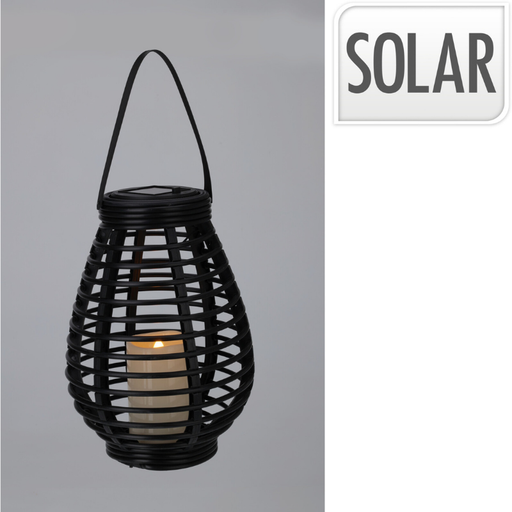
Why it suits this profile: This lantern is a simple choice for a patio, garden path or balcony where soft decorative lighting is desired.
The product description mentions one warm yellow LED and positions the light as ambient lighting, so you will not expect a high light output for security purposes.
Measures 18 × 18 × 26 cm, with an integrated 1.2 V Ni-MH battery and an on/off switch.
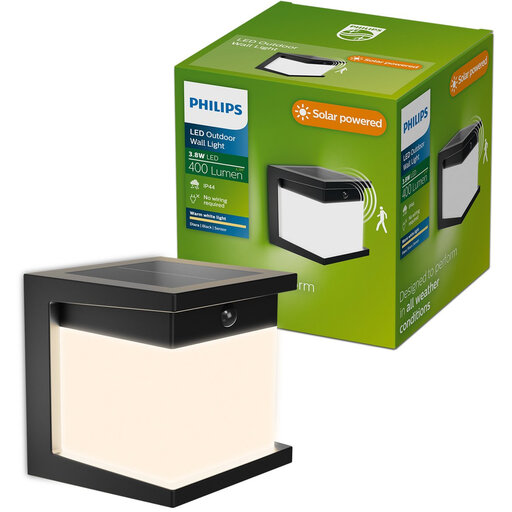
Why it suits this profile: This solar wall light combines a compact black design with warm light for an entrance, garden path or balcony.
The specifications state 400 lumens, 2700 K and IP44. This makes it clear that it is a splash-resistant outdoor light for general use, not a light designed to be submerged.
Two light modes, integrated LED, motion sensor and a stated lifespan of 25,000 hours according to the product information.

Why it suits this profile: For a wide driveway, garage, garden or property where focused lighting and motion detection are more important than a soft ambience.
The sensor and lighting specifications are specific: a detection range of up to 60 ft, a 180° angle and three adjustable modes. The IP65 rating does not mean that you can place the light underwater.
302 LEDs, a stated light output of 3000 lumens, three adjustable light heads and IP65 according to the product information.
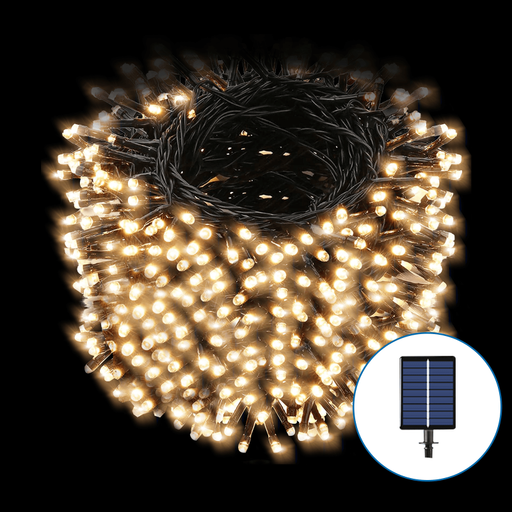
Why it suits this profile: A practical option for a balcony edge, fence, window or small garden where a longer string light is preferred.
The information states that it has a 10-metre string light, 100 LEDs, IP65, 8 modes and a stated operating time of 8 to 12 hours. This makes it easier to assess the ambience and coverage in advance.
Charging time of 4 to 6 hours according to the product description, 8 light modes and a built-in 1.2 V, 800 mAh battery.
We have put together a complete, up-to-date list of products that fully meet these strict selection criteria and the applicable European safety regulations.
Do not position a solar outdoor light solely where the illumination is needed; choose a location where the panel will also receive enough sunlight. With a separate solar panel, a cable several metres long is practical: for example, you can hang the light on a fence and position the panel higher up or in a sunnier spot.
Clean the panel a few times each season with a soft, dry or slightly damp cloth. Do not use harsh cleaning products. With a wall light, check that the mounting is still secure. A motion sensor works less reliably when branches, rain marks or dirt cover the sensor window.
Also consider the desired colour. Warm white from 2700 to 3000 K works well around a seating area. More neutral or cooler light may be better suited to a driveway, but can appear harsher in a small garden.
Yes, a panel can also make use of diffuse daylight, but the output is usually lower than in direct sunlight. As a result, the operating time and light intensity may decrease. Keep the panel unobstructed and clean it regularly.
This depends on the battery type, charging cycles, temperature and exposure to moisture. According to the manufacturer’s information, the LED itself may have a long stated lifespan, but the battery is a wear component. Therefore, check whether it can be replaced and store the light according to the instructions if it will not be used for an extended period.
During normal use, the light draws its energy from the solar panel and built-in battery. You do not need a permanent connection. However, costs may arise from replacing the battery or carrying out maintenance. Use a solar string light for decoration and choose a solar security light when your main aim is to detect movement and cover a larger area.
