
Vandaag of morgen in huis

Kwaliteit gegarandeerd

Welkomstaanbiedingen ontgrendelen: GRATIS bezorging | Tot 80% korting | Gratis 30 dagen JoyPlus-proefperiode
Download de app
Solar outdoor lighting is handy if you don’t want to run cables or don’t have a mains connection in your garden. However, the reality can sometimes be disappointing: a light may stay on for less time than expected, give off too little light or become damaged after a wet season. Choosing the right specifications helps you avoid a disappointing purchase and make a more informed choice between solar lights for outdoors, a solar wall light, a solar garden light or a solar security light.
A high number of LEDs doesn’t automatically mean that a light will brightly illuminate a large area. Also consider the light output in lumens, the light distribution and the beam angle. Decorative solar garden lights often produce only a few lumens each. That’s enough to make a flower bed or path visible, but not to light up a whole driveway.
An IP rating indicates how well a product is protected against dust and water. IP44 is suitable for splashes and a sheltered outdoor spot. For an open garden, exterior wall or driveway, IP65 may be more practical, as this rating indicates protection against dust and water jets. IP65 doesn’t automatically make a light suitable for every situation: correct installation and regular checks are still important.
A solar light charges via its panel during the day. If you place it under a canopy, next to a tall fence or in the shade of a tree, the battery may store less energy. The stated running time usually depends on having enough sunlight and on the selected light mode. In dark or cloudy conditions, the actual running time may be shorter.
For ambience, 3000 K warm white and a low lumen output are usually pleasant. Soft light may be enough for a path, while a driveway or back door may need more light. If you’re choosing an outdoor solar light with a motion sensor, also consider how the light operates: a short burst of bright light when movement is detected usually uses less energy than staying on continuously.
One example of a light designed to illuminate a specific area is the UME light, which has 3000 lumens, 302 LEDs and three lighting modes according to its product specifications. The stated colour temperature is 7000 K. Always check that the light colour you want matches the product description; a higher colour temperature usually looks whiter and brighter than warm white light.
Check whether the battery is included, what capacity is stated and how many hours of sunlight are needed. For example, the UME solar path lights specify 6 to 8 hours of sunlight for a stated running time of 8 to 12 hours. This is a product specification based on certain conditions, not a guarantee for every winter’s day in the Netherlands.
Some models provide only general information about the battery. Also check how the light is operated: automatic dusk activation, an on/off switch, a fixed lighting mode or a motion sensor can all affect how long it runs.
A stake light is easy to place alongside a flower bed or path. A wall light needs a sturdy surface and a position where the solar panel gets enough direct sunlight. Before you buy, check:
Clean the solar panel and sensor occasionally with a soft, slightly damp cloth. Don’t use harsh cleaning products.
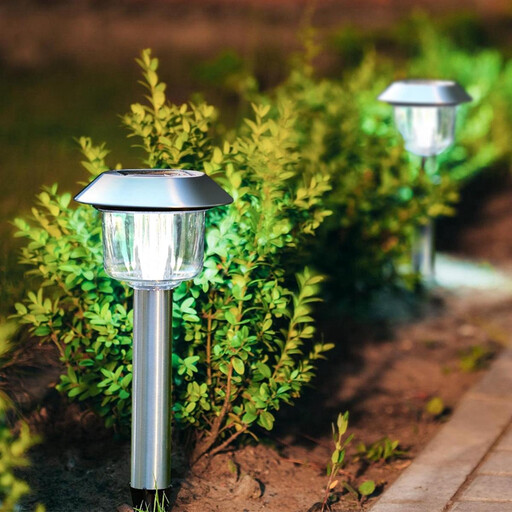
Why it suits this profile: This compact solar garden light is designed to provide simple decorative lighting in a garden or on a patio. It stands 36.6 cm tall and runs on solar power.
The product information states a low output of 0.08 W. So expect mood lighting rather than broad security lighting.
Stainless steel construction, compact dimensions and easy installation with no wiring.

Why it suits this profile: This solar wall light combines an integrated LED, two lighting modes and a motion sensor, making it suitable for an entrance, patio or exterior wall.
The IP44 rating is clearly stated. It’s therefore best to place this light somewhere sheltered rather than fully exposed above a driveway.
1000 lumens according to the product specifications, 3000 K warm white light, a motion sensor and automatic dusk function.

Why it suits this profile: The three adjustable heads, wide light distribution and motion detection are designed for larger areas such as a garage, back garden, patio or driveway.
The product specifications state IP65, three lighting modes and a detection range of 60 feet. Before installation, check that this range suits your property.
According to the product description: 302 LEDs, 3000 lumens, 270° adjustable coverage and a 180° motion sensor.
We’ve put together a complete, up-to-date list of products that meet these strict selection criteria and the applicable European safety regulations.
It varies depending on the model, battery, lighting mode and amount of sunlight. Product information sometimes gives a range, such as 8 to 12 hours. Treat this as a guide for favourable charging conditions. A motion sensor can help the battery last longer than it would with a light that stays on continuously all evening.
Yes, but its output may be lower because of shorter days, cloudy weather and the sun being lower in the sky. Position the panel as unobstructed as possible to make the most of the available sunlight, and keep it clean. When there’s little daylight, expect a shorter running time or dimmer light.
An outdoor solar light doesn’t use mains electricity during normal operation. It charges via the solar panel and runs on a built-in battery. However, you may need to pay for maintenance or a replacement if the battery loses capacity over time. So check in advance whether the battery can be replaced and what warranty or statutory rights to a remedy apply.
