
Vandaag of morgen in huis

Kwaliteit gegarandeerd

Welkomstaanbiedingen ontgrendelen: GRATIS bezorging | Tot 80% korting | Gratis 30 dagen JoyPlus-proefperiode
Download de app
Solar outdoor lighting is a convenient option for a garden, balcony, patio, entrance or driveway where you do not want to install an electricity cable. However, not every light performs equally well in the same conditions. A small solar panel in the shade, an insufficient protection rating or a poorly adjusted motion sensor can all leave you disappointed with your purchase.
With this guide, you can compare solar lights for outdoor use based on factors that matter in everyday use: light output, positioning, sensor performance, battery, IP rating and intended use.
Lumens indicate how much light a lamp can produce according to its product specifications. The actual experience also depends on light distribution, the height at which you install the lamp and the remaining battery charge. For example, a wide beam is useful on a driveway, while a softer beam is better suited to a patio.
Also pay attention to colour temperature. 2700K to 3000K generally creates a warmer look. 4000K appears more neutral, while 5000K or higher produces bright, cooler light. Check the specification rather than relying solely on terms such as “warm white” or “bright”.
An IP44 solar lamp is protected against solid objects and splashing water. This makes the rating suitable for many sheltered façades, balconies and patios, but not automatically for areas exposed to direct jets of water or prolonged heavy rain.
IP65 solar lighting offers greater protection against dust and water jets. Even with IP65, correct installation remains important. Position the panel and lamp according to the instructions, and do not immerse the housing or solar panel.
Solar garden lighting needs direct sunlight during the day to charge its built-in battery. Shade from a canopy, tree or façade can reduce the amount of energy generated. During the darker winter months and in cloudy weather, the operating time may also be shorter than in summer.
Therefore, check the following before buying:
For decoration, such as a solar string light, a soft light colour and several lighting modes are often more important than high light output. For an entrance or garden path, 180 to 500 lumens may be sufficient, depending on the distance and mounting height.
A solar outdoor light with motion sensor for a driveway or large garden will generally benefit from a wider detection range and a broad beam. In addition to lumens, check the detection angle and detection range. A sensor with a wide range can be practical, but position the light so that passers-by or traffic do not trigger it unnecessarily.
The first digits and letters of the IP code indicate the level of protection provided by the housing. IP44 and IP65 are common ratings for outdoor use:
A higher IP rating does not automatically make a light suitable for every location. Also consider the mounting method, cable entry and the direction from which rain may reach the light.
Look at the battery capacity, stated charging time and expected operating time. These figures depend on sunlight and usage. A lamp that is specified to operate for 8 to 14 hours will not necessarily achieve this every night in winter.
For security lighting, a sensor mode can help save battery power. For ambient lighting, a constant mode, flashing function or memory function may be more useful. Also check whether the battery is integrated and whether the manufacturer permits replacement. With integrated LED lighting, the light source is often not intended to be replaced by the user.
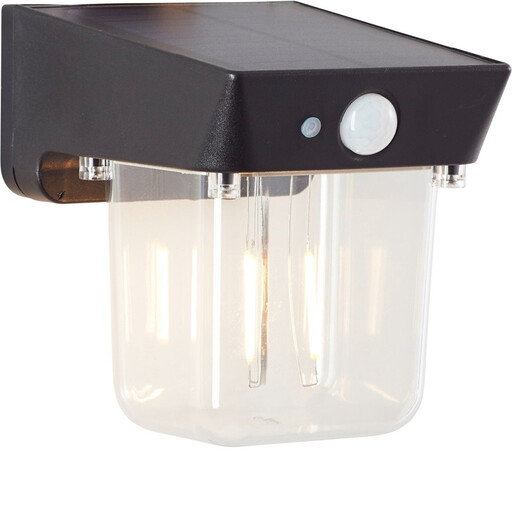
Why it suits this profile: This compact solar wall light is suitable for an entrance, balcony or small patio where you do not want to install wiring. The built-in motion sensor switches the light on when needed.
The product specification states 180 lumens, 2700K and IP44. This makes it clear in advance that this is primarily ambient and functional lighting, rather than a wide-beam floodlight.
Integrated motion sensor, warm 2700K light, compact height of 11.5 cm and installation without a mains connection.

Why it suits this profile: This solar security light is designed to provide broad, powerful illumination for a driveway, garage or large garden. The adjustable head helps direct the beam towards the desired area.
The listing explicitly states 4000 lumens, IP65, a detection range of 8 metres when approached directly and 16 metres from the side. This allows you to match the light more effectively to a spacious outdoor area.
4000 lumens, IP65 protection, motion and dusk sensors, and two lighting modes. Available with bright white 5000K light.

Why it suits this profile: This solar floodlight is designed for larger areas, such as a garage, spacious back garden, pool area or driveway.
The three adjustable light heads and the stated 270-degree angle make the light distribution easier to control than with a compact lamp featuring a single fixed beam.
302 LEDs, stated light output of 3000 lumens, IP65 and three lighting modes. The product specification states a sensor range of 60 feet and an angle of 180 degrees.
We have put together a complete, up-to-date list of products that fully meet these strict selection criteria and the applicable European safety regulations.
Yes, but charging performance may be lower due to shorter days, cloudy weather and the low winter sun. Position the panel as unobstructed as possible and keep it clean. For a dark location, choose a lamp with an energy-saving sensor mode or a larger battery capacity.
Its lifespan depends on the battery, LED module, housing, installation and weather conditions. Manufacturers may specify a lifespan of, for example, 20,000 or 25,000 operating hours for the LED light source. This does not automatically mean that all components will last equally long. Therefore, check the warranty, battery details and maintenance instructions.
During normal use, a solar lamp does not need to be connected to the mains electricity supply. The battery is charged by the solar panel during the day. However, there may be purchase, maintenance and potential battery replacement costs. Actual operating time remains dependent on sunlight, temperature and the selected lighting mode.
