
Vandaag of morgen in huis

Kwaliteit gegarandeerd

Welkomstaanbiedingen ontgrendelen: GRATIS bezorging | Tot 80% korting | Gratis 30 dagen JoyPlus-proefperiode
Download de app
Installing a solar outdoor light without cables or extra power use sounds simple. Yet many purchases disappoint. After a few weeks the light dims, the motion sensor triggers for every cat, or the solar panel hardly gets any sun. With the right specifications, you’ll avoid spending money on lighting that doesn’t suit your garden, balcony, driveway or facade.
In this buying guide, you’ll learn what to look out for with solar outdoor lighting. We also compare a few models for different use cases.
A high LED count doesn’t automatically mean a light will illuminate a large area well. Focus instead on the light output in lumens. A solar wall light with 400 lumens suits an entrance or balcony, while a solar floodlight with 3,000 to 4,000 lumens is a better fit for a driveway or larger garden.
Light distribution matters too. A light with multiple adjustable heads can cover a bigger area than a single fixed light point with the same lumens.
The designation IP44 includes protection against solid objects larger than 1 millimetre and splashing water. That works for a sheltered facade, balcony or canopy, but it’s not the same as protection against powerful water jets.
IP65 offers full protection against dust and protection against water jets. The light still must not be submerged. So check the mounting location carefully: under an eaves overhang has different conditions to fully open on a post along the driveway.
A solar outdoor light only works well when the panel gets enough light during the day. Shade from a fence, tree or neighbouring building shortens charging time. In the Netherlands, overcast days can also affect run time.
Note the difference between stated charge and run times and real-world use. Manufacturers usually list these values under specific conditions. For the VIVREAL string lights, for example, a charge time of 6 to 8 hours of direct sunlight and a run time of 8 to 14 hours are given. According to the product description, the actual duration depends on the weather.
For ambient light on a patio or balcony, warm white light of around 2,700 to 3,000 kelvin is usually pleasant. A solar string light with warm white LEDs is mainly for decoration, not for lighting an entire driveway.
For visibility and movement around a garage or back door, more lumens are useful. Also check whether the colour temperature suits your surroundings:
An outdoor light with a motion sensor only switches on when it detects movement. That can save battery energy, but the sensor needs to be aimed properly at the walkway. Look at the detection distance and field of view. The UME solar security light lists a range of 60 feet, approximately 18 metres, and a 180-degree detection angle. The light has three lighting modes and three adjustable heads.
A sensor that’s too sensitive can switch on unnecessarily due to traffic, branches or animals. A fixture mounted too low can also be easily twisted or damaged.
A built-in battery stores the energy generated during the day. Capacity alone doesn’t determine how long the light stays on; brightness, sensor settings and weather conditions also play a part. Position the panel to face as much direct light as possible and clean it regularly with a soft cloth.
With a solar string light, the position of the panel is just as important as the cable length. With wall lights, also check whether the wall suits the supplied fixings.
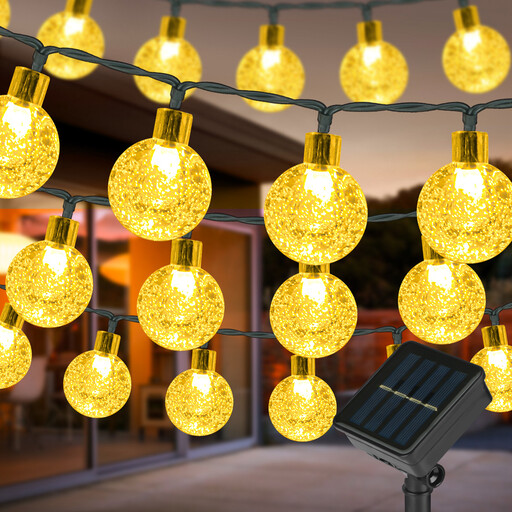
Why this suits the profile: These solar string lights are easy to place in a garden, on a balcony or around a patio. No wiring is needed and the 50 warm white light points are designed for atmosphere, not for illuminating an entire area.
The product information states an IP65 rating and makes clear that the panel needs sufficient sunlight. The stated run time of 8–14 hours depends on the weather, helping you align expectations with real conditions.
7 metres in length, 50 LEDs, warm white light and eight lighting modes. According to the product description, the system charges automatically when the switch is set to "on".
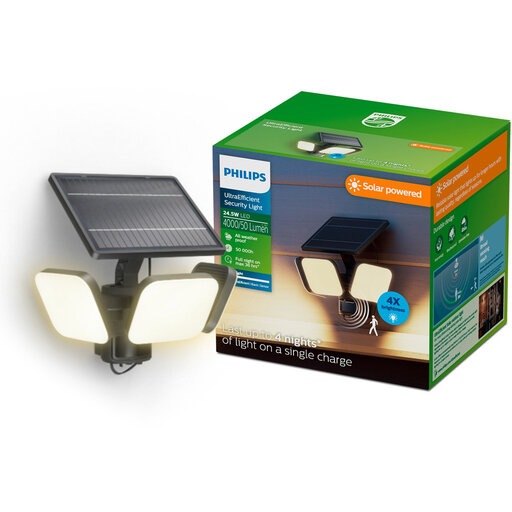
Why this suits the profile: The combination of high light output, motion detection and an adjustable light head suits a driveway, garage or wide facade where functional light matters more than decoration.
The specifications list 4,000 lumens, IP65 and a PIR range of 8 metres for direct approach and 16 metres for lateral movement. That lets you compare measurable data instead of just the LED count.
4,000 lumens, 3,000 K warm white light, two modes and, according to the product description, up to four nights of operation on a fully charged battery.

Why this suits the profile: This solar security light is designed for larger gardens, garages, patios and driveways where broad light coverage and automatic switching are needed.
The light lists not only the LED count, but also 3,000 lumens, a 180-degree detection angle and three light modes. The IP65 rating suits a more exposed mounting spot, as long as submersion is avoided.
302 LEDs, 3,000 lumens, three adjustable heads and, according to the product information, a detection distance of about 18 metres.
We’ve put together a complete, up-to-date list of products that fully meet these strict selection criteria and comply with current European safety regulations.
Yes, a solar panel can also use diffuse daylight. The battery will usually charge more slowly, and the light may run shorter or less brightly in the evening. So don’t place the panel under a canopy or in constant shade.
Lifespan depends on the battery, LED module, housing, mounting location and maintenance. An integrated LED is often not intended for user replacement. Check the warranty terms and keep the solar panel clean. A stated light source lifespan, such as 25,000 hours for some Philips models, is a manufacturer’s product specification and not a guarantee of the light’s total lifespan.
During use, solar garden lighting draws energy from the battery charged during the day. There’s no mains connection required. The light does still need energy to be manufactured, and the battery may need replacing over time. So when buying, consider not only energy costs but also repairability, warranty and whether the mounting location is suitable.
