
Vandaag of morgen in huis

Kwaliteit gegarandeerd

Welkomstaanbiedingen ontgrendelen: GRATIS bezorging | Tot 80% korting | Gratis 30 dagen JoyPlus-proefperiode
Download de app
Solar outdoor lighting is a convenient solution for a garden, balcony, patio, driveway or entrance without cables connected to the electricity grid. During the day, the panel charges the built-in battery; once darkness falls, the light switches on automatically or the motion sensor responds to activity.
However, not every solar light performs equally well in Dutch conditions. Shade, rainy days and unclear product specifications can mean that your light stays on for less time than expected. With these practical checkpoints, you can make a more informed choice from the range of solar outdoor lights.
A product with a high lumen output may seem appealing for a driveway or façade. However, its real-world usefulness also depends on light distribution, detection angle, mounting height and the selected lighting mode. A powerful solar security light may be ideal for brief illumination when movement is detected, but less suitable if you want atmospheric light throughout the evening.
For a garden path, softer lighting is often more practical. For a garage or dark side entrance, a wide beam and motion sensor are more important than a high lumen figure alone.
Always check the IP rating. An IP65 solar light is, according to the classification, dust-tight and protected against water jets. IP44 protects against solid objects and splashing water, but is not designed for immersion or direct, powerful water jets.
The term “waterproof” in a sales description is therefore no substitute for checking the official IP code. Ideally, position an IP44 light under a sheltered overhang or on a façade where rain is less likely to hit the housing directly.
A quoted runtime is usually based on a fully charged battery and sufficient sunlight. In the Netherlands, short winter days, cloud cover, leaves and a north-facing position can limit charging time. A motion sensor may also perform differently from a light that remains continuously on at low brightness.
Therefore, consider the combination of charging time, runtime, battery type and lighting modes. Do not place the light only where illumination is needed; also ensure that the solar panel receives several hours of direct daylight.
For exposed garden paths and flower beds, a higher level of protection such as IP65 can be practical. For a sheltered wall beside the front door, IP44 may be sufficient, provided the light is not exposed to direct water jets.
Also consider the material. ABS and polycarbonate are often used for lightweight, weather-resistant housings. Metal components can create a more substantial appearance, but check that the finish is suitable for outdoor use.
Colour temperature is expressed in kelvins:
A warm-white LED is not automatically less functional, but it generally creates a softer look. For solar path lighting, even, glare-free light distribution is more important than maximum brightness.
Check the detection angle and detection range. A sensor with a wide angle performs better when people approach a door or driveway from different directions. Also pay attention to the mounting hardware: wall lights should be securely installed on a suitable surface.
For ground lights, positioning is just as important. Insert them deeply enough and check that the spike is stable, so they do not create a tripping hazard. Clean the solar panel regularly with a soft, dry cloth.
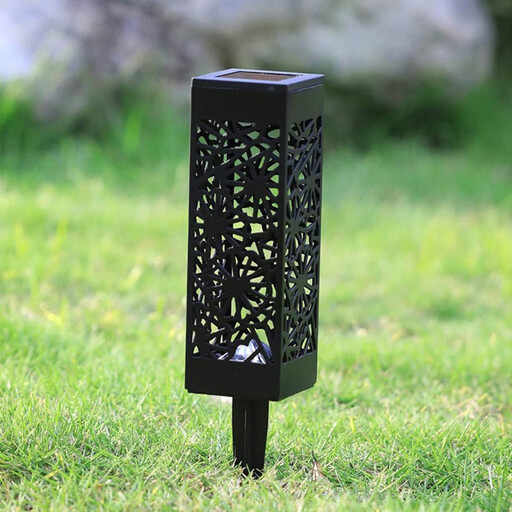
Why it is a good fit: This set is ideal for anyone who wants to mark out several areas of the garden easily, without wiring or tools.
The product description lists a charging time of 4–6 hours, a runtime of 5–8 hours and an IP65 rating separately. This makes it easier to set realistic expectations.
Six ground lights, warm-white LED illumination, automatic switching on and off, and a length of approximately 38 cm per light.
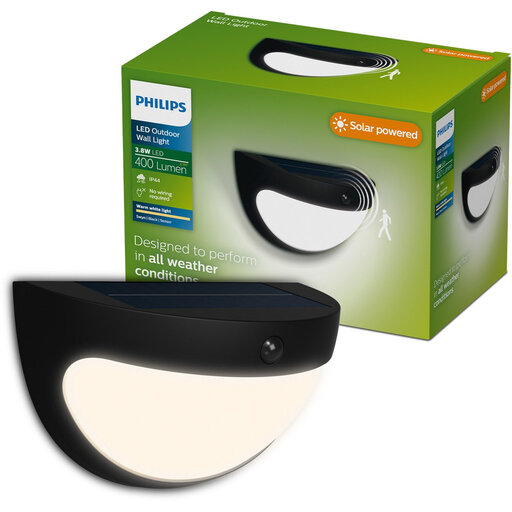
Why it is a good fit: A compact solar-powered outdoor wall light for a façade, balcony or sheltered entrance, with a choice of two lighting modes.
The IP44 rating is clearly stated. This highlights the difference from an IP65 light: do not install this wall light where it will be exposed to direct water jets.
According to the product description, the integrated LED delivers 400 lumens at 2700 K and the light includes a motion sensor.

Why it is a good fit: For anyone looking for a broad area of illumination beside a driveway, garage, patio or larger garden.
The specifications list the detection range, detection angle, three lighting modes and IP65 protection. This allows you to assess in advance whether the light is suitable for the location.
According to the product description, this model has three adjustable heads, a stated light output of 3000 lumens and a detection angle of 180 degrees.

Why it is a good fit: For broad façade lighting where visibility and an adjustable light direction are important.
The product information specifies IP65, a colour temperature of 5000 K and multiple detection directions. However, check that the higher light output is appropriate for your surroundings and neighbours.
According to the product description, this model delivers 4000 lumens, has an adjustable head and offers a stated range of up to 8 metres when approached directly.
Browse a current selection of solar outdoor lighting by use case, light colour, IP rating and mounting method.
Yes, although runtime may decrease because of shorter days, a lower sun angle and increased cloud cover. Position the panel as unobstructed as possible and, during the darker months, consider a model with multiple lighting modes or a larger battery.
Under normal use, no connection to the electricity grid is required. The light runs on stored solar energy. Over time, however, you may need to replace the battery once it can no longer hold sufficient capacity. Service life varies by model, battery and operating conditions.
No. For decorative solar garden lights or path lighting, automatic activation at dusk is often sufficient. For an entrance, garage or driveway, a motion sensor can be more practical because the light only becomes brighter or switches on temporarily when movement is detected.
