
Vandaag of morgen in huis

Kwaliteit gegarandeerd

Welkomstaanbiedingen ontgrendelen: GRATIS bezorging | Tot 80% korting | Gratis 30 dagen JoyPlus-proefperiode
Download de app
Solar outdoor lighting sounds simple: place the light outside, let the solar panel charge during the day and enjoy the light in the evening. In practice, the results depend heavily on where you put it, how bright it is and how well it’s protected from rain. Choose the wrong light and it may give off too little light, run out of charge quickly or work less well after a wet winter.
Use this guide to compare solar lights for outdoor use based on verifiable features. It’ll help you choose the right solar wall light, solar garden lighting, solar outdoor light with a motion sensor or decorative solar lighting.
A product with a high lumen count can give off bright light, but that doesn’t automatically mean it will illuminate a large area evenly. The beam angle, positioning and colour temperature all matter too. A gentle light is often enough for a garden path. A driveway or dark side wall is more likely to need focused lighting with a motion sensor.
Look out for conflicting product information too. Some models list different lumen counts, wattages and light colours in different places. Check the technical specifications on the product page before you order.
The IP rating shows how well a product is protected against ingress. IP44 is suitable for splashes and general sheltered outdoor locations, but not for immersion or direct jets of water. IP65 offers greater protection against dust and water jets, but the light still shouldn’t be left standing in water.
So don’t place a solar light in a dip where rainwater collects. Also check that cable connections, the solar panel and mounting points are properly sealed.
A north-facing wall, a balcony beneath a canopy or a spot under a dense tree can significantly increase charging time. A brand’s product information may assume direct sunlight and ideal conditions. In the Netherlands, cloudy weather, short winter days and dirt on the panel can reduce how long the light stays on.
Choose a spot with as much unobstructed daylight as possible. Clean the panel regularly with a soft, slightly damp cloth and check that the light remains securely fixed in place.
Brightness is measured in lumens (lm). As a rough guide:
Colour temperature is measured in kelvin (K). Warm white, around 2700–3000 K, creates a softer atmosphere. At around 4000 K, the light looks more neutral. Higher values give a cooler, whiter light. Warm tones usually work best for ambient solar lighting, while a more neutral or cooler light can be practical for a solar security light.
A sensor can switch the light on only when it detects movement. Check the detection angle and range. A wide angle is useful by a driveway or garden path, while a shorter range may be enough beside a front door.
Check which modes are available too. Some solar outdoor lights stay dimly lit and get brighter when they detect movement. Others only come on when movement is detected or offer a constant-on setting. According to a brand’s product information, a long detection range doesn’t automatically guarantee the same performance in every garden; mounting height and the direction people approach from affect the results.
As well as the IP rating, compare:
The stated run time is an estimate based on specific conditions. With little sunlight, the light may stay on for less time. So don’t just look at the longest claimed run time; consider the charging conditions at your location too.
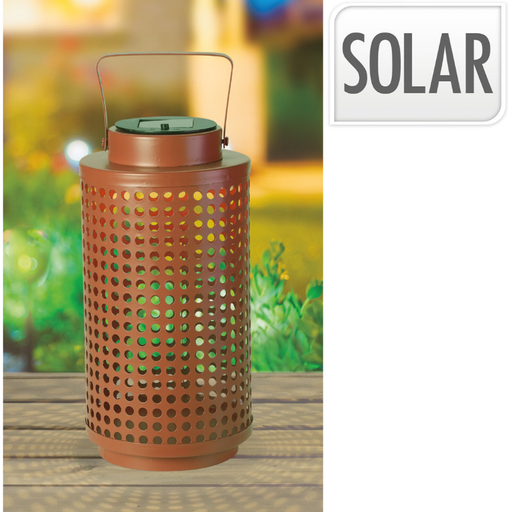
Why it suits this type of shopper: This decorative lantern is for anyone looking to add a little atmosphere to a balcony, patio or garden without the need for wiring.
The product information gives clear dimensions and a run time of around 6 hours after a full charge. Expect ambient lighting, not a powerful security light.
Metal housing, 28 cm tall and easy to position without tools.
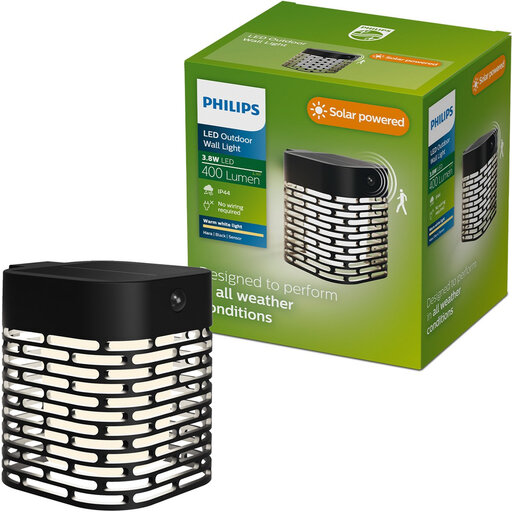
Why it suits this type of shopper: A good choice if you’re looking for a fixed solar wall light with warm lighting and clear product specifications.
The product information specifies 2700 K, two lighting modes and IP44. This makes it clear that the light is designed to withstand splashes, not immersion.
400 lumens per light, integrated LED and installation without a mains connection.

Why it suits this type of shopper: Designed for anyone looking for wide light coverage and motion detection for a driveway, garage, patio or larger garden area.
The specifications list three lighting modes, three adjustable heads, IP65 and a sensor range of 60 feet with a 180-degree angle. Check in advance that your chosen mounting position makes the most of this coverage.
According to the product description, it has 302 LEDs, 3000 lumens and a 1800 mAh lithium-ion battery.
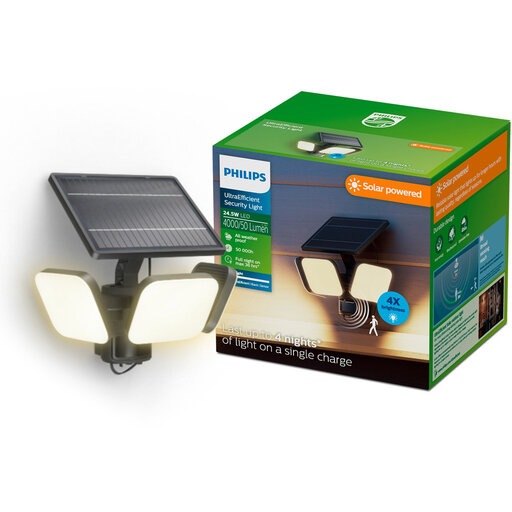
Why it suits this type of shopper: This solar security light is a good fit for exterior walls and driveways where a high light output and wide sensor range are important.
The product information specifies IP65 and an adjustable light head. This lets you direct the beam more accurately towards an entrance or driveway, although secure mounting and a sunny position remain important.
According to the product description, it offers 4000 lumens, 3000 K and a motion detection range of up to 8 metres when approached directly and 16 metres for movement from the side.
We’ve put together a complete, up-to-date list of products that meet these strict selection criteria and current European safety requirements.
A few simple steps can help solar-powered LED outdoor lights last longer:
A ground stake is handy for solar garden lights along a path, but make sure the light isn’t somewhere you could easily hit it with a lawnmower or bicycle.
Yes, but performance may be lower because of shorter days, cloudy weather and the sun sitting lower in the sky. Position the panel somewhere as unobstructed as possible and keep it clean. If there’s little sunlight for an extended period, the light may stay on for less time or appear dimmer.
It depends on the battery, LED module, materials and exposure to the weather. The stated lifespan of an LED isn’t the same as the total lifespan of the light. Check whether the battery can be replaced, what warranty applies and which IP rating is listed.
A solar light doesn’t use mains electricity during normal operation. Its battery charges from the solar panel during the day. The actual run time depends on sunlight, battery capacity, lighting mode and temperature.
