
Vandaag of morgen in huis

Kwaliteit gegarandeerd

Welkomstaanbiedingen ontgrendelen: GRATIS bezorging | Tot 80% korting | Gratis 30 dagen JoyPlus-proefperiode
Download de app
A solar outdoor light with a motion sensor can be useful by your front door, garage, garden, balcony or driveway. It works without fixed wiring and switches on when it detects movement. However, not every model is suitable for every situation. A compact light designed for ambient lighting, for example, may not provide enough light for a wide driveway.
As a Joybuy Product Recommendation Officer, I check product information against verifiable specifications. This helps you quickly see which solar-powered LED outdoor light suits your needs, and which marketing claims are best treated with a little caution.
The lumen rating indicates the total light output, but doesn’t automatically tell you how the light is distributed. A 500-lumen light may be enough by a front door, while a large garden or long driveway needs a wider spread of light. So check:
A solar security light with several light heads can cover a larger area than a compact wall light designed for the same purpose.
An IP44 outdoor light is protected against solid objects larger than 1 millimetre and water splashes. This makes IP44 suitable for many sheltered walls, entrances, balconies and patios. The light isn’t designed to be submerged or exposed to direct jets of water.
An IP65 outdoor light offers greater protection against dust and water jets. It’s a practical choice for a more exposed wall, garage or driveway. Correct installation is still important, even with IP65. The IP rating doesn’t mean you can place a light underwater.
A wire-free outdoor light needs enough daylight to charge its battery. If you install the solar panel under a canopy, behind a tall fence or on a north-facing wall, the operating time may be disappointing. Check in advance:
According to the product information provided by various brands, actual performance may also depend on sunlight, temperature, operating mode and battery charge. Treat the stated operating time as product information based on certain conditions, not as a guarantee for every winter’s day in the UK.
For finding your way by a front door or garden path, around 180 to 500 lumens may be enough. For a garage, wide driveway or practical security lighting, a higher light output is more useful. Also consider the colour temperature:
A light with a dimming function or several modes can help you balance brightness and battery use.
Not all motion sensors have the same range. A range of a few metres is usually suitable for a front door or small patio. A wider detection angle is useful for a driveway or garden path. Check whether the manufacturer gives different ranges for movement directly towards the sensor and movement from side to side.
Don’t install the sensor somewhere it will be triggered unnecessarily often by passing traffic, moving branches or a busy pavement. This can drain the battery more quickly.
Most solar outdoor wall lights have a built-in lithium-ion battery. Check whether the battery is replaceable, how it charges and whether the light has an on/off switch. An automatic dusk sensor can activate the light when daylight is low; the motion sensor then determines when extra light is needed.
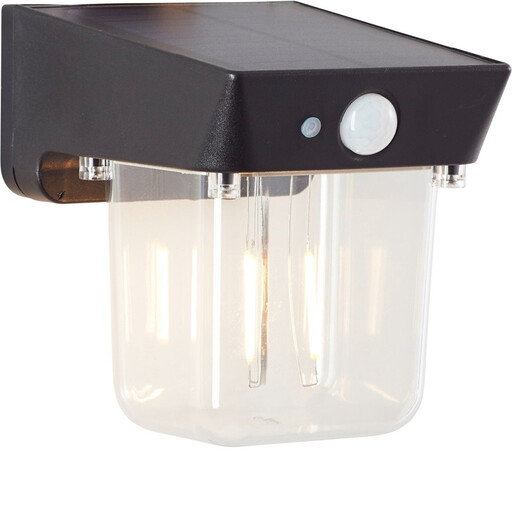
Why it suits this need: This compact solar wall light is designed for basic lighting by an entrance, small patio or balcony. It provides 180 lumens of warm white light at 2700 K and has a built-in motion sensor.
The product specifications give a specific lumen rating and an IP44 rating. This makes it clear that the model is intended for focused, splash-resistant outdoor lighting, not for a large driveway.
180 lumens, warm 2700 K light, built-in battery and installation without fixed wiring.

Why it suits this need: This model is designed for large, practical outdoor spaces such as a garage, back garden or driveway. The product information lists 4000 lumens, IP65 and a sensor range of 8 metres for movement directly towards it and 16 metres for movement from the side.
Its higher IP65 rating makes it more suitable than IP44 for a more exposed installation location. The stated detection distances also make it easier to assess the sensor’s range.
4000 lumens, adjustable light head, IP65 and two stated directions of detection.

Why it suits this need: Its three adjustable light heads and wide coverage are designed for larger gardens, patios, garages and driveways. The product specifications list 3000 lumens, IP65 and three lighting modes.
Light distribution isn’t judged by a high lumen rating alone: the three heads and stated 270-degree angle give you more information about the potential coverage.
302 LEDs, 3000 lumens, IP65, three lighting modes and a stated detection angle of 180 degrees.
Install the light on a sturdy surface and use the supplied fixings according to the instructions. Point the solar panel towards a spot that gets as much direct daylight as possible. Clean the panel and sensor window with a soft, slightly damp cloth. Don’t use harsh cleaning products.
Once installed, check that the light isn’t shining into windows, onto a public road or into a neighbour’s property. The motion sensor should detect the route you want to light, not passing traffic or branches all the time.
We’ve put together a complete, up-to-date list of products that meet these strict selection criteria and the applicable European safety regulations.
It can be, but performance depends on the amount of daylight, shade, temperature and battery capacity. During the darker winter months, the light may stay on for less time or come on less often. Choose a spot that gets as much direct sunlight as possible and clean the solar panel regularly.
Lifespan varies depending on the battery, LED module, housing and conditions of use. With built-in LEDs, the light source often can’t be replaced by the user. So check the warranty, battery details and maintenance instructions in advance. The stated lifespan of an LED doesn’t automatically indicate how long the battery or complete light will last.
A solar security light uses energy stored in its built-in battery during the day. It normally doesn’t need to be connected to the mains. The light does rely on energy from sunlight to charge, and may run for less time when there’s little sun. This makes a solar model especially practical in places where running a cable is difficult.
