
Vandaag of morgen in huis

Kwaliteit gegarandeerd

Welkomstaanbiedingen ontgrendelen: GRATIS bezorging | Tot 80% korting | Gratis 30 dagen JoyPlus-proefperiode
Download de app
A solar outdoor light with a motion sensor seems simple: charge it during the day, then enjoy automatic light in the evening. But some buyers are disappointed when the light barely comes on in winter, doesn’t reach far enough or turns out not to be suitable for an exposed wall.
For a garden, driveway, balcony or entrance, there are three common pitfalls to watch out for:
The IP rating indicates what the casing is protected against. An IP44 outdoor light is protected against solid objects 1 millimetre or larger and against splashing water from different directions. This is often suitable for a sheltered balcony, covered entrance or wall beneath the eaves.
An IP65 outdoor light also offers complete protection against dust and is designed to withstand water jets from different directions. This can be a more practical choice for an exposed driveway, the side of a garage or an unprotected garden wall. However, no IP rating means you can submerge a light in water.
Don’t just check whether a light has a sensor. Also look at the detection range and detection angle. A sensor will usually work better when someone walks across its detection area than when they walk straight towards it.
Mount the light securely and point the sensor towards the area where you expect movement, such as a path, gate or driveway. Mounting it too high can limit its detection range, while positioning it too low may cause it to switch on unnecessarily when pets or passers-by move nearby.
The number of lumens indicates the total light output. A few hundred lumens may be enough for ambient lighting by a patio. For a driveway or larger area of the garden, a higher light output makes more sense. An LED outdoor light with a colour temperature of 2700K or 3000K will usually produce warm white light. 5000K looks cooler and brighter.
Also check whether the manufacturer provides information about the battery, lighting modes and operating time. Claims about running for several nights depend on factors including sunlight, temperature, the mode selected and how often the sensor is activated. Treat these figures as a guide, rather than a guarantee for every situation in the Netherlands.
The recommendations below are based on verifiable product information, such as IP rating, light output, sensor range, colour temperature and power source.
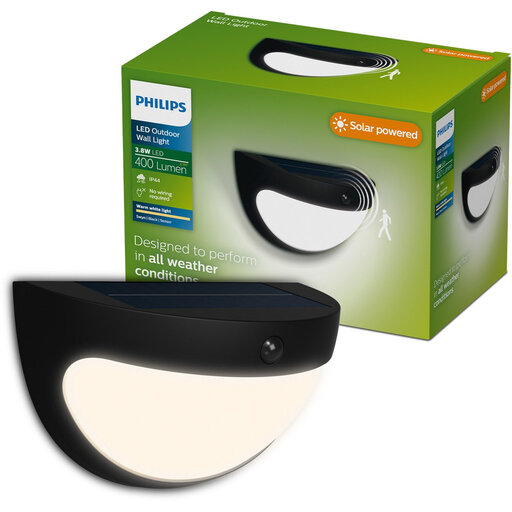
Why it suits this type of user: This compact solar-powered outdoor wall light is ideal for an entrance, balcony or small garden where you want automatic lighting without wiring. It has two lighting modes, a motion sensor and a 400-lumen output.
The IP44 rating makes it clear that the light is protected against splashes, not submersion. This helps you choose a sheltered position for it rather than relying on a vague claim such as “waterproof”.
400 lumens, warm white 2700K light, two modes and installation without a mains cable.
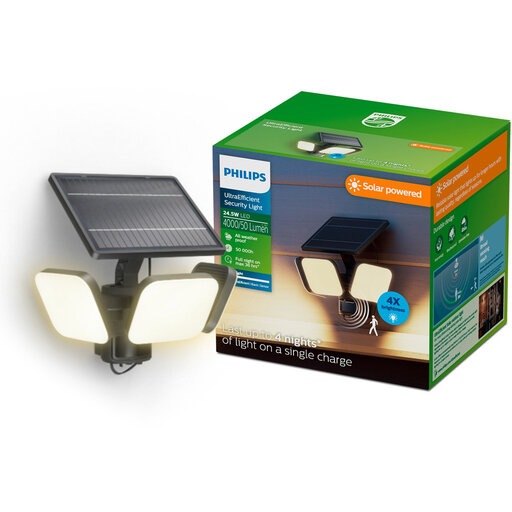
Why it suits this type of user: With an output of 4000 lumens, this solar security light is designed to illuminate a larger area, making it a good choice for a driveway, larger exterior wall or broad area of the garden. The adjustable lamp head helps you direct the beam where you need it.
The product specifications state a sensor range of 8 metres when approached directly and 16 metres when approached from the side. Its IP65 rating is also more specific than simply calling it “weather-resistant”.
4000 lumens, IP65 rating, motion and dusk sensors, two lighting modes and, according to Philips, a stated run time of up to four nights on a full battery.

Why it suits this type of user: This solar outdoor light with a motion sensor is designed to illuminate a wide area, such as a garden, garage, patio or driveway. Its three light heads and broad spread of light are useful when a single narrow beam isn’t enough.
The specifications list the light output, detection angle and IP rating separately: 3000 lumens, 180° detection, a range of up to 60 feet according to the product information, and an IP65 rating. This makes it easier to assess whether it’s suitable for a large area.
302 LEDs, three lighting modes, three adjustable heads, 270° coverage and installation without electrical wiring.
We’ve put together a complete, up-to-date list of products that meet these strict selection criteria and the applicable European safety regulations.
Position the solar panel somewhere it will get as much direct daylight as possible. Check that it won’t be shaded for long periods by an eave or tall fence. If you’re mounting the light on a wall, make sure the surface is sturdy and follow the supplied installation instructions.
Clean the panel and sensor window a few times a year with a soft, damp cloth. Don’t use abrasive cleaners. After a storm or frost, check that the light is still securely fixed. If your solar light has a built-in lithium-ion battery, don’t open or replace the battery yourself unless the manufacturer provides specific instructions.
Yes, but performance may drop because of shorter days, a lower sun, cloudy weather and dirt on the panel. Position the light in the sunniest spot possible and select a lower lighting mode if needed.
It depends on the size of the area and how you want the light to spread. A few hundred lumens may suit an entrance or path. For a wide driveway or a larger area of the garden, a model with around 3000 to 4000 lumens may be more suitable. Also consider the beam direction and sensor angle.
The light doesn’t draw power from the mains during normal use. Its solar panel charges the battery during the day. However, you’ll need to factor in the purchase and installation, as well as the possible replacement of parts over time.
