
Vandaag of morgen in huis

Kwaliteit gegarandeerd

Welkomstaanbiedingen ontgrendelen: GRATIS bezorging | Tot 80% korting | Gratis 30 dagen JoyPlus-proefperiode
Download de app
A solar outdoor light with a motion sensor might seem simple to choose: check the number of lumens, pick a suitable model and put it up. In practice, it’s the positioning, sensor settings and protection from the elements that have the biggest impact on how well it works. A high lumen rating alone doesn’t tell you enough.
There are three common pitfalls to watch out for when choosing a light for a driveway, garage, garden, exterior wall or business premises.
A light can produce plenty of illumination yet leave dark corners if its beam is too narrow. Check whether it has multiple light heads, an adjustable housing or wide light coverage. For example, a solar floodlight with three adjustable heads can illuminate a larger area than a compact light with a single fixed LED module.
It’s also worth distinguishing between the stated light output and how long the light lasts in practice. The listed 3000 or 4000 lumens describes the brightness stated in the product information, but it doesn’t automatically tell you how long that level of output will be available in different weather conditions.
An outdoor light with a PIR sensor responds to moving heat sources. If you hang the light too high, point the sensor towards a busy road or place it behind an obstacle, it may switch on too often or too late.
Before you buy, check:
A solar security light works best when the sensor is aimed at the driveway, path or entrance, rather than a public pavement.
IP65 means the casing is protected against dust and water jets. That’s suitable for many outdoor locations, but IP65 doesn’t mean the light can be submerged. Make sure a solar wall light is securely fitted at the correct angle, and avoid letting water collect around the connections or seams for long periods.
The materials used in the product also matter. ABS and polycarbonate are often used to make lightweight casings, but the fixings also need to be sturdy enough to withstand wind. After installation, check regularly that the screws and brackets are still secure.
Moderate light output is often enough for a small garden or patio. A driveway, wide exterior wall or garage may need more light. According to the product information, the UME model’s 3000 lumens are intended for wide outdoor illumination. The Philips Zyren models list 4000 lumens per light point.
Colour temperature is measured in Kelvin:
A solar outdoor light needs enough daylight to charge its internal battery. In the Netherlands, shade, dirt, cloud cover and the low angle of the sun can all affect charging. So, install the panel somewhere as clear of trees, roof edges and walls as possible.
A larger or more efficient solar cell doesn’t guarantee the same lighting duration in every season. According to the product information, the UME model has an 1800mAh lithium-ion battery and a solar panel with a stated 25% higher conversion rate. Philips says the Zyren lights can provide illumination for up to four nights on a full charge. These are product specifications and stated product information; actual duration depends on sunlight, temperature, operating mode and how often the light is triggered.
An outdoor light with a PIR sensor is useful for short bursts of bright light when someone approaches. An outdoor light with a dusk sensor can switch on automatically when it gets dark. Some models combine both functions and also offer steady or energy-saving modes.
It’s best to choose a model that clearly explains which modes are available. “Three modes” could mean, for example: motion-activated only, a dim base light that brightens when motion is detected, or continuous light for a limited period. Read the manual or product description before ordering.

Why it suits this buyer: This model has multiple light heads and three modes, with no wiring required. It’s a good fit if you want to light a garden, patio or garage yourself and are looking for a straightforward place to start.
According to the product information, the three heads provide a combined 270° of light coverage, while the sensor has a range of 60 feet and a 180° angle. When installing it, check that the stated range suits your space.
302 LEDs, 3000 lumens according to the product information, IP65 rating, 1800mAh battery and fixings included.
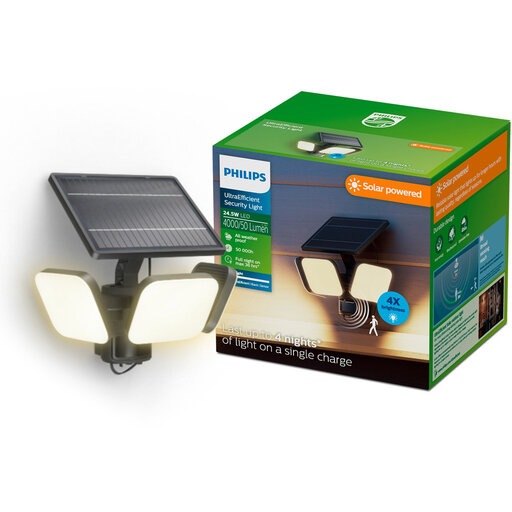
Why it suits this buyer: The adjustable head and warmer light colour work well on an exterior wall, by an entrance or on a patio where you want practical lighting that still feels subtle.
The product information lists both a PIR sensor and a dusk sensor, as well as two lighting modes. That means you don’t have to rely solely on a bright light triggered by movement.
4000 lumens, 3000K, IP65 rating and, according to the product information, a PIR range of 8 metres for direct approach and 16 metres for sideways movement.

Why it suits this buyer: The whiter 5000K version may suit a garage, business premises, side entrance or wide driveway where clear lighting helps you find your way.
The sensor information distinguishes between direct and sideways approaches. This can help you plan where to install it, especially along a long exterior wall or driveway.
4000 lumens, 5000K, adjustable light head, IP65 rating and, according to the product information, up to four nights of illumination on a full charge.
We’ve put together a full, up-to-date list of products that meet these strict selection criteria and the applicable European safety regulations.
Choose a spot that gets as much direct daylight as possible. A light facing north, beneath an overhang or behind dense foliage may not get enough sunlight to charge. After installation, point the light heads at the area you want to illuminate and test the sensor both during the day and in the dark.
Also bear the following in mind:
An LED outdoor light powered by solar energy doesn’t need a permanent mains connection during normal use. This keeps running costs at the installation site low, but the battery is a wear part. Its lifespan depends on charging cycles, temperature, how often it’s used and how it’s stored. Store a removable battery according to the manufacturer’s instructions, and don’t try to open or modify it yourself.
Yes, but performance may be lower during the darker months because there’s less direct sunlight and the nights are longer. Position the panel somewhere as clear as possible, keep it clean and use an energy-saving mode if one is available. IP65 protects against dust and water jets, but not submersion.
That depends on the stated range and the direction of movement. A person walking straight towards the sensor may be detected at a different distance from someone passing across it. So, check the product specifications and point the sensor towards the main route. A model with multiple light heads may be more practical for wider areas.
It doesn’t need to be connected to the mains while in use. The light uses solar energy during the day to charge its internal battery. The actual lighting duration depends on sunlight, temperature, sensor activation and the selected lighting mode. Keep the panel clean and choose a setting that suits how often you need the light to switch on.
