
Vandaag of morgen in huis

Kwaliteit gegarandeerd

Welkomstaanbiedingen ontgrendelen: GRATIS bezorging | Tot 80% korting | Gratis 30 dagen JoyPlus-proefperiode
Download de app
A solar outdoor light with a motion sensor can be useful by your front door, garage, driveway, shed or patio. You won’t need a power cable, and the light only switches on when needed. However, not every model is suitable for every location. A light that works perfectly on a sheltered balcony wall may disappoint on an exposed wall or a dark driveway.
As a Joybuy Product Recommendation Officer, I filter product information for practical details: light output, protection against moisture, sensor performance, installation and charging options. This makes it easier to find solar-powered outdoor lighting that suits your needs.
A product may state a high light output, but that doesn’t automatically mean your whole driveway will be lit evenly. The installation height, beam angle and position of the solar panel all make a big difference.
So don’t focus on lumens alone. Also consider:
For a small path, 180 to 500 lumens may be enough. For a wide driveway or garage, a more powerful model with several light heads may be more practical.
An IP44 outdoor light is protected against solid particles of 1 millimetre or larger, as well as splashing water from different directions. This makes IP44 suitable for many sheltered walls, balconies and entrances. However, the light is not designed to be submerged or exposed to direct jets of water for extended periods.
For an exposed garden wall or driveway, an IP65 solar light may be a more suitable choice. IP65 offers greater protection against dust and water jets. Also check that the light is installed somewhere water won’t collect.
A motion sensor responds to movement within a certain range. A dusk or daylight sensor determines whether it’s dark enough to switch the light on. Many models use both functions, but they work differently from one product to another.
So check:
A light that responds to movement during the day wastes battery power unnecessarily.
Colour temperature is measured in kelvin. 2700K to 3000K gives a warm white light, which often suits an entrance, patio or black outdoor wall light. A higher value looks whiter and can be useful for a driveway or garage.
Lumens indicate the amount of light. Compare models designed for the same type of use. An LED outdoor light with 180 lumens isn’t necessarily unsuitable; this may be enough for a narrow passage. A model with 1000 or 3000 lumens is more suited to a larger area.
A solar light charges during the day, so position the panel somewhere with as little shade as possible. A north-facing wall, a balcony above the light or dense foliage can limit charging time. The light may also stay on for less time during dark winter months than in sunnier seasons.
Check whether the product information covers:
Clean the panel with a soft cloth. Dirt, leaves and bird droppings reduce the panel’s light output.
A wall light without wiring is usually easy to install, but the surface needs to be stable. Use suitable wall plugs and screws for brick, concrete, wood or exterior cladding. Check the dimensions beforehand, especially if you’re fitting it on a narrow wall next to a door.
Plastic is lightweight and practical. Aluminium, or a combination of metal and plastic, may suit you if you’re looking for a different appearance. The material alone doesn’t indicate how long a light will last, so always check the full product specifications and warranty terms.
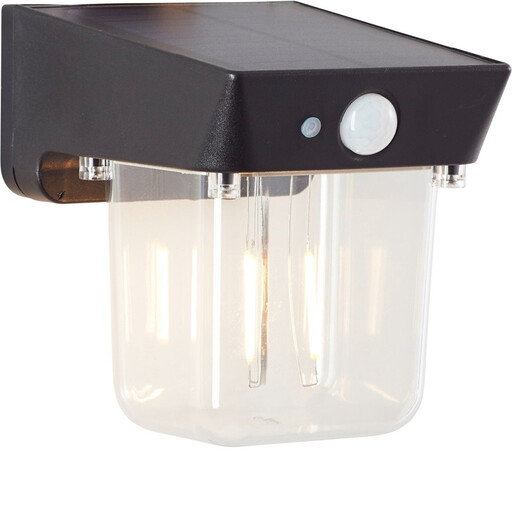
Why it suits this profile: This compact model is designed for an entrance, patio or small garden wall, and doesn’t need to be connected to mains electricity.
The product details state an output of 180 lumens and an IP44 rating. This makes expectations clearer than with a model that doesn’t specify its light range or level of protection.
Integrated battery, solar panel, motion sensor, dimming function and warm white light at 2700K.

Why it suits this profile: A good choice if you’re looking for more light by an entrance or on an exterior wall, and want to use two light modes.
The stated output of 1000 lumens gives you a clear point of comparison. The light also has a dusk sensor and motion sensor, so movement is considered in relation to the light level.
1000 lumens, 3000K, two light modes, integrated LED and IP44 protection.

Why it suits this profile: This model is designed for larger areas such as a driveway, garage, garden or wide rear wall.
The specifications list three adjustable heads, a 180-degree detection angle and IP65 protection. This helps you compare coverage and weather resistance.
302 LEDs, stated light output of 3000 lumens, three modes, 1800mAh battery and IP65 rating.
We’ve put together a complete, up-to-date list of products that meet these strict selection criteria and the applicable European safety regulations.
Choose a spot where the solar panel gets several hours of direct daylight. Avoid deep shade from roof edges, trees and walls. Point the light towards the area you want to illuminate, and test the sensor range before tightening all the screws.
How long it lasts each night depends on sunlight, battery capacity, light mode and how often the sensor is activated. Manufacturers may state an expected operating time, but actual performance varies by season and location. Clean the panel regularly and check that the light is securely fitted.
A solar security light doesn’t use electricity from the mains during normal operation. Its battery is charged by the solar panel. Bear in mind, though, that battery capacity may decrease over time, and some models may need maintenance or replacement parts.
