
Vandaag of morgen in huis

Kwaliteit gegarandeerd

Welkomstaanbiedingen ontgrendelen: GRATIS bezorging | Tot 80% korting | Gratis 30 dagen JoyPlus-proefperiode
Download de app
A solar outdoor light with motion sensor may seem easy to choose: attach the solar panel, put up the light and you’re done. In practice, the positioning, brightness and water protection largely determine how useful it will be day to day. A light installed in a dark corner without direct sunlight will charge less effectively. A model with a high light output may also be too bright by a front door or on a balcony.
A high lumen count means more light, but it does not automatically make a better choice. For an entrance or patio, 300 to 500 lumens may be enough. A driveway, shed or large part of the garden may benefit from more light. Also check the colour temperature:
An IP44 rating means protection against solid particles larger than 1 millimetre and splashing water. This is suitable for a sheltered façade, balcony or entrance, but it is not the same as protection against powerful water jets or immersion. An IP65 outdoor light offers greater protection against dust and water jets, but it must not be placed in water either.
Also pay attention to installation. Use suitable mounting hardware, check that the wall can support the weight and do not install the light where rainwater can collect for long periods.
A motion sensor switches the light on when movement is detected. An outdoor light with dusk sensor responds to ambient light and can switch on automatically when it is dark enough. Some models combine both functions. Check whether the light has several modes, such as automatic operation and continuous lighting. This prevents disappointment if you expect the light to remain on all evening.
Look at both the lumen output and the sensor range. A sensor with a range of 8 metres when approached directly and 16 metres for sideways movement is useful for a wider driveway. For a balcony or small garden path, this range may be unnecessarily large.
A motion sensor is not a full alarm system. The light can make movement visible, but it does not guarantee security. Use the feature as practical lighting around a shed, gate or front door.
A wireless outdoor light does not need to be connected to the mains, but it does depend on daylight. Position the panel as far as possible from trees, overhangs and tall fences. In winter and during prolonged cloudy weather, the lighting duration may decrease.
Clean the panel regularly with a soft, damp cloth. Also check the sensor opening and the mounting. According to product information from various brands, a fully charged battery can provide lighting for several nights, but the actual duration depends on the selected mode, temperature, amount of sunlight and battery condition.
For a solar wall light for outdoor use, plastic, aluminium or a combination of the two are common materials. Look for UV resistance, corrosion protection and the stated IP rating. An integrated LED generally does not require a separate bulb, but on many models it cannot be replaced by the user.
Also check the dimensions before buying. A compact light suits a balcony or narrow façade, while a larger model with an adjustable head may be more suitable for a driveway or garden.
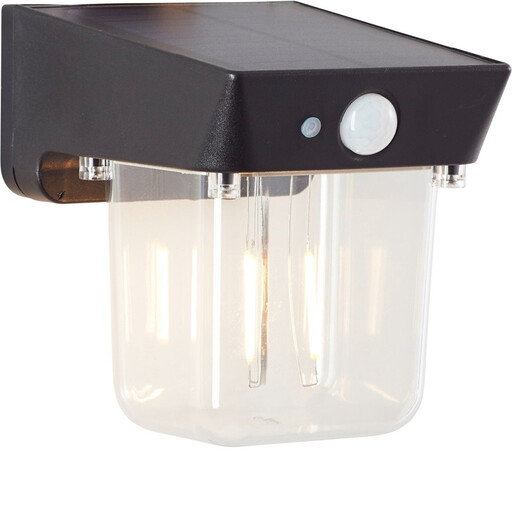
Why this suits the profile: This compact model is designed for basic lighting by a door, patio or small garden path. It runs on solar power and does not require fixed wiring.
The specifications state 180 lumens, 2700 K and IP44. This makes it clear that the model is mainly intended for nearby, sheltered areas rather than a large driveway.
Integrated motion sensor, solar panel, dimming function and a compact size of 11.5 × 10 × 11 cm.

Why this suits the profile: Suitable for anyone looking for a Philips solar outdoor light with relatively high brightness for an entrance, façade or shed.
The product information clearly states 1000 lumens, 3000 K, two lighting modes and IP44. This allows you to compare the light output and protection rating without relying solely on marketing language.
Integrated LED, dusk and motion sensors, wireless installation and a stated lifespan of 25,000 hours according to the product description.

Why this suits the profile: This model is designed for a wide driveway, garage or large property where prominent lighting and a broad sensor range are desirable.
The specifications state 4000 lumens, IP65 and a detection range of 8 metres straight ahead and 16 metres sideways. This makes the intended use clearer than a general claim about “powerful security”.
Adjustable lamp head, two lighting modes, 5000 K and, according to the product description, up to four nights of lighting after a full charge.
We have put together a complete, up-to-date list of products that fully meet these strict selection criteria and the applicable European safety requirements.
Yes, but charging performance may be lower because of shorter days, cloudy weather and the lower position of the sun. Position the solar panel in an unobstructed location and clean it regularly. Choose a light with an automatic mode so the battery is not put under unnecessary strain.
For a small entrance or garden path, around 300 to 500 lumens may be sufficient. A wide driveway or large shed may require more light, such as a model with 1000 lumens or more. Also consider the beam angle and sensor range.
During normal use, a solar outdoor light does not consume electricity from the mains. However, there are purchase and maintenance costs. The battery has a limited lifespan, and the light output may decrease if the panel is dirty or does not receive enough sunlight. So do not just check the purchase price; also consider the warranty, battery specifications and how accessible the solar panel is.
