
Vandaag of morgen in huis

Kwaliteit gegarandeerd

Welkomstaanbiedingen ontgrendelen: GRATIS bezorging | Tot 80% korting | Gratis 30 dagen JoyPlus-proefperiode
Download de app
A solar outdoor light with a motion sensor seems straightforward: mount the light on the wall, let the solar panel charge during the day and enjoy automatic light whenever someone walks past. In practice, its usefulness depends on more than just the number of lumens. A shaded solar panel, a limited detection angle or a low IP rating can make the light less suitable for your garden, entrance or driveway than the product title suggests.
With these points in mind, you can compare solar-powered outdoor lighting based on verifiable specifications rather than marketing claims alone.
A high lumen figure tells you how much light the manufacturer claims the product produces, but not necessarily how that light is distributed. A lamp with a narrow beam can brightly illuminate a small area, while a model with several adjustable heads spreads the light more widely.
For a front door or garden path, 180 to 500 lumens may be enough for orientation. For a garage, wide driveway or larger garden, a more powerful solar security light with multiple light heads is more practical. Also check the colour temperature: 2700K to 3000K produces warmer light, while 5000K to 7000K looks cooler and more striking.
The stated sensor range is not always the same for every direction of movement. A sensor may detect movement directly towards the light differently from movement from left to right. Therefore, check both the range in metres and the detection angle.
Do not place an outdoor light with a sensor directly behind a drainpipe, bush or canopy. Mounting the light too high can also make it harder for the sensor to detect movement. For a driveway or garage, a wide detection angle is usually more important than a large theoretical range alone.
The IP code consists of two digits. The first refers to protection against solid particles, while the second refers to protection against water. IP44 provides protection against splashing water and is suitable for many sheltered walls, entrances and patios. IP65 offers greater protection against dust and water jets.
Neither classification means that you can submerge the light. Also check the installation instructions. An incorrectly installed waterproof outdoor light can still develop moisture problems if the seals do not fit properly.
Look at the stated number of lumens and consider the area you want to illuminate. A compact solar outdoor wall light is mainly intended for an entrance, balcony or small patio. A solar floodlight with multiple light heads is better suited to a wide driveway or back garden.
The colour temperature affects the overall appearance:
Check whether the light only comes on when movement is detected or whether it also works with a dusk sensor. Some models offer several modes, such as full brightness during movement, dimmed background lighting or a short afterglow following detection. This affects battery life.
Also pay attention to the direction in which the sensor detects movement. A light above a narrow front door has different requirements from an outdoor light for gardens and driveways that needs to monitor a wide area.
Solar lighting works without an electricity cable, but it still needs sufficient daylight. Ideally, position the panel somewhere with direct sunlight and as little shade as possible from trees, walls or roof edges. In winter and during prolonged cloudy weather, the available operating time may decrease.
Check whether the battery is integrated, what capacity is stated and whether it can be replaced. Clean the solar panel regularly with a soft cloth. Installation is straightforward for many models, but the mounting surface must be sturdy enough to withstand wind and the weight of the light.
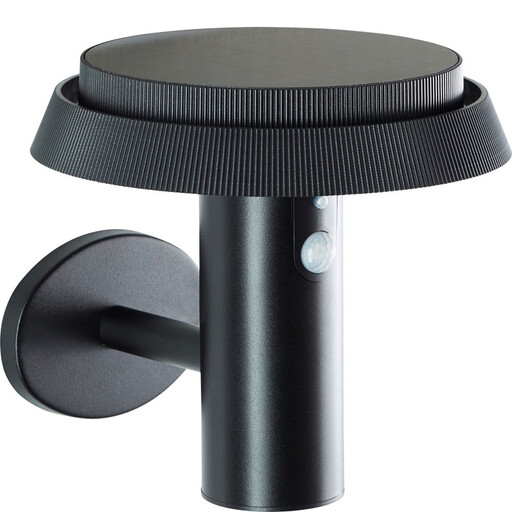
Why it suits this profile: The combination of 500 lumens, warm white light and an integrated solar solution is ideal for a front door, garden path or small patio without the need for wiring.
The product information clearly states 500 lumens, 3000K and IP44. This shows that the model is designed to withstand splashing water, not submersion or direct water jets.
500 lumens, 3000K, integrated LED, motion sensor and installation without electrical wiring.

Why it suits this profile: This model is designed to provide broad, powerful lighting around a garage, wall or driveway where greater coverage is required.
According to the product information, the detection range is 8 metres when approaching directly and 16 metres when approaching from the side. IP65 is also stated; the light must not be submerged.
According to Philips, the stated light output is 4000 lumens; the light has an adjustable head, dusk sensor and two lighting modes.

Why it suits this profile: The three light heads and wide coverage are practical for a large garden, garage area, courtyard or wide driveway.
The product information states a detection distance of 60 feet, an angle of 180 degrees and three lighting modes. When installing it, check that the stated range is suitable for your outdoor area.
According to the product information: 3000 lumens, three adjustable heads, IP65 and a solar panel with an integrated 1800mAh lithium-ion battery.
We have put together a complete, up-to-date list of products that fully meet these strict selection criteria and the applicable European safety regulations.
A model with outdoor lighting without electricity reduces electricity consumption during use, but the overall cost also depends on the purchase price, battery life and any replacement costs. A solar-powered light is therefore particularly practical when installing wiring is difficult or when you only need lighting at certain times.
Yes, but operating time may decrease because of shorter days, lower light levels and cloudy weather. Position the panel as far as possible from shade and keep it clean. Choose a model for which the manufacturer states the battery life or offers several lighting modes.
This varies depending on the battery, LED module, operating time and weather conditions. The LED light source is often integrated and cannot be replaced by the user. Therefore, check the warranty, battery specifications and maintenance instructions before placing your order.
During normal use, energy is stored via the solar panel during the day. No connection to the mains is required. However, the battery may eventually need replacing, depending on the design and operating conditions.
