
Vandaag of morgen in huis

Kwaliteit gegarandeerd

Welkomstaanbiedingen ontgrendelen: GRATIS bezorging | Tot 80% korting | Gratis 30 dagen JoyPlus-proefperiode
Download de app
A solar outdoor light with a motion sensor can be useful by the front door, garage, driveway, shed, balcony or garden path. You do not need a power cable, and the light only switches on when movement is detected. However, these lights vary considerably in brightness, protection against rain and installation method.
If you only look at the number of LEDs or lumens, you could end up buying a product that disappoints in practice. So pay particular attention to the following potential pitfalls.
An LED outdoor light with a high lumen output does not automatically provide useful light distribution. A narrow light may direct a strong beam at one spot, while a model with adjustable heads can illuminate a larger area. So also consider the beam angle, the number of light heads and the position of the motion sensor.
For a small entrance, 300 to 1,000 lumens is often more practical than a powerful solar security light. A higher light output may be suitable for a wide driveway or dark back garden.
An IP44 outdoor light is protected against splashing water, but is not designed for direct water jets or immersion. An IP65 outdoor light offers greater protection against dust and water jets. IP65 still does not mean that the light can be left in a pond or puddle.
Also check whether the light can be mounted securely enough. Wind, driving rain and an unsuitable wall can affect its service life, regardless of the IP rating.
A solar-powered light will not work optimally beneath a balcony, next to a tall fence or in a north-facing spot with lots of shade. The stated operating time depends on factors including sunlight, season, temperature, battery capacity and how often the sensor is activated.
So position the panel towards as much open sky as possible. Clean the panel regularly with a soft, slightly damp cloth.
Pay attention to the stated detection range and detection angle. A sensor that mainly detects movement directly in front of it works differently from one with a wide angle for a driveway or garden path. Also check whether the sensitivity, operating time or light mode can be adjusted.
An outdoor wall light with a sensor is suitable for an entrance or façade. For a larger area, a model with several light heads and broad coverage may be the more logical choice.
Lumens indicate the amount of light. Kelvin describes the light colour:
Check whether the stated light output refers to one light point or the complete light. Multiple settings can help conserve battery power. According to information provided by Philips, various solar products feature an automatic mode and a permanently-on mode; check which mode is available for each model.
For a covered entrance, IP44 may be sufficient if the light is not exposed to direct water jets. For an open façade, garage or driveway, IP65 is a practical choice if you want greater protection against dust and water jets.
Consider the surface, the supplied fittings and the dimensions. A heavier light requires a sturdy wall and suitable wall plugs. For a light with an integrated battery or LED, it is also sensible to check in advance whether these components can be replaced by the user.
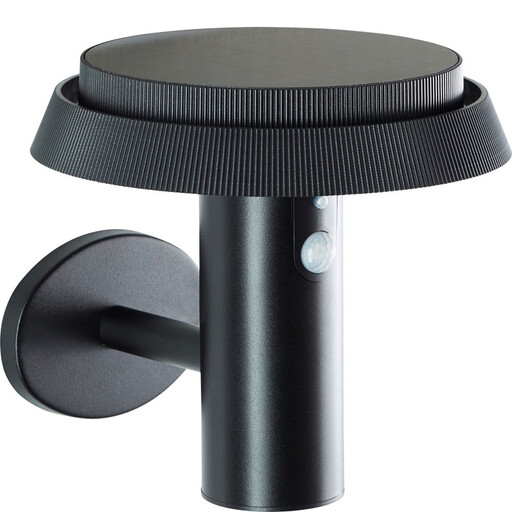
Why it suits this profile: This compact solar wall light provides 500 lumens, 3,000 K and an integrated motion sensor without electrical wiring. That makes it suitable for an entrance, patio or small garden path.
The specifications state the light output, colour temperature, battery and IP44 rating. This makes it clear that the light is splash-proof, but is not designed for direct water jets.
500 lumens, 3,000 K, integrated lithium-ion battery and a detection angle of 120°, according to the product information.

Why it suits this profile: This solar outdoor light is designed for anyone looking for a neat wall-mounted solution with 1,000 lumens, warm white light at 3,000 K and two light modes.
The IP44 rating is clearly stated. So install the light in a sheltered position or out of reach of direct water jets, rather than treating IP44 as fully waterproof.
1,000 lumens, 3,000 K, built-in motion sensor and automatic or permanent mode, according to the product description.

Why it suits this profile: This model is aimed at larger areas such as a garage, wide driveway or spacious garden. The three light heads and stated coverage are practical when a single light point is not enough.
The light separately states a detection range of 60 feet, a sensor angle of 180° and IP65 protection. However, check beforehand that the stated dimensions and light distribution suit your installation position.
302 LEDs, 3,000 lumens, three light modes, three adjustable heads and IP65, according to the product details.

Why it suits this profile: The adjustable head and high stated light output suit users looking for a broad, brightly lit area around a driveway, garage or rear façade.
The product information states an IP65 rating and a detection range of 8 metres for a direct approach and 16 metres for sideways movement. The light must be positioned correctly and receive direct sunlight.
4,000 lumens, IP65, adjustable light head, two light modes and a stated detection distance of up to 16 metres, according to Philips’ own information.
We have put together a complete, up-to-date list of products that fully meet these strict selection criteria and the applicable European safety regulations.
Installing a solar outdoor light is usually straightforward, but its position also plays a key role in the result.
A fixed outdoor light with a 230 volt motion sensor can be an alternative if the installation position receives very little sunlight. Bear in mind that installation by a qualified electrician may then be required. A solar model avoids wiring, but remains dependent on daylight and battery capacity.
It can, but performance may decline due to shorter days, cloudy weather, low temperatures and less direct sunlight. Position the panel away from shade and keep it clean. For a dark location, choose a model with a larger battery or consider mains-powered lighting.
The operating time depends on the battery, charging conditions, outdoor temperature and the number of activations per night. According to product information, an integrated LED may sometimes have a long stated service life, but the battery is a separate consumable component. So check whether the battery and LED can be replaced and what warranty conditions apply.
When in use, a solar light draws energy from the battery charged during the day. This means you do not pay for separate electricity consumption from the mains for the light. There are, however, purchase costs, and the battery or the complete light may need to be replaced over time.
