
Vandaag of morgen in huis

Kwaliteit gegarandeerd

Welkomstaanbiedingen ontgrendelen: GRATIS bezorging | Tot 80% korting | Gratis 30 dagen JoyPlus-proefperiode
Download de app
A solar outdoor light with a motion sensor can illuminate a driveway, garden path, garage or patio without an electricity cable. In practice, however, results can sometimes be disappointing. For example, a light may only stay on briefly after a cloudy day, fail to cover the desired detection area or not withstand rain properly.
As a Joybuy Product Recommendation Officer, I therefore start by looking at verifiable specifications. Not just the number of LEDs or a striking lumen claim, but also the sensor, battery, positioning and protection against the elements.
A high lumen count sounds appealing, but the way the light is distributed is just as important. A narrow beam may only illuminate the area directly in front of the light. For a driveway or wide garden, an adjustable head, multiple light panels or a wide beam angle may be more practical.
Also pay attention to the colour temperature. Around 3000K generally creates a warmer impression, while 5000K looks cooler and whiter. Product descriptions may also use varying terminology. Check the stated colour temperature rather than relying solely on terms such as “bright white” or “warm white”.
A waterproof outdoor light IP65 is designed to protect against dust and water jets. This makes IP65 suitable for many outdoor locations, but the light must not be submerged in water. Do not place it in a low-lying area where rainwater collects.
Also check that the housing, connections and mounting points fit together securely. Solid installation prevents wind or vibrations from moving the light head.
A motion sensor does not detect every movement pattern in the same way. Someone walking directly towards the sensor may be detected differently from someone walking sideways past the light. Walls, bushes and other obstacles can also limit the range.
Position an outdoor light with sensor so that the desired walking area falls within the detection angle. Also check whether the light has a dusk sensor. This ensures that the light only switches on when it gets dark, rather than activating with every movement during the day.
For a small back door, a compact detection area may be sufficient. For a wide driveway or garage, a broad angle and adjustable light head are more useful. Look at:
For example, the UME light states a detection distance of 60 feet, equivalent to approximately 18 metres, with a detection angle of 180 degrees. According to the product information, the three light heads provide adjustable coverage of up to 270 degrees. Actual performance will still depend on mounting height, obstacles and the surrounding environment.
A solar floodlight depends on daylight. A panel on a north-facing wall, beneath a canopy or in the shade of a tree will charge less efficiently. Choose a location with as much direct sunlight as possible and clean the panel regularly with a soft, damp cloth.
Pay attention to the combination of:
The UME Solar Outdoor Lights states that it has an 1800mAh lithium-ion battery and three light modes. According to Philips’ product description, the Zyren light can provide up to four nights of illumination from a single fully charged battery. This is a claim from the brand’s product information and may vary in practice depending on the season, cloud cover, usage time and selected light setting.
For a light mounted on a façade, shed or veranda, IP65 is a relevant specification. It indicates protection against dust and water, but does not automatically say anything about impact resistance, lifespan or the quality of the wall mounting.
Before buying, also check:
A wireless outdoor light is particularly practical in locations without an available power point. However, the light must be securely mounted and checked regularly.

Why it suits this profile: This solar security light is suitable for anyone who wants to illuminate a wide area around a garage, driveway, garden or patio without wiring. The three light heads and three modes make it possible to adjust the settings to suit the location.
The stated detection angle of 180 degrees and light coverage of up to 270 degrees make the specifications more concrete than a general claim about brightness alone. The IP65 rating indicates the stated protection against dust and water jets.
302 LEDs, stated brightness of 3000 lumens, 1800mAh battery, three light modes and wall mounting without an electricity cable.
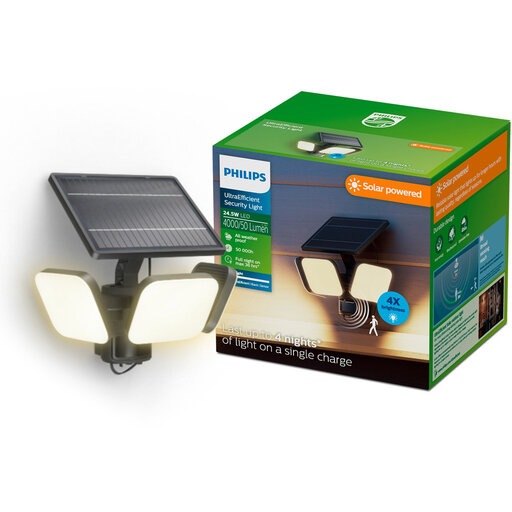
Why it suits this profile: This Philips Zyren outdoor light is suited to a façade, entrance or veranda where a fixed wall light with a warmer colour temperature is preferred. The adjustable head helps you direct the light exactly where it is needed.
The product information mentions both a motion sensor and a darkness sensor. This makes it clearer when the light responds and when it can operate automatically.
According to Philips: 4000 lumens, IP65, 3000K, a detection range of 8 metres for direct approach and 16 metres for sideways approach.
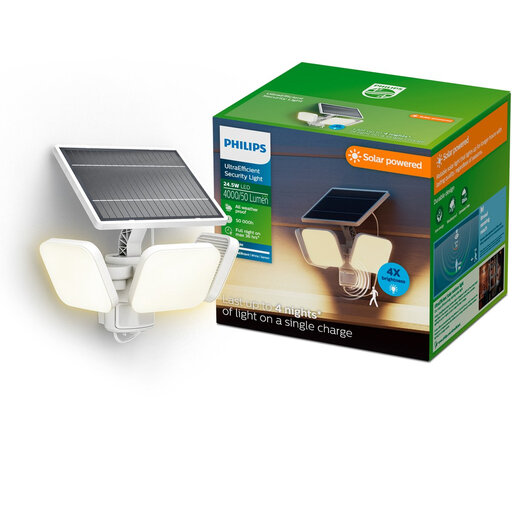
Why it suits this profile: The 5000K version is aimed at anyone who wants a whiter light around a driveway, work area or garage. The wall-mounted model is suitable for a permanent installation point with plenty of direct sunlight.
The stated sensor distances and IP65 rating provide specific points to check. The light is not designed to be placed underwater; correct wall mounting remains essential.
According to the product description: 4000 lumens, 5000K, two light modes, integrated LED and a sensor range of 8 metres straight ahead and 16 metres to the side.
We have put together a complete, up-to-date list of products that fully meet these strict selection criteria and the applicable European safety regulations.
Mount the light on a solid wall or other suitable surface with an unobstructed view of the desired walking area. Point the solar panel towards a location with as much direct daylight as possible. Avoid shade from roof edges, trees and high fences. After installation, test whether the sensor actually reaches the driveway, door or garden path.
Operating time depends on the battery, charge level, temperature, sunlight and light mode. A light that stays on at full brightness all night uses more energy than a model that only switches on when movement is detected. Clean the solar panel regularly and follow the safety instructions for the built-in battery. Do not dismantle or replace an internal battery yourself if the manufacturer advises against it.
During normal operation, the light draws its energy from the solar panel and built-in battery. It does not need to be connected to the mains. However, its practical output depends on the available sunlight and the season. Choose a model with a suitable light mode and position the panel as unobstructed as possible.
