
Vandaag of morgen in huis

Kwaliteit gegarandeerd

Welkomstaanbiedingen ontgrendelen: GRATIS bezorging | Tot 80% korting | Gratis 30 dagen JoyPlus-proefperiode
Download de app
A light without wiring sounds simple, but not every solar outdoor light with a motion sensor is suitable for every Dutch garden, façade or driveway. For example, a small light with an attractive design may not provide enough light for a dark driveway. A powerful solar security light may be unnecessarily bright on a balcony.
Marketing claims also deserve attention. “Waterproof”, “long-lasting night light” and “wide detection angle” only mean something when the technical specifications are provided as well. With this buying guide, you can compare brightness, sensor range, IP protection and installation in a practical way.
A high number of LEDs does not automatically mean that a light will illuminate a large area effectively. Pay particular attention to lumens, the unit used to measure the total amount of light. For a balcony or beside a front door, 180 to 500 lumens may be sufficient. For a driveway, garage or large back garden, a higher light output is generally more suitable.
Also consider the colour temperature. 2700K to 3000K produces warm white light for a wall light for gardens and patios. Around 4000K to 5000K, the light looks whiter and more functional. The description “warm white” should therefore always be read together with the Kelvin value.
An IP44 outdoor light is protected against solid particles larger than 1 millimetre and splashing water. This is suitable for many sheltered façades, balconies and entrances, but not for immersion or direct jets of water.
An IP65 outdoor light provides dust protection and protection against water jets from various directions according to the classification. This makes it better suited to an open driveway or a façade exposed to heavy rain. IP65 still does not mean that the light can be placed underwater. Also check whether the solar panels, connections and mounting points are suitable for outdoor use according to the product information.
A solar outdoor wall light only works reliably when the panel receives enough daylight. Shade from a canopy, tree or north-facing façade reduces its ability to charge. In winter and during several consecutive cloudy days, the operating time may also be shorter.
Therefore, do not place the light only where illumination is needed; choose a location where the solar panel has as clear a view of the sky as possible. Clean the panel occasionally with a soft, damp cloth. Before buying, check whether the sensor can be aimed towards the pathway and whether the mounting height is suitable for the detection range.
For atmospheric lighting beside a patio, a compact LED outdoor light producing a few hundred lumens is often practical. For a garage or driveway, a model with several light heads and a wide angle may be more suitable. The UME light in this selection, for example, lists 302 LEDs, 3000 lumens and an illumination angle of 270 degrees.
Pay attention to the difference between the light’s illumination angle and the sensor’s detection angle. A wide beam illuminates a large part of the garden, but that does not automatically mean that movement will be detected across the same area.
An outdoor light with a sensor can remain permanently dimmed and become brighter when movement is detected, or switch on only when the sensor registers movement. Multiple lighting modes give you more choice, but check exactly what each mode does.
The product information for the UME Solar Outdoor Lights lists a detection range of 60 feet, equivalent to approximately 18 metres, with a sensor angle of 180 degrees. Philips Fyns lists 1000 lumens, a built-in motion sensor and two lighting modes. The right choice depends on the distance between the light and the path, door or driveway.
A wireless outdoor light is easy to install, but its battery has a limited capacity. Check whether the product page provides information about the battery type, charging method and operating mode. With integrated batteries, do not open the casing or make your own modifications.
Also check whether fixing materials are included and whether the wall is strong enough. In rented properties, a compact light requiring limited installation or using a magnetic system may be more convenient than a heavy floodlight.
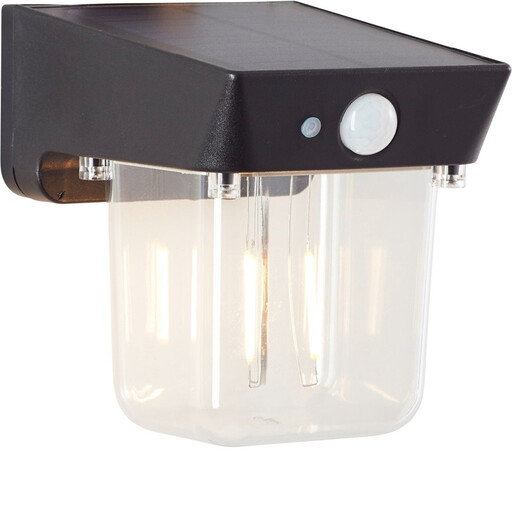
Why it suits this profile: This compact solar outdoor wall light is designed for an entrance, balcony, patio or small garden path where focused lighting is needed without wiring.
The specifications list 180 lumens, 2700K, an integrated battery and IP44. This makes it clear that the model is intended more for basic and atmospheric lighting than for illuminating a large driveway.
Solar power, motion sensor, dimmable function and installation without an electricity cable.
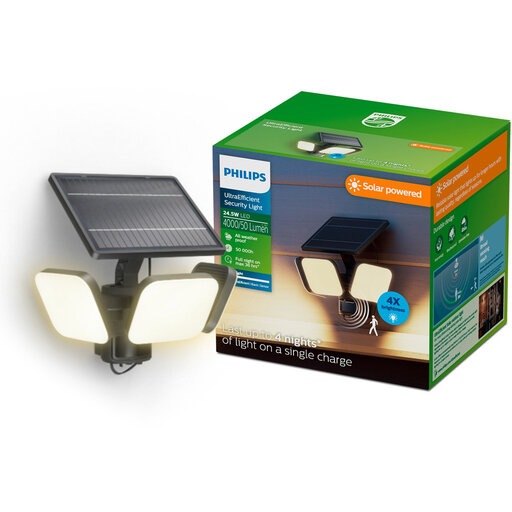
Why it suits this profile: This model is aimed at anyone looking for a powerful solar security light for a driveway, garage or larger outdoor area.
The product information specifies 4000 lumens, IP65 and a sensor range of 8 metres for direct approach and 16 metres for sideways approach. This helps you match the light more effectively to the space.
IP65 rating, adjustable light head, 3000K colour temperature and two lighting modes according to the product description.

Why it suits this profile: The three adjustable light heads are practical for large gardens, patios, garages and driveways where a single fixed beam would not provide enough coverage.
The stated 270° illumination angle and three lighting modes make its use more specific than a simple claim about brightness. According to the product information, the light also offers IP65 protection.
302 LEDs, 3000 lumens, three light heads, a 180° sensor angle and a stated detection distance of approximately 18 metres.
We have put together a complete, up-to-date list of products that fully meet these strict selection criteria and the applicable European safety regulations.
Yes, but charging time may be reduced because of shorter days, cloudy weather and the lower position of the sun. Position the panel as openly as possible and keep it clean. A light with multiple lighting modes can help limit energy consumption each night.
Operating time depends on battery capacity, charging conditions, temperature, selected lighting mode and the number of detections. Manufacturers may state an estimated LED lifespan or a number of operating hours. Based on independent research or a brand’s stated figures, such values are not a guarantee of the same performance in every garden.
A solar outdoor light charges through its built-in solar panel and normally does not need to be connected to the mains. Its practical performance does depend on receiving enough daylight. A USB-rechargeable wireless outdoor light, on the other hand, uses an external power source for charging and is not the same as outdoor lighting powered entirely by solar energy.
