
Vandaag of morgen in huis

Kwaliteit gegarandeerd

Welkomstaanbiedingen ontgrendelen: GRATIS bezorging | Tot 80% korting | Gratis 30 dagen JoyPlus-proefperiode
Download de app
A dark driveway, an unlit garden path, or a balcony where you want a bit more ambiance in the evening. Installing outdoor lighting often feels like a hassle, involving complex wiring and high costs. Fortunately, there's a simple and sustainable solution: a solar-powered outdoor light with a motion sensor.
These lights charge themselves during the day and turn on automatically when needed. No wiring hassles, no extra costs on your energy bill. In this article, we'll guide you with practical tips and highlight several popular choices to help you find the right lighting for your situation, whether you're looking for ambiance or security.
Before you make a choice, it's helpful to know which features are important. A good solar outdoor light is more than just a bulb; it's a smart solution tailored to your needs.
Not every light serves the same purpose. The choice of brightness and colour is highly personal and depends on what you want to achieve.
solar-powered security light with higher brightness (lumens) and a more neutral light colour is a better choice. Think 3000K to 4000K for bright, white light and a brightness of 500 lumens or more. This deters unwanted visitors and ensures good visibility.The 'intelligence' of the light lies in its sensors. Most models have a combination of:
Some lights offer different modes, such as a standard dim light that brightens upon detecting motion, or a mode that only turns on fully when motion is detected.
Outdoor conditions demand durable outdoor lighting. Therefore, pay attention to the IP rating. An IP44 rating means the light is splash-proof and protected against objects larger than 1 mm. For a solar-powered outdoor wall light, this is typically sufficient to withstand rain and wind. Materials like UV-resistant plastic or coated metal also prevent discolouration and corrosion.
Based on functionality and specifications, we have selected a few models that align well with the needs of both ambiance-seekers and security-conscious users.

Why It Stands Out The Philips Swyn is designed with ambiance in mind. Its warm white light creates an inviting and cosy atmosphere, ideal for long summer evenings in the garden or on the balcony.
Key Features
Who Is It For? For anyone looking for functional solar-powered garden lighting that primarily adds ambiance and cosiness to outdoor spaces like a patio, balcony, or seating area.

Why It Stands Out With a powerful light output of 1000 lumens, the Philips Fyns is a serious solar-powered security light. It effortlessly illuminates dark corners, driveways, or the area around a shed.
Key Features
Who Is It For? For homeowners or renters who prioritise security and visibility around their property. Perfect for illuminating entrances, paths, and other areas where bright light is desired upon motion.
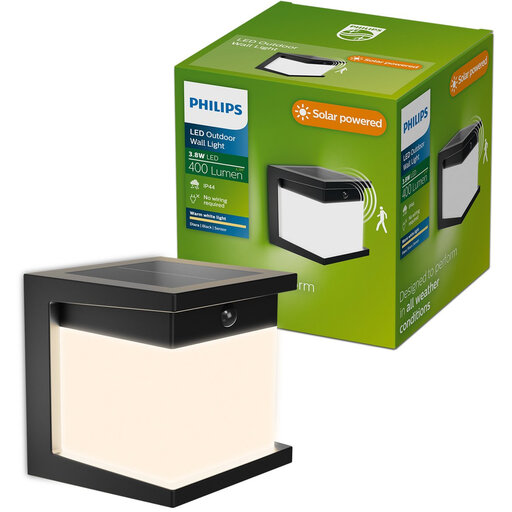
Why It Stands Out The Philips Diara combines the atmospheric qualities of warm white light with a sleek, modern, and square design. This Philips solar wall light is a subtle addition to any facade.
Key Features
solar-powered LED outdoor light is energy-efficient and has a long lifespan of 25,000 hours, according to the manufacturer.Who Is It For? For those seeking a balance between modern design and atmospheric, functional lighting. A great choice for the front door, a fence, or the balcony.
The world of solar outdoor lighting is vast and diverse. Are you looking for other styles, such as post lights, ground spots, or string lights? There are countless solutions to fit every garden and budget.
? Explore More Low-Voltage Outdoor Lighting Options Here
The runtime depends on the amount of sunlight the solar panel has absorbed during the day, the battery's capacity, and the selected mode. With most lights, you can expect several hours of light after a sunny day. In the mode where the light only activates with motion, the battery will naturally last much longer.
Yes, a solar-powered outdoor light also works in winter. However, performance may be reduced because the days are shorter and the sun is less intense. It is therefore important to install the light in a location where the solar panel can capture as much direct daylight as possible, even during the darker months.
No, the installation is actually one of its biggest advantages. Since no electrical wiring is involved, you just need to mount the light to a wall, fence, or shed with a few screws. Ensure the chosen spot is sturdy and receives plenty of sunlight during the day.
