
Vandaag of morgen in huis

Kwaliteit gegarandeerd

Welkomstaanbiedingen ontgrendelen: GRATIS bezorging | Tot 80% korting | Gratis 30 dagen JoyPlus-proefperiode
Download de app
A solar-powered outdoor light with a motion sensor may seem simple to choose: mount it, let it soak up the sunlight and enjoy automatic lighting whenever someone walks past. In practice, some models disappoint because they’re poorly positioned, don’t produce enough light or aren’t suited to the conditions where they’re installed.
So don’t focus only on a low price or a high lumen count. Check the technical specifications, installation requirements and how you plan to use the light. That way, you’re less likely to find it barely lights up after a few dark days or has been damaged by rain.
A solar-powered outdoor light only works well when its panel gets enough daylight. Under a canopy, beside a tall fence or on a wall that’s mostly in the shade, the battery may not charge as well. There’s also less energy available in winter and during overcast weather.
Choose a spot that gets as much direct sunlight as possible. Also check that trees, balcony edges or gutters won’t cast a shadow over the panel during the day.
A high lumen figure tells you about the light output, but it doesn’t automatically mean the light will cover a wide area. A compact wall light may be bright enough by the entrance, while a driveway or large patio may need a wider beam and multiple light heads.
A modest LED outdoor light may be enough for a front door or garden path. For a garage, driveway or back garden, a model with multiple heads, a wider detection angle or higher light output is a better choice.
In practice, IP44 means protection against solid objects above a certain size and splashing water. A light with this rating is suitable for many sheltered outdoor locations, but it shouldn’t be submerged or exposed to powerful jets of water.
Weather-resistant outdoor lighting with an IP44 rating may be suitable for a wall, balcony or entrance under a roof. Don’t install the light where water runs down the casing for long periods. For a completely exposed location, a higher IP rating, such as IP65, may be more practical.
Compare the lumen count with how you plan to use the light:
Colour temperature affects the look and feel of the light. Warm white light around 2700 to 3000 K creates a relaxed feel by an entrance or on a patio. Cooler light can be practical on a driveway, but often looks brighter.
An outdoor light with a motion sensor usually switches on when it detects movement. Check whether the product information gives the detection range, detection angle and whether it switches on in the dark. Not every model lets you adjust these settings.
A built-in dusk or daylight sensor stops the light switching on unnecessarily during the day. Also check which mode you’ve selected. Some models offer an automatic setting and a permanently-on setting. This is useful when you want constant lighting for a while, but it can drain the battery more quickly.
Battery capacity and the amount of sunlight determine how long a solar light will work in the evening. Manufacturers’ information about operating time usually depends on conditions such as sunlight, temperature and how often the light switches on. Treat these figures as a guide, not a guarantee for every situation.
Clean the solar panel regularly with a soft cloth. Also check that the fixings are secure and that leaves or dirt aren’t blocking the motion sensor. An outdoor light with no wiring is easier to install, but the position of the panel is still crucial to how well it works.

Why it suits this user: This black solar-powered outdoor light is designed for an exterior wall, entrance or sheltered outdoor spot where you want to avoid wiring. The product information specifies a warm white colour temperature of 2700 K, two lighting modes and 400 lumens per light.
The specifications clearly state IP44, a motion sensor and an automatic mode. Direct sunlight is still essential for charging; IP44 isn’t designed for submersion.
No mains connection required, two lighting modes, integrated LED and a black plastic casing.
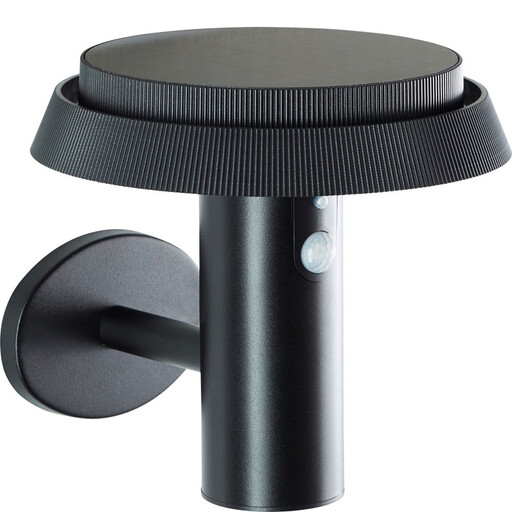
Why it suits this user: This model combines a metal and plastic casing with 500 lumens, warm white light at 3000 K and a motion sensor. It’s a good fit if you want to light an exterior wall, patio or entrance effectively, with clearly stated light output.
The product details state the IP44 rating, colour temperature, lumen count and battery technology. This makes it easier to compare the light with other models than judging by appearance alone.
500 lumens, 3000 K, integrated LED, dimming function and a design made for mounting on an exterior wall.

Why it suits this user: For a driveway, garage or larger garden area, three adjustable light heads and wide coverage are more practical than a single small wall light. The product description specifies 3000 lumens, three lighting modes and IP65.
The higher IP rating and three light heads are better suited to a larger, more exposed outdoor space. Direct sunlight is still needed to charge the battery.
302 LEDs according to the product information, three lighting modes, a 180° detection angle and IP65 protection.
A solar security light can provide extra lighting when it detects movement, but it’s no substitute for an alarm system or other security measures. Set your expectations based on light output, detection and installation, rather than general security claims.
We’ve put together a complete, up-to-date list of products that meet these strict selection criteria and the current European safety regulations.
How long it works each evening depends on the battery, the amount of sunlight, the temperature and how often the sensor switches on. Product information often gives an estimate, but actual performance can vary depending on the season and where the light is installed.
Yes, but shorter days and less direct sunlight can mean the battery doesn’t charge as much. Position the panel somewhere as open as possible and keep it clean. If sunlight is limited, consider a model with a larger battery or a separate solar panel that you can position in a sunnier spot, if the product design allows for one.
A solar light doesn’t use mains electricity during normal operation. The product description says that its built-in battery charges via the solar panel. Bear in mind that batteries wear out and may need replacing eventually, which can involve a cost.
