
Vandaag of morgen in huis

Kwaliteit gegarandeerd

Welkomstaanbiedingen ontgrendelen: GRATIS bezorging | Tot 80% korting | Gratis 30 dagen JoyPlus-proefperiode
Download de app
A solar outdoor light with a motion sensor sounds simple: install it, let it soak up the sun and have it switch on automatically when someone walks past. In practice, models vary considerably in light output, detection, battery life and protection from rain. For a driveway, entrance, garden or garage, choosing the right combination of specifications is what matters most.
A high lumen rating doesn’t automatically mean your whole driveway will be well lit. A compact solar outdoor light with a single LED can be bright in one spot but provide little coverage at the sides. For a wide exterior wall or garage, adjustable light heads or multiple light sources are more practical.
So, check:
An outdoor light with a sensor won’t always detect movement in the same way. The range and angle depend on the sensor and the direction someone is walking. Some models respond better when someone walks straight towards the light, while others are better at detecting movement from the side.
Before buying, check the stated detection range and detection angle. A sensor that detects movement up to 8 metres straight ahead isn’t automatically suitable for a 15-metre driveway.
“Waterproof outdoor light” is often used as a general term, but the IP rating gives you a more precise idea. In practice, IP44 means protection against solid objects above a certain size and splashing water. The light is suitable for many sheltered outdoor locations, but it shouldn’t be submerged or sprayed directly with a powerful jet of water.
IP65 offers greater protection against dust and water jets. An IP65 light still shouldn’t be submerged. So don’t just look for the term “water-resistant”; check the official IP rating in the product specifications.
Light output is measured in lumens. A lower output may be enough for a front door, balcony or patio. For a garage, shed or driveway, a higher output makes more sense, especially if the light only switches on briefly when it detects movement.
Colour temperature is measured in Kelvin:
Bear in mind that labels such as “warm white” don’t always match the stated Kelvin value. It’s best to compare the technical specifications.
A solar security light often uses a PIR motion sensor. Check whether the light:
Multiple modes are useful, but only if they’re easy to set. An outdoor light with a sensor that only works at maximum brightness may drain the battery more quickly.
A solar light for your garden or patio works most reliably when its panel gets direct sunlight during the day. Don’t install the light behind a canopy, beneath dense foliage or on a north-facing wall that doesn’t get enough light.
In winter, the days are shorter and the sun is lower. This can reduce how long the light stays on each night. Clean the panel regularly with a soft, slightly damp cloth. Also check that the fitting remains secure and that dirt isn’t covering the sensor.
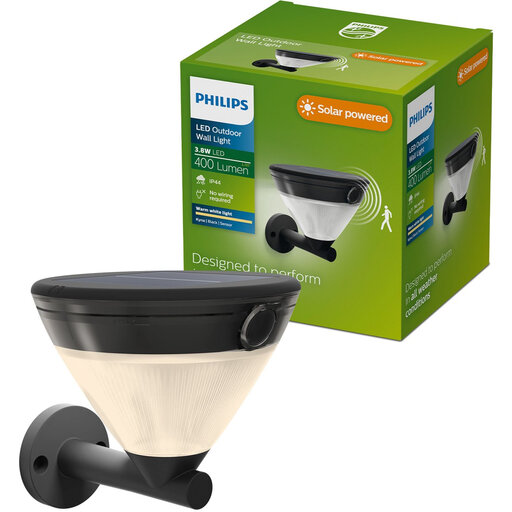
Why it suits this type of buyer: This compact model is designed for an exterior wall, balcony or small entrance, and doesn’t need wiring. Its 400-lumen output and 2700 K colour temperature provide practical, warm outdoor lighting.
The specifications list two lighting modes and an IP44 rating. This makes it clear that the model is intended for general outdoor use, not for submersion.
400 lumens, 2700 K, two modes, integrated motion sensor and installation without a mains connection.
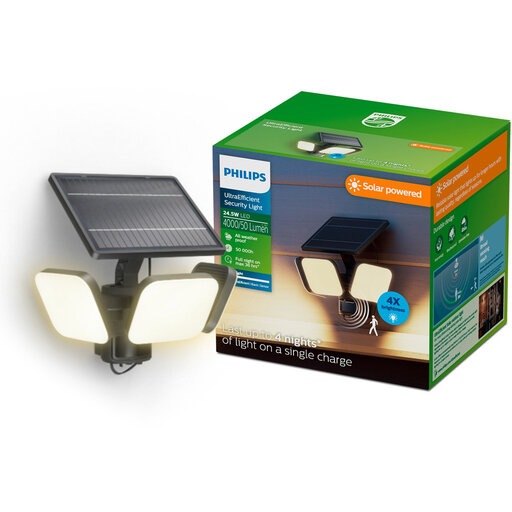
Why it suits this type of buyer: For a spacious driveway, exterior wall or garage, this model offers 4000 lumens, an adjustable light head and IP65 protection, according to the product description.
The stated sensor range makes it easy to compare: 8 metres when approached directly and 16 metres for movement from the side, according to Philips.
4000 lumens, IP65, adjustable head, dusk sensor and two lighting modes. Available with 3000 K warm white light.

Why it suits this type of buyer: According to the product description, this model is designed to illuminate a wide area around a large garden, patio, garage or driveway. Its three adjustable heads let you direct the light in different directions.
The specifications list a detection range of 60 feet, a 180-degree angle and three lighting modes. When installing it, be sure to check the converted distance and the coverage you need.
302 LEDs, stated output of 3000 lumens, three heads, three modes and IP65. The solar panel is made with toughened glass, according to the product description.

Why it suits this type of buyer: With 1000 lumens, a 3000 K colour temperature and a built-in motion sensor, this light is a good fit for an entrance, patio or smaller driveway where you want practical lighting without cables.
The product information lists two lighting modes and an IP44 rating. This helps you decide in advance whether the light will be installed in a sheltered spot.
1000 lumens, 3000 K, dusk and motion sensors, two modes and installation without wiring.
We’ve put together a complete, up-to-date list of products that meet these strict selection criteria and current European safety regulations.
Mount the light on a firm surface and point the solar panel towards a spot that gets as much direct daylight as possible. Take the direction of approach to the sensor into account. Test the detection angle before tightening the screws fully. A fixed outdoor wall light connected to the mains must be installed by a qualified person; solar models generally don’t need a mains connection.
How long it stays on each night depends on sunlight, battery capacity, temperature, the selected lighting mode and how often the sensor is triggered. Manufacturers may state a certain number of hours or nights of illumination, but this depends on the conditions. Clean the panel and check the battery and housing according to the instructions.
During normal use, a solar outdoor light doesn’t draw power from the mains. Its integrated solar panel charges the battery during the day. However, you may incur a cost if the internal battery needs replacing over time. So check whether the battery is replaceable and what warranty terms apply.
