
Vandaag of morgen in huis

Kwaliteit gegarandeerd

Welkomstaanbiedingen ontgrendelen: GRATIS bezorging | Tot 80% korting | Gratis 30 dagen JoyPlus-proefperiode
Download de app
A solar outdoor light with a motion sensor can illuminate an entrance, garden path, patio, balcony or driveway without an electricity cable. During the day, the solar panel charges the battery; once it gets dark and movement is detected, the light switches on automatically.
However, a purchase does not always work out as expected. For example, a high light output stated on the packaging means little if the panel is mostly in the shade. And a light with a motion sensor is not automatically suitable for a wall that is directly exposed to rain. So pay particular attention to the pitfalls below.
Lumens indicate how much light a lamp emits according to the product specification. This is useful, but it is not the whole story. A 300-lumen light may be sufficient for a balcony or front door, while a driveway or large garden may need more light and wider coverage.
Also consider:
A water-resistant IP44 outdoor light is protected against splashing water, but is not designed for submersion or powerful jets of water. IP44 may be suitable for a sheltered wall, balcony or covered area. For an exposed wall or a location subject to heavy driving rain, an IP65 solar floodlight is often the more sensible choice.
Always check the full IP rating in the product information. The installation position remains important: even an IP65 light must be securely fitted according to the instructions.
A solar light does not work independently of the weather indefinitely. Trees, nearby buildings and a north-facing wall can limit charging performance. In winter, the days are shorter and there is less direct sunlight.
So choose a position where the panel receives as much sunlight as possible. Clean the panel regularly with a soft cloth and check that leaves or dirt are not blocking the light. The stated operating time also depends on the charge level, lighting mode, temperature and number of movements detected.
For atmospheric solar-powered outdoor lighting, warm white light of around 2700–3000 K often works well on a patio, balcony or garden path. For a driveway, shed or entrance, 4000–5000 K can provide greater contrast.
Use lumens as a practical guide:
A higher value is not always desirable. Excessively bright light can disturb neighbours or passers-by. So also look at dimming settings and whether the light head can be directed.
An LED outdoor light with a sensor only works well when the sensor is positioned correctly. Pay attention to the stated range and detection angle. A sensor that only detects movement effectively from directly in front may be less suitable for a path where people walk past from the side.
Also check:
According to the product description, the Philips Zyren has a PIR detection range of 8 metres when approached directly and up to 16 metres for movement from the side. The stated IP65 rating makes this model technically suitable for a more exposed position, provided it is installed correctly.
A wireless outdoor light is useful for rented properties and locations without an existing connection point. However, check whether the battery is integrated and replaceable, how the light is charged and whether mounting materials are included.
With a solar model, installation is generally easier than with a wired light, but the direction of the sun makes a major difference. A wall light with an integrated panel should be positioned so that both the light and panel are practical to use. A rechargeable USB light is wireless in use, but it is not the same as a solar light: it needs to be charged manually.
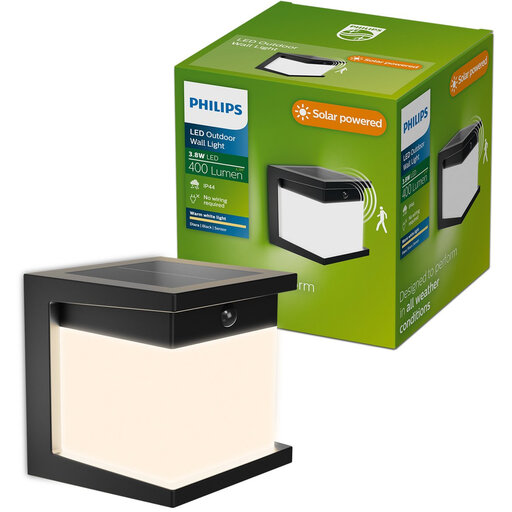
Why it suits this profile: This compact solar wall light is designed for general lighting in a garden, balcony or entrance. It can be installed without a mains electricity cable.
The specifications state 400 lumens, 2700 K, two lighting modes, a motion sensor and IP44. This makes it clear in advance that this model is intended mainly for sheltered, general lighting.
400 lumens, warm 2700 K light, integrated LED and compact dimensions of 12 × 11 × 12 cm.

Why it suits this profile: For a front door, patio or wall where brand, higher light output and warm white light are important.
The stated 1000 lumens and IP44 rating distinguish this from general wall lighting by offering more light. IP44 still means protection against splashing water, not submersion.
1000 lumens, 3000 K, two lighting modes and an integrated motion sensor.

Why it suits this profile: This solar security light is designed for a driveway, garage, large garden or another area that needs broad, powerful illumination.
The product information states 3000 lumens, three lighting modes, a 180° detection angle and IP65. During installation, check that the wide beam does not cause a nuisance.
302 LEDs, 3000 lumens, three adjustable heads and a stated detection distance of 60 feet.
We have compiled a complete, up-to-date list of products that fully meet these strict selection criteria and the applicable European safety regulations.
Choose a stable surface and fit the light at a height where the sensor can detect the desired walking area. Do not place the solar panel behind glass or beneath a covered area if this significantly reduces the amount of light it receives. Point the light away from windows and busy public routes to limit unnecessary activation.
For a rented property, a magnetic or rechargeable wireless outdoor light can be useful. With a magnetic model, check that the mounting plate can support its weight. An IP44 model must not be exposed to direct jets of water; use it in a more sheltered location instead.
This depends on the battery, charge level, sunlight, temperature and number of activations. Manufacturers may state an operating time or number of hours of illumination, but this is not a fixed guarantee for every situation. Clean the solar panel and check the battery and fittings regularly.
Yes, but its output may be lower because of shorter days, cloudy weather and the sun being lower in the sky. Position the panel as freely as possible towards direct sunlight. A light with multiple lighting modes or a shorter activation time can make better use of the available energy.
During normal use, a solar light draws energy from the solar panel and internal battery. It does not need to be connected to the mains. A rechargeable light without a solar panel must be charged via USB. So check carefully whether the product description actually states “solar” or “solar-powered”.
