
Vandaag of morgen in huis

Kwaliteit gegarandeerd

Welkomstaanbiedingen ontgrendelen: GRATIS bezorging | Tot 80% korting | Gratis 30 dagen JoyPlus-proefperiode
Download de app
A solar-powered light seems simple: put it up, let it soak up the sunshine and enjoy automatic lighting whenever someone walks past. In practice, though, the wrong choice can leave you with dim light, a flat battery or a lamp that doesn’t stand up well to British weather.
If you’re looking for solar-powered outdoor lighting with a motion sensor, it’s worth looking beyond the number of LEDs or an eye-catching lumen claim. Placement, the IP rating and how the motion sensor works all matter just as much.
A light with more lumens produces more light, but that doesn’t automatically mean the illumination will be comfortable or well directed. For a balcony or entrance, 300 to 1,000 lumens may be enough. For a driveway or large patio, a wider spread of light may matter more than simply choosing a higher number.
Also consider the colour temperature:
An IP44 outdoor light is protected against splashing water and solid objects larger than 1 millimetre. This rating makes it suitable for many sheltered walls, balconies and entrances, but not for immersion or direct, powerful jets of water.
An IP65 outdoor light offers a higher level of protection against dust and water jets under the IP rating system. It’s a practical choice for a more exposed wall, shed or driveway. Even with IP65, correct installation is important: don’t put the light somewhere where water can collect for long periods.
A sensor has a set detection range and viewing angle. If you hang the light too high, point it in the wrong direction or place the sensor behind an obstacle, the light may switch on too late.
So check:
A solar-powered outdoor light needs direct daylight to charge its battery. A spot under a canopy, close to a tall fence or on the north-facing side of a wall can reduce how long it stays lit. Before you buy, check that the panel will have a clear view of the sky for much of the day.
Clean the panel regularly with a soft, slightly damp cloth. Leaves, dust and bird droppings can reduce its output. Treat claims such as “light for multiple nights” as a product specification based on certain conditions, not a guarantee for every winter’s day.
Lumens indicate how much light the lamp produces. The light distribution then determines where that light falls. For example, a compact solar wall light with 180 to 500 lumens may suit a path or small entrance. For a wide driveway, several lights, adjustable heads or a wider beam angle may be more practical.
Plastic housings are often lightweight and easy to install. Aluminium may offer a different look and construction, but always check the full product specifications. Also look at:
A wireless outdoor light isn’t always completely maintenance-free. With models that have an internal battery or integrated LED, opening or modifying the unit is usually not permitted. Follow the manufacturer’s safety instructions.

Why it suits this type of buyer: This compact solar-powered outdoor wall light is ideal for an entrance, balcony or small patio where easy installation and warm light are important.
The specifications list 400 lumens, two lighting modes, a motion sensor and IP44. So it’s clear what the light is designed for: general outdoor lighting, not a wide-beam floodlight.
Warm white light at 2700K, two modes, an integrated LED and installation without a mains cable.
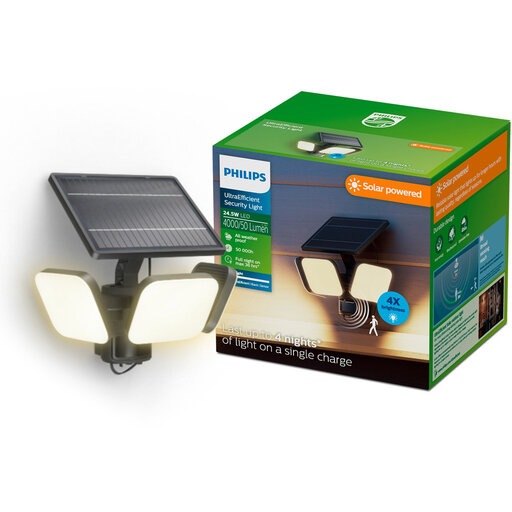
Why it suits this type of buyer: This solar security light is designed for larger outdoor areas such as a driveway, garage or spacious garden where plenty of light and greater weather resistance are desirable.
The product details state IP65, 4000 lumens and a detection range of 8 metres for movement towards the sensor and 16 metres for movement from the side. This makes it easier to assess the light based on its specifications, rather than just a marketing claim.
IP65, an adjustable light head, two lighting modes and 3000K warm white light, according to the product listing.

Why it suits this type of buyer: The three adjustable heads are well suited to a wide driveway, back garden or large patio where one light needs to illuminate several directions.
As well as the stated 3000 lumens, the product listing gives three lighting modes, a 180-degree detection angle and a range of 60 feet. Check that these figures suit your installation height.
IP65, three light heads, three modes and a stated 1800 mAh lithium-ion battery.
We’ve put together a full, up-to-date range of products that meet these strict selection criteria and the applicable European safety requirements.
A solar wall light is particularly useful when running cables is difficult. For a fixed, permanent light source, a wired wall light may be more suitable. Check that each product really is solar-powered; some outdoor lights with sensors need a 230-volt connection.
Yes, but it may stay lit for less time because the days are shorter, the weather is cloudier and there’s less sunlight. Position the panel somewhere as unobstructed as possible and keep it clean. The stated lighting time depends on charging conditions and the mode you use.
That depends on the battery, LED module, exposure to the weather and maintenance. Product listings may give an estimated LED lifespan, but this isn’t the same as a guarantee for the whole light. Check the warranty terms and your statutory rights too.
In normal use, a solar-powered outdoor light gets its energy from the built-in panel and battery, so it doesn’t need to be connected to the mains. Models with a USB charging function, such as some wireless outdoor lights, may need to be charged using an adapter if there isn’t enough sunlight.
