
Vandaag of morgen in huis

Kwaliteit gegarandeerd

Welkomstaanbiedingen ontgrendelen: GRATIS bezorging | Tot 80% korting | Gratis 30 dagen JoyPlus-proefperiode
Download de app
Solar outdoor lighting works without a permanent mains connection, making it useful for a garden path, balcony, patio, façade or driveway. However, the reality does not always live up to expectations. A light may not receive enough sunlight during the day, a sensor may be positioned incorrectly or an IP rating may be misinterpreted.
In this buying guide from the Joybuy Product Recommendation Officer, you’ll learn what to look for when choosing solar lights for outdoor use. The selection below is based on verifiable product specifications, such as light output, IP rating, sensor functions, dimensions and charging method.
More lumens generally mean more light, but not automatically a better solution for every location. A 1,000- or 3,000-lumen light is suitable for a driveway or security use, but may be too bright for a small balcony. For solar ambient lighting or a patio, 170 to 400 lumens are often more practical.
Also pay attention to the colour temperature:
The IP code indicates what external influences a light is protected against. IP44 means protection against solid particles from 1 mm in size and splashing water. An IP44 light is therefore suitable for many sheltered outdoor locations, but should not be hung under a direct jet of water or submerged.
IP65 offers a higher level of protection against dust and water jets. Even then, correct installation remains important. Always check the full product information rather than simply searching for the term “waterproof solar light”.
Solar garden lighting charges during the day and then operates using the stored energy. Shade from a fence, tree or canopy reduces the amount of energy generated. In winter and during cloudy weather, the operating time may also be shorter.
Position the panel as openly as possible, facing the sky. Clean the panel regularly and check that the light is switched to “on” before charging if this is specified in the instructions. A solar light with a sensor usually only switches on when it gets dark or when it detects movement.
First decide what the light needs to do:
A stated lumen value is useful for comparison, but the actual impression also depends on positioning and light distribution.
For an open garden or driveway, IP65 can be a practical choice. For a sheltered balcony or patio, IP44 may be sufficient, provided the light is not exposed to direct water jets. Also check whether the fitting is made of plastic, metal or stainless steel.
For ground spikes, height is an important consideration. A low model works well along a border, while a taller solar garden light is more visible along a driveway or path. Also check that the ground is firm enough for installation.
Operating time depends on battery capacity, sunlight, lighting mode and temperature. A light with several modes can often be set to use less energy than a model that only operates at full brightness.
An additional USB charging function is useful for a patio light. This makes you less dependent on sunny weather. With cordless outdoor lighting, you should also look out for:
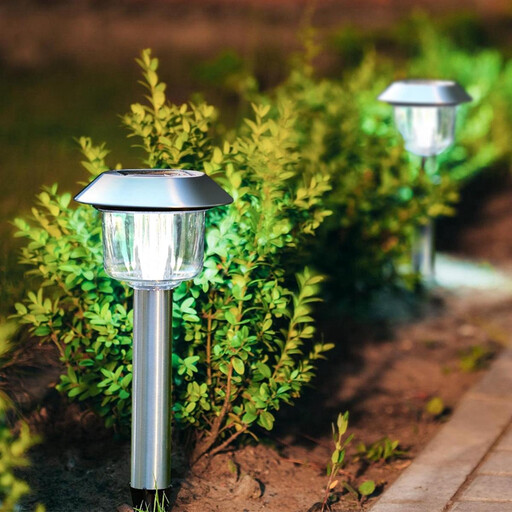
Why it suits this profile: This compact model is designed for gardens or patios and runs on solar power without wiring. Its height of 36.6 cm makes it easy to position along a border or small path.
The product specification clearly states the size, material and charging method. The IP44 rating also makes it clear that this is splash protection, not a light designed for submersion.
Stainless steel construction, 36.6 cm tall, 6,500K light colour and a stated charging time of 4–6 hours.

Why it suits this profile: This solar wall light is designed for an entrance, façade or driveway where automatic lighting is desirable. The motion sensor and 1,000 lumens make it suitable for functional use.
The light output, colour temperature and IP44 classification are specified. This allows you to assess whether the light is suitable for a sheltered façade, without interpreting “waterproof” more broadly than the manufacturer states.
1,000 lumens, 3,000K warm white light, motion sensor, two lighting modes and installation without a mains cable.

Why it suits this profile: For a large driveway, garden, garage or grounds, broad light coverage is more important than a small decorative fitting. This model has three adjustable light heads and several modes.
The product information explicitly states a detection range of 60 feet, a 180° sensor angle, IP65 and three lighting modes. Before installation, check that the stated dimensions and light colour suit your situation.
302 LEDs, stated light output of 3,000 lumens, three light heads, 270° coverage and IP65 water protection.
We’ve put together a complete, up-to-date list of products that fully meet these strict selection criteria and the applicable European safety regulations.
For installation, choose a location with as much direct daylight as possible. Mount a wall light securely on a suitable surface and avoid pointing a motion sensor towards a busy public road if you want to minimise unnecessary activation. For ground lights, the spike must be firmly inserted into the soil.
Clean the solar panel and sensor with a soft, slightly damp cloth. Do not use a pressure washer with an IP44 light. Store loose or portable solar table lamps during prolonged periods of poor weather, following the manufacturer’s instructions.
Yes, but operating time may decrease because of shorter days, a lower position of the sun and cloudy weather. Position the panel away from shade and keep it clean. A model with a USB charging function offers extra flexibility during darker periods.
Lifespan varies depending on the battery, LED module, material and conditions of use. Product information may, for example, state an expected lifespan for the LEDs or battery, but this does not guarantee the same operating time in all weather conditions. Therefore, pay attention to the statutory guarantee and maintenance instructions.
During normal use, a solar light does not use electricity from the mains. The battery is charged through the solar panel during the day. Models with USB can also be charged manually. Bear in mind that the battery may require maintenance or replacement in the longer term.
