
Vandaag of morgen in huis

Kwaliteit gegarandeerd

Welkomstaanbiedingen ontgrendelen: GRATIS bezorging | Tot 80% korting | Gratis 30 dagen JoyPlus-proefperiode
Download de app
Solar outdoor lighting is a convenient option for a garden, balcony, patio, driveway or entrance without electrical cables. However, things do not always work out as expected. A lamp may charge well during the day but provide very little light in the evening. Or a product may be described as waterproof when its IP rating only allows for protection against splashing water.
As a Joybuy Product Recommendation Officer, I filter the most important product information down to practical points. This helps you see which solar lights for outdoors are suitable for creating ambience, everyday use or providing extra lighting around your home.
The number of LEDs tells you very little unless the luminous flux is also stated. Lumens (lm) indicate how much light a lamp produces according to the product specification. A string light with dozens of small LEDs is mainly designed to create ambience. A solar floodlight needs a much higher light output to illuminate a driveway or exterior wall.
So pay attention to the combination of lumens, light colour and intended use. Warm white light around 2700–3000 K works well on a patio or garden path. Cooler light can be more practical for a driveway or solar security lighting.
The IP code consists of two digits. The first indicates protection against solid particles, while the second refers to water. IP44 includes protection against splashing water; do not place such a lamp where it will be exposed to direct jets of water or prolonged immersion. IP65 offers a higher level of protection against dust and water jets, but this still does not mean you can place a lamp underwater.
A solar lamp described as waterproof in a product title may therefore still have a limited IP rating. Always check the technical specifications rather than relying solely on the marketing copy.
Solar garden lighting is not independent of its location. Shade from a fence, tree or canopy reduces charging capacity. In winter and on cloudy days, the operating time may also be shorter than on a sunny day.
Choose a location with as much direct daylight as possible. The installation position is particularly important for wall lights: a north-facing wall may be less suitable than an unobstructed position on the south or west side. Also check that the panel stays clean.
For decorative lighting, anything from a few dozen to a few hundred lumens is often sufficient. A solar string light or torch is designed to create ambience, not to brightly illuminate an entire garden. For an entrance or garden path, you could look for a solar wall light with, for example, 180 to 500 lumens. Models with a higher light output are more suitable for larger areas.
Also consider the colour temperature:
IP44 may be sufficient for a sheltered veranda, provided the lamp is not exposed to direct water jets. For an open garden, driveway or exterior wall, it is worth considering a higher rating such as IP65. Also check whether the product is designed for wall mounting, ground placement or use as a table lamp.
A metal housing may offer a different look and construction from ABS plastic. Pay particular attention to the mounting method, weight and stability. A freestanding table lamp should be placed on a flat surface, while a wall light must be securely fixed in place.
A solar outdoor light with a motion sensor does not need to operate at full brightness all night. This can help make more targeted use of the available battery charge. Check the detection angle and range. A sensor with a wide range can be useful by a driveway, but less desirable if passers-by or pets are likely to activate the lamp frequently.
Also check whether the lamp has several modes, such as dimmed light that becomes brighter when movement is detected, automatic on/off operation or manual control. The stated operating time depends on sunlight, temperature, battery status and the selected light setting.
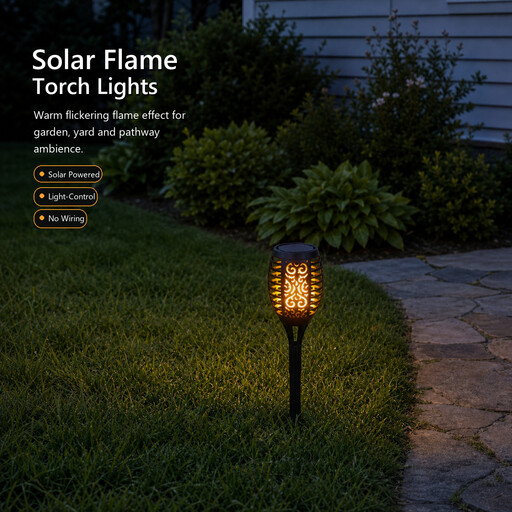
Why it suits this profile: Four 51 cm solar torches offer a simple way to highlight a garden path, border or patio edge without any wiring.
The product description lists four separate lamps, an automatic on/off function and IP65. This makes it clear that the lamps are intended for decorative garden lighting rather than illuminating a large area.
Set of four, 12 LEDs per lamp according to the product name, and a height of 51 cm.
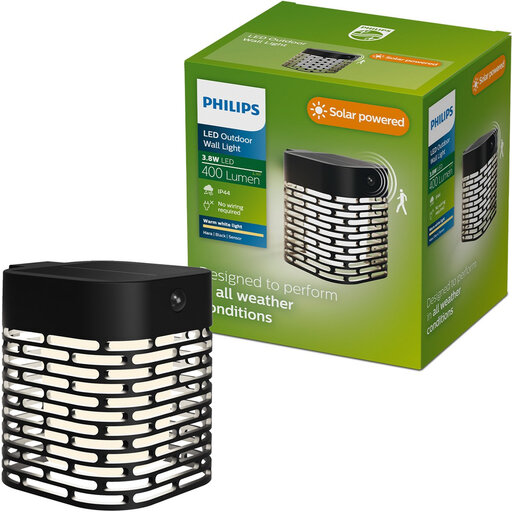
Why it suits this profile: This solar wall light is well suited to an entrance, balcony or sheltered exterior wall where warm light and fixed installation are preferred.
The specifications state IP44, making it clear that this means protection against splashing water rather than immersion. The lamp has two light modes and a dusk sensor.
Warm white light at 2700 K, 400 lumens per light point and an integrated LED.
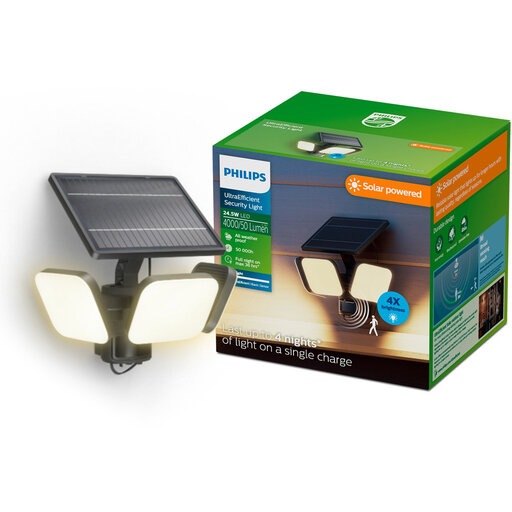
Why it suits this profile: Ideal for a driveway, large garden or exterior wall where high light output and motion detection matter more than subtle ambient lighting.
The product description states 4000 lumens, IP65 and a PIR range of 8 metres for a direct approach and 16 metres for a sideways approach. This means the relevant security specifications are clearly stated.
Adjustable light head, dusk sensor, motion sensor and two light modes according to the product information.
We have put together a complete, up-to-date list of products that fully meet these strict selection criteria and the applicable European safety regulations.
Place the panel where it will receive direct daylight and check that branches, roof edges or dirt are not covering the surface. Mount a wall light on a sturdy surface and use the supplied fixing materials. Clean the panel regularly with a soft, slightly damp cloth. Do not use harsh cleaning products, and do not attempt to open the integrated battery yourself.
Stability is important for solar patio lighting and table lamps. Place a freestanding lamp on a flat surface and take wind, rain and the risk of tipping over into account. An IP44 model is splash-resistant, but is not suitable for immersion or direct water jets.
Yes, but performance may be lower because of shorter days, cloudy weather and less direct sunlight. Position the panel as unobstructed as possible and keep it clean. A model with a USB charging option can be practical when sunlight is temporarily limited.
The operating time per night depends on the battery, charging conditions, light setting and temperature. Manufacturers may also state the expected lifespan of the LED. According to the Philips product description, certain models have a stated lifespan of 25,000 operating hours; this is a product specification, not a guarantee that the entire lamp will continue to function for that long.
During normal use, the lamp draws energy from the solar panel and internal battery rather than the mains. This means there are no mains electricity costs while it is lit. Actual performance does, however, depend on the amount of daylight and the selected light mode.
