
Vandaag of morgen in huis

Kwaliteit gegarandeerd

Welkomstaanbiedingen ontgrendelen: GRATIS bezorging | Tot 80% korting | Gratis 30 dagen JoyPlus-proefperiode
Download de app
Solar garden lighting seems like the ideal solution: no fussing with cables, no extra electricity costs, and a beautifully lit garden or balcony. Yet, the purchase often leads to disappointment. Lights that die after just an hour, illumination that looks more like a floodlight than ambient lighting, or a set that doesn't survive the first autumn storm.
As a Joybuy Product Recommendation Officer, I see where things go wrong every day. Before you invest in new solar-powered outdoor lighting, it's wise to be aware of the most common pitfalls. This will help you avoid a bad purchase and enjoy your investment for years to come.
To make a good choice, focus on a few concrete specifications. These determine whether a solar garden light will deliver on its promise.
A long runtime starts with the battery. The capacity is expressed in milliampere-hours (mAh). A higher value theoretically means a longer runtime. However, this only works if the solar panel can actually fully charge the battery. Pay attention to the panel type: amorphous silicon panels often perform better in cloudy weather than standard polycrystalline panels, making them a good option for less sunny climates.
Match the light to its purpose. Use these rules of thumb:
These specifications will help you choose the right led solar lighting that fits your needs for your garden, patio, or driveway.
Not every lamp is suitable for every situation. Below are a few popular choices, matched to specific needs and users.
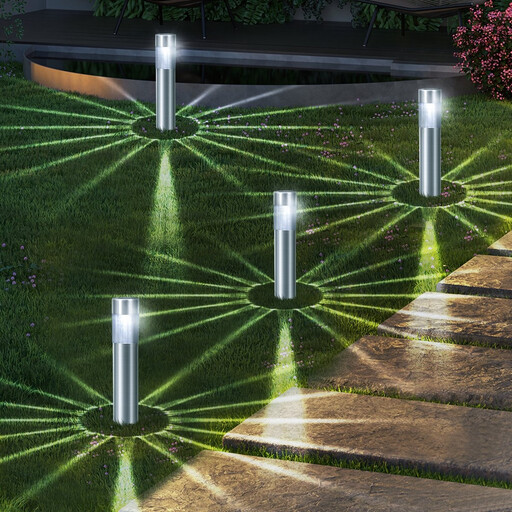
Why This Fits Their Persona: Ideal for those who want to mark a garden path or flowerbed without a large investment. These solar stake lights are easy to place in the ground and require no technical knowledge. They offer a simple, effective way to get acquainted with solar garden lighting.
The amorphous silicon solar panel is designed to charge even in less direct sunlight (pitfall 1). The 6500K light colour is deliberately chosen for bright marking, not for ambience (pitfall 2). The expectation is clear: functional marker lighting.
Automatic on/off function thanks to the dusk-to-dawn sensor. The IP44 rating makes the lamp splash-proof and suitable for most climates.
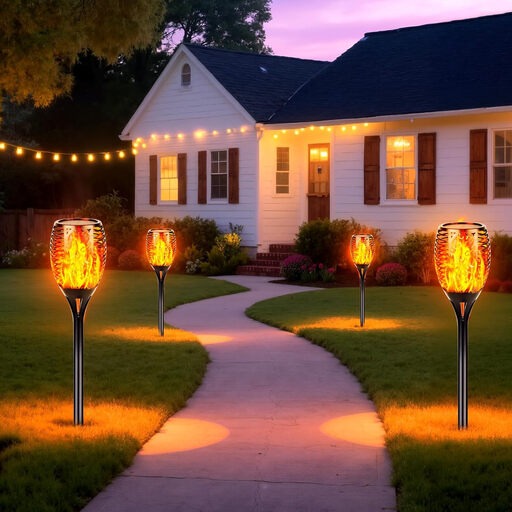
Why This Fits Their Persona: For those who want to create a warm, dynamic atmosphere. These torches mimic a dancing flame, perfect for placing next to the patio, near a pond, or scattered throughout the garden for a magical effect. This is purely about experience and cosiness.
This lamp bypasses the lumen pitfall (pitfall 2) by focusing entirely on the atmospheric effect rather than brightness. The high IP65 rating means it is dust-tight and protected against water jets, making it far more resistant to harsh weather than standard lamps (pitfall 3).
The realistic, dancing flame effect creates a unique atmosphere. The high waterproof rating (IP65) guarantees a long lifespan in all weather conditions.
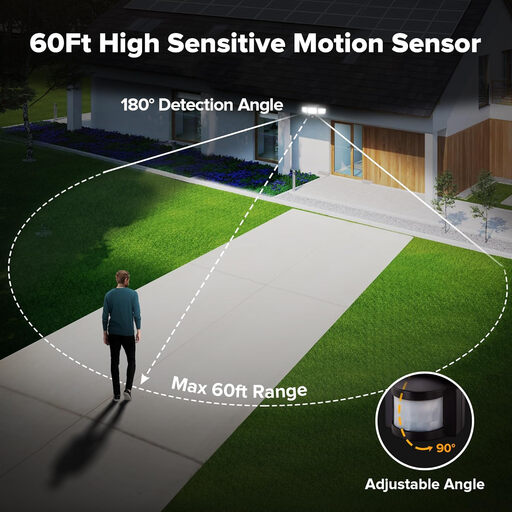
Why This Fits Their Persona: When functionality and security are top priorities. This powerful floodlight is designed to illuminate driveways, sheds, or dark corners around the house. The motion sensor provides light when it's needed, which acts as a deterrent.
This product is the solution to pitfall 1 (light is too weak). With 3000 lumens, the light output is extremely high. The large battery (1800mAh) and efficient panel ensure reliable performance. The IP65 rating guarantees durability (pitfall 3).
Very high light output (3000 lm) for maximum visibility. The sensitive motion sensor has a wide detection angle (180°) and multiple adjustable modes.
We have compiled a complete, up-to-date list of products that fully meet these strict selection criteria and safety regulations.
The runtime of solar-powered outdoor lighting is shorter in the winter than in the summer. The days are shorter and the sun is less powerful, so the battery charges less. However, a quality model with an efficient solar panel (like amorphous silicon) and a good battery should still be able to provide several hours of light after a winter day. Expect about 30-50% of the runtime achieved in the summer.
This depends on the IP rating. Lights with IP44 are splash-proof and can handle rain and light frost just fine. During severe or prolonged frost, it may be wise to bring them indoors to extend the battery's lifespan. Models with a higher rating, such as IP65, are better protected and can typically be left outside all year round.
In many cheaper solar garden lights, the battery is built-in and not easily replaceable. More expensive or robust models sometimes offer the option to change the battery (often a standard NiMH or 18650 Li-ion battery). If you plan to use the lighting for many years, it's worth checking for this in the product description.
