
Vandaag of morgen in huis

Kwaliteit gegarandeerd

Welkomstaanbiedingen ontgrendelen: GRATIS bezorging | Tot 80% korting | Gratis 30 dagen JoyPlus-proefperiode
Download de app
Solar garden lighting makes a garden, balcony, patio or driveway visible without having to run an electricity cable outdoors. However, not every solar outdoor light is suitable for every location. A small garden light along a border has different requirements from a solar security light by the garage.
Anyone who focuses solely on the number of LEDs or a low price may end up disappointed. Runtime can be underwhelming in winter, a sensor may not respond properly, or a light may prove less weather-resistant than expected. With these practical checks and product recommendations, you can quickly determine which solar-powered LED garden lighting suits your situation.
A product with a high lumen output does not automatically provide useful light everywhere. Light distribution, mounting height and beam angle also influence the result. For example, a powerful light with a narrow beam illuminates a smaller area than a light with several adjustable heads.
Also consider the colour temperature. 2700K to 3000K is generally perceived as warm white. 6500K to 7000K typically looks much cooler and brighter. Always check that the product description states the colour temperature accurately and clearly.
The term waterproof is too vague. Look for the IP rating:
An IP rating does not mean that a product can never deteriorate. Seals, plastic components and the solar panel still require maintenance.
Charging time and runtime depend on direct sunlight, the season, cloud cover, shade and battery condition. In the Netherlands, short winter days provide less charging energy than a sunny summer day. Avoid placing the panel beneath a canopy, tree or close to a tall fence.
Also check whether the light switches on automatically, which modes are available and whether a motion sensor drains the battery more quickly. A light that operates at full brightness throughout the night requires more energy than a model that only increases brightness temporarily when motion is detected.
For decorative solar garden lights along a path, a gentle light output is usually sufficient. Consider a solar garden light, solar path lighting or a set of stake lights for a border. For a driveway, shed or back door, lumens, detection angle and mounting height are more important.
The product description for the UME Solar Outdoor Lights lists 302 LEDs, 3000 lumens, three adjustable heads and broad overall coverage. The manufacturer also states a detection range of 60 feet, equivalent to approximately 18 metres, and a detection angle of 180 degrees. Before buying, check that these dimensions suit the layout of your garden.
A motion-sensor outdoor light can be useful at an entrance or garage. Pay attention to three points:
A light with two or three modes offers greater flexibility, but runtime varies by setting. Philips Fyns, for example, lists an automatic mode and a permanent-on mode in addition to a motion sensor. Philips Diara also lists two lighting modes and a sensor, with a stated light output of 400 lumens.
A larger or more efficient panel can charge more quickly in favourable conditions, but actual performance still depends on available sunlight. Check the battery type and capacity whenever this information is provided. The UME light, for example, specifies an 1800 mAh lithium-ion battery. The Aigostar SunGlow light string specifies a built-in 1.2 V, 800 mAh battery.
Also consider installation. A wall light requires a solid surface and sufficient sunlight on the panel. Stake lights are easy to install, but may become loose in soft soil. For rental properties, cordless models requiring minimal drilling are often the most practical choice.

Why This Fits Their Persona: An accessible choice for borders, compact gardens and rental properties where you want to mark out a path without cables.
The product information states a charging time of 4–6 hours, a runtime of 8–12 hours and an IP44 rating. This makes it clear that the light is intended primarily for paths and decoration, not as a floodlight.
Stainless-steel housing, a height of 550 mm and tool-free installation by simply pushing the light into the ground.

Why This Fits Their Persona: Ideal for a façade, front door or patio where a refined black solar wall light with a motion sensor is preferred.
The specifications state 1000 lumens, 3000K, two lighting modes and IP44. Install the light in a sheltered location and do not expect IP65-level protection.
Integrated LED, motion sensor and a stated runtime that varies according to the selected mode.

Why This Fits Their Persona: Designed for anyone who wants to illuminate a large area around a garden, patio, pool area or driveway with a single wall light.
The description specifies three heads, 270° coverage, a 180° sensor angle and IP65 protection. However, the stated 7000K colour temperature is cool white in character, despite the product being described as “warm white”.
302 LEDs, a stated output of 3000 lumens and three lighting modes; wall-mounted installation without a mains power cable.
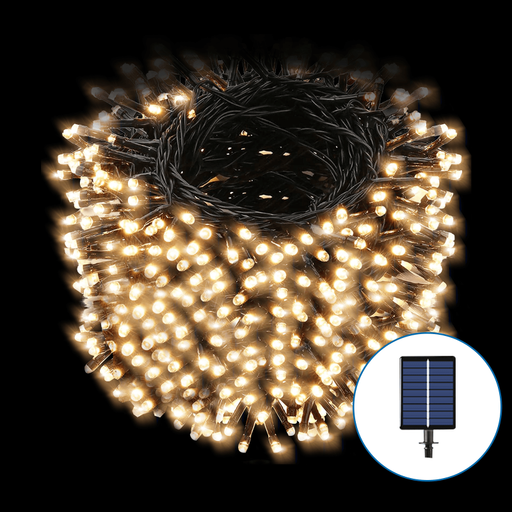
Why This Fits Their Persona: A practical choice for anyone looking for a warm string light to decorate a balcony, pergola, window, tree or patio.
The specifications state a 10-metre cable, eight modes, a charging time of 4–6 hours and a runtime of 8–12 hours. This allows you to assess the coverage in advance.
IP65 protection according to the product information, with a choice of eight lighting effects; no power outlet required.
Browse a current selection of decorative solar garden lighting and compare models by use, design and technical specifications.
Place the solar panel where it will receive as much direct daylight as possible. A south-facing position can be beneficial, but obstacles and seasonal shade are more important than compass direction alone. Clean the panel regularly with a soft, damp cloth. For wall lights, check that the mounting remains secure.
Do not use solar outdoor lighting as a replacement for fixed security lighting when you need bright, continuous illumination. A motion-sensor light only performs well when the sensor has an unobstructed view. Avoid pointing the sensor directly at a busy street if you want to minimise unnecessary activation.
Yes, but runtime may be shorter because of reduced daylight, cloud cover and the lower position of the sun. Place the panel in as open a position as possible and keep its surface clean. For critical areas, choose a light with a motion-activated mode instead of continuous illumination.
The light does not use mains electricity during normal operation. You do, however, pay for the initial purchase and potentially for battery replacement over time. Actual running costs depend on the product’s lifespan, maintenance requirements and battery quality.
According to the classification, IP65 protects against dust and water jets, but the product must not be submerged. Always follow the manufacturer’s installation and safety instructions. IP44 may be sufficient for a sheltered façade, while IP65 offers greater protection against the elements in an exposed border or driveway.
