What should you look for when choosing?
First, decide whether you have room for two lights on either side of the print. Then choose between a complete kit and separate components, and check the result with a test shot of the whole sheet.
Two lights with softboxes
Choose this if: you have room for lights on either side and even lighting is your priority.
Trade-off: two lights and stands need more floor and storage space.
One continuous light with a softbox
Choose this if: you have limited setup space or want to put the light away after each session.
Trade-off: check with a test shot that one light illuminates the whole sheet evenly enough.
Separate lights and light modifiers
Choose this if: you want to customise your setup and select your lights, softboxes and stands separately.
Trade-off: check the connection and exactly what’s included with each component.
The Canadian Conservation Institute recommends two light sources on either side, at an angle of around 45 degrees, as a starting point for even lighting. Check the corners of your own print with a test shot.
| What matters |
What to check before buying |
Who should consider this? |
| Even lighting |
Check whether two lights, diffusers and stands are included, and whether the setup will fit on both sides of the sheet. |
If I want the print to be lit consistently across the whole sheet, I’ll choose my setup with that in mind. Around 36% of consumers give even reproduction their top priority. |
| Paper and ink colour |
Check whether the lights can be set to the same colour temperature and whether you can adjust the white balance using a neutral reference. |
If the colours of the paper and ink need to look true to life, I want to be able to check the colour in the photo. Around 29% of consumers give colour reproduction their top priority. |
| Setup and storage space |
Measure the available floor and work space, and check whether stands, cables and softboxes can be put away after use. |
If I share my workspace with others, I want to be able to put the lights away after taking the photo. Around 21% of consumers give limited setup space their top priority. |
| Complete kit and connections |
Check for each version whether a light, softbox, diffuser and stand are included, and whether the fittings are compatible. |
If I’m putting together separate components, I want to avoid missing a necessary connection or part. Around 14% of consumers give complete, compatible equipment their top priority. |
An adjustable colour temperature can help you match the lights, but it doesn’t by itself guarantee that the paper and ink will look true to life in the photo. A neutral reference and a test shot help you assess the white balance and the lighting across the whole sheet separately.
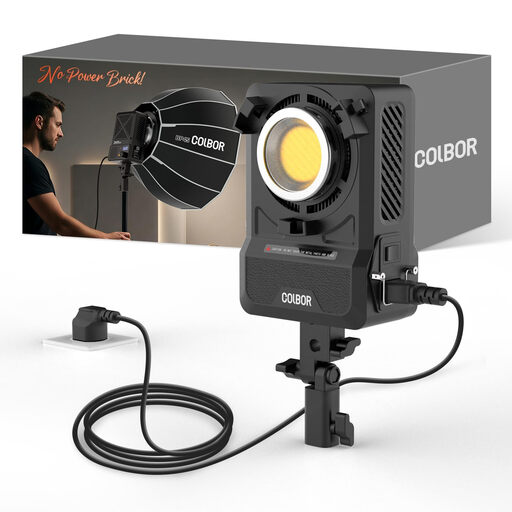
Joybuy product for a separate softbox setup
This product suits a separate COB light setup with a Bowens light modifier. Check separately which softbox and stand you need.
 No image available
COLBOR 200 W bi-colour COB LED video light
As a standalone light, this model suits anyone putting together their own softbox setup. Check how evenly the light falls with a test shot of the whole print.
The product name lists bi-colour, 2700–7000 K, 200 W and a Bowens mount. Check separately whether the softbox you want and the stand you need are included.
Shop at Joybuy
Frequently asked questions
Do you need two lights for a flat linocut print?
Not in every situation, but the Canadian Conservation Institute recommends two light sources on either side, at an angle of around 45 degrees, as a starting point for even lighting. If you choose one light, check with a test shot that the whole sheet is evenly lit enough for your needs.
How do you check the paper colour once everything is set up?
Take a test shot with a neutral reference in the same light, then adjust the white balance to match it. Also check the corners of the sheet, as white balance can’t correct uneven lighting.
Will any softbox fit any studio light?
No. Check the mount on the exact light and softbox before buying. The NEEWER NK200 lights described use an E27 fitting; the Godox SL60IID and amaran COB 60x S have a Bowens mount. The Nanlite FS-60B has an FM mount and, according to Nanlite, comes with a Bowens adapter.
What can you do if a light bought online is incomplete or disappointing?
For a distance purchase by a consumer in the Netherlands, you generally have a 14-day cooling-off period after delivery, subject to statutory exceptions. This is separate from your statutory rights if a product doesn’t meet what you could reasonably expect under normal use; in that case, contact the seller. ACM ConsuWijzer explains these rules. Also check the box contents and returns policy before ordering.
Is CE marking relevant for studio lights in the Netherlands?
Electrical equipment placed on the Dutch market is subject to the applicable European product safety rules. The Dutch government’s Ondernemersplein explains that the manufacturer must provide the required CE marking and EU declaration of conformity. This doesn’t confirm that a specific version from abroad meets the requirements.


