
Maker who wants to show off the folds
You photograph three-dimensional paper art and want to adjust the direction of the light without creating harsh cast shadows.


A standalone softbox is a better choice if you want to adjust the direction of the light to keep the folds in your paper art visible. A lit light tent is more convenient for small pieces photographed against a fixed background. First, measure your largest piece, then check that the light, connection, stand and any diffuser will work with your setup. Also check whether the paper colour in the photo matches the original, and adjust the white balance if needed.
You photograph three-dimensional paper art and want to adjust the direction of the light without creating harsh cast shadows.
You regularly photograph small objects against a fixed background and want a neat tabletop setup.
You want paper colours to look consistent across a series of product photos, so you pay attention to the lighting and white balance.
When photographing folded paper art, the light should reveal its shape without harsh shadows stealing the show. Choose a setup to suit the folds, colours and space you have available.
| What to consider | What to look for | Who is it important for? |
|---|---|---|
| Soft shadows and visible folds | Check whether a diffuser and, if needed, a grid are included. Take a test shot with the light angled towards the piece. | If you want to show the depth of the folds without harsh cast shadows, you’ll need to be able to adjust the direction of the light. Around 40% of consumers prioritise soft, shaping shadows. |
| True-to-life paper colours | Compare a photo with the piece under familiar lighting, and use a white reference if needed to assess the white balance. | If you want colours to look consistent across a series of product photos, pay attention to the white balance and avoid inadvertently mixing different types of light. Around 30% of consumers prioritise paper colour. |
| The right size and workspace | Measure the piece, including any protruding points. Check the internal space, camera opening and room for any stands. | If you often photograph small pieces, you’ll want a fixed setup that suits your work and table. Around 20% of consumers prioritise a compact, repeatable workspace. |
| Complete, compatible components | Read the contents list and check the light, power supply, connection, stand and background individually. | If you want to use your setup straight away, you’ll need to know which components are compatible and what you already have. Around 10% of consumers prioritise complete, compatible components. |
With folded paper, a soft shadow can actually help bring out the shape. Very even lighting can make the folds look less deep.
Compare test shots of the same piece with the light coming from different directions.
A Bowens mount tells you what the softbox can connect to; it doesn’t mean that a light or stand is included.
Check the contents list before ordering and compare the connection with your existing light or flash head.
Your piece needs to fit inside the tent, including any protruding points. Also consider how much room the camera opening gives you for your chosen shooting angle.
Measure your largest piece and compare its dimensions with the stated internal space and camera access.
These brands offer different types of lighting setups and light modifiers. The features listed apply to the specific models and versions mentioned.
PULUZ describes the PU5060EU as a 60 × 60 × 60 cm light tent with interchangeable backgrounds.
NEEWER describes the NK200 as a continuous lighting kit with two 60 × 60 cm softboxes, LED bulbs and stands.
Godox describes the SB-FW6090 as a 60 × 90 cm rectangular softbox with a Bowens mount and grid.
SmallRig describes the RA-D85, model 3586, as an 85 cm softbox for lights with a Bowens mount.
Bresser states that the Quick Lock F004880 has a 60 × 90 cm surface, a Bowens mount and a grid.
This Joybuy selection is an LED light source with a Bowens mount for use with a standalone softbox; the product itself is not a softbox.
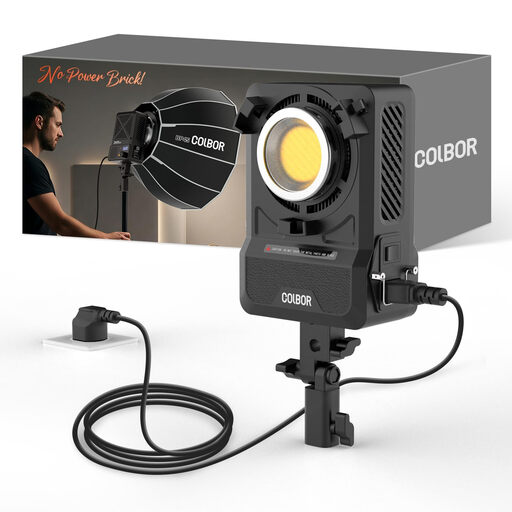 Image unavailable
Suitable for a setup with a standalone softbox if you’re looking for a compatible light source with a Bowens mount; this product is the light source, not the modifier.
200 W; dimmable; adjustable colour temperature from 2700 K to 7000 K; built-in power adapter design. A compatible softbox is needed to shape the light.
Angle a diffused light source towards the piece and check whether the remaining shadow makes the folds visible. Change the direction of the light or use less fill light if the shape isn’t standing out enough.
Take a photo with a white reference under your chosen lighting and check the white balance. A stated colour temperature for the light doesn’t, by itself, guarantee true-to-life paper colour.
You’ll need a compatible light source if you don’t already have one. Check that the Bowens mount is compatible with your existing light or flash head, and make sure you have a suitable stand too.
This depends in part on whether you’re buying as a consumer or a business. According to ACM ConsuWijzer, consumers generally have 14 days from delivery to change their mind about an online purchase. Ondernemersplein explains that statutory consumer rights, including guarantees, apply to consumers. If you’re buying for your business, check the contract and the guarantee offered.
Business.gov.nl states that electrical equipment sold in the Netherlands must comply with the applicable European rules. For the specific light you’re considering, check the power specifications, product information and instructions for use with your setup.