
Vandaag of morgen in huis

Kwaliteit gegarandeerd

Welkomstaanbiedingen ontgrendelen: GRATIS bezorging | Tot 80% korting | Gratis 30 dagen JoyPlus-proefperiode
Download de app
A good socket set is indispensable for anyone who works on cars, bikes, or around the house. But the options are overwhelming, and not every set is worth the money. Many sets look impressive with a vast number of parts, but they hide weaknesses that only come to light after a few uses.
Before you make a purchase, it's smart to know the common pitfalls. We often see buyers regret their decision due to three specific problems:
Fortunately, these problems are easy to avoid if you know what to look for.
You don't need to be an expert to avoid a bad purchase. Simply check these three points. They determine 90% of a socket set's usability and durability.
The material is the most critical factor for your tool's longevity. Always look for sets made from Chrome Vanadium steel (Cr-V). This alloy is significantly stronger than standard steel and offers good resistance to corrosion. An extra polished or chrome-plated finish not only helps prevent rust but also makes the tools easier to wipe clean after a job involving oil or grease.
The drive size is the square connector that the socket fits onto. Each size has its own application:
A comprehensive socket set for serious mechanics often includes all three sizes. For most DIYers, a 1/4" or 3/8" set, or a combination of the two, will suffice.
The mechanism inside the ratchet head determines how smoothly and efficiently you work. This is expressed in the number of teeth. A ratchet with 72 teeth needs a swing arc of only 5 degrees to turn a bolt. A 90-tooth ratchet needs just 4 degrees.
The more teeth, the smaller the movement you need to make. This is crucial in tight spaces. A ratchet with fewer than 72 teeth can be unusable in many situations. Also, look for a quick-release button, which allows you to change sockets quickly with one hand.
Based on these objective criteria, we have selected a few options that suit different users.
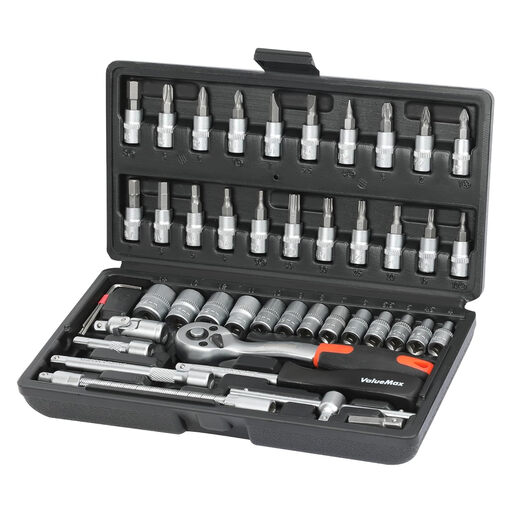
Why it's a match: Perfect for general jobs in and around the house, like assembling furniture or minor bike repairs. This compact 1/4" set includes the most common metric sizes without unnecessary parts.
This set focuses on the essentials. Instead of hundreds of obscure bits, you get a practical selection of Cr-V steel sockets and a 72-tooth ratchet that also works in tighter corners.
Complete with extension bars, a flexible shaft, and a handy case. All components are made from durable Chrome Vanadium steel.
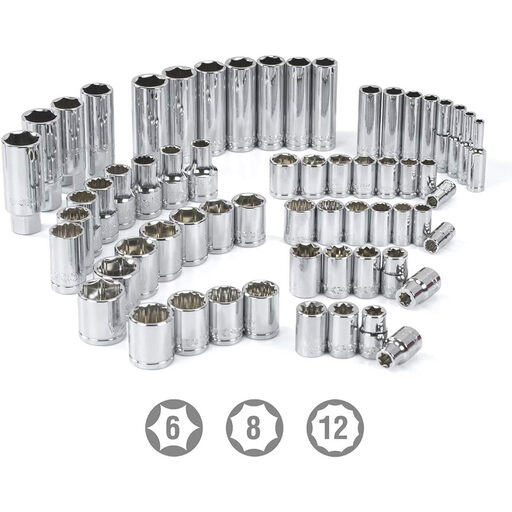
Why it's a match: For those who regularly work on cars or motorcycles and never want to be without the right tool. This comprehensive automotive tool set includes all three drive sizes (1/4", 3/8", 1/2") and a huge variety of metric and imperial sockets.
Although this is a very extensive socket set, every component is functional and made from heat-treated, chrome-plated Cr-V steel. This isn't filler; it's a complete workshop in one case.
Three different quick-release ratchets, a wide range of combination wrenches, and bits make this an extremely versatile set.
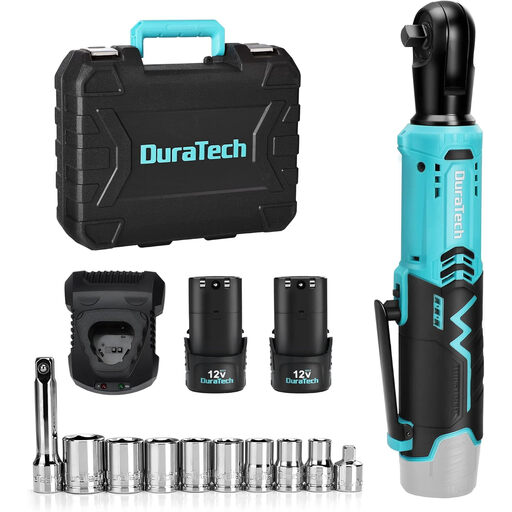
Why it's a match: For those who prioritize speed and convenience. An electric ratchet takes the repetitive turning out of your hands, saving an enormous amount of time when working with long bolts or on disassembly jobs.
This isn't a standard ratchet set, but a tool that solves a specific problem: wasted time. The slim head can reach tight spots, and the variable speed trigger gives you control. It's a supplement to, not a replacement for, hand tools.
Comes as a complete kit with two 2.0 Ah batteries, a fast charger, sockets, and a storage case. You can get started right away.
We have compiled a complete, up-to-date list of products that fully meet these strict selection criteria and UK usage standards.
The drive size determines the size and strength of the ratchet and sockets.
Proper maintenance is simple and significantly extends its lifespan. Clean and dry the parts after use, especially if they have come into contact with moisture or oil. Store the set in its case in a dry place. A drop of lubricating oil in the ratchet mechanism once a year will keep it operating smoothly.
An electric ratchet wrench significantly speeds up work, particularly when loosening and tightening long bolts. For the hobbyist who does occasional work, it might be a luxury. But for anyone who frequently works on projects, it can save a lot of time and effort. For final tightening to the correct torque specification, it is still recommended to do the last turn by hand.
