
Vandaag of morgen in huis

Kwaliteit gegarandeerd

Welkomstaanbiedingen ontgrendelen: GRATIS bezorging | Tot 80% korting | Gratis 30 dagen JoyPlus-proefperiode
Download de app
A socket set may seem straightforward at first: choose a case with plenty of pieces and you’re all set. In practice, sets vary considerably in drive sizes, materials, fit and contents. A large socket set isn’t automatically the best choice for car repairs or maintenance at home.
Watch out for these three common pitfalls:
Lots of pieces, but few useful sizes
Some cases include dozens of bits and accessories, yet leave out the metric sockets you’re most likely to need. For cars and bikes, sizes such as 10, 13, 17, 19 and 21 mm are often useful, but the exact requirements vary from one vehicle to another.
A ratchet that needs too much room to move
There’s little room to manoeuvre the handle in an engine bay or when you’re working on a hard-to-reach bolt. A fine-tooth ratchet, such as one with 72 teeth, may work with a swing arc of around 5°, according to the product description. Check that the set also includes a suitable extension bar or universal joint.
Using a standard socket with an impact wrench
A standard Cr-V socket is not the same as an impact socket. For wheel nuts and use with an impact wrench, look for a set specifically designed for impact use, often made from Cr-Mo steel. Don’t use a standard socket set for applications the manufacturer hasn’t approved it for.
A ratchet set usually uses a 1/4-inch, 3/8-inch or 1/2-inch square drive.
A set with all three drive sizes offers greater flexibility. Also look for deep sockets, extension bars and universal joints. These are useful when a bolt is recessed or difficult to reach straight on.
In the Netherlands, metric sockets are generally the standard choice. A tool set with both metric and SAE sockets can still be useful for older vehicles, imported machinery or American components. Check that the sizes are clearly stamped or laser-marked on the sockets.
A set with both types is only worthwhile if you’ll actually use the SAE sizes. Otherwise, you may be paying for pieces that mainly take up space in your toolbox.
Many sets are made from Cr-V steel, or chrome vanadium steel. According to the product descriptions from the brands mentioned, these sockets are heat-treated and have a chrome-plated finish. This can help protect against corrosion, but their lifespan also depends on workload, storage and correct use.
Also look for:
A ratchet set is designed for tightening or loosening bolts and nuts. To tighten components to a specified torque, you’ll also need a torque wrench.
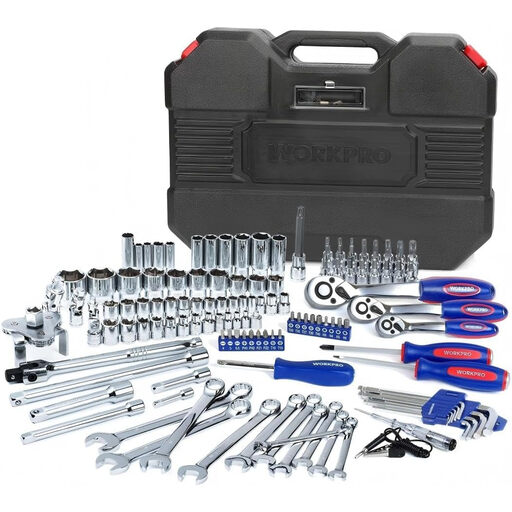
Why it suits this type of user: This set is designed for regular maintenance at home, small repairs and use in the car. The combination of sockets, ratchets, screwdrivers, bits and hex keys means you’re less likely to need to buy individual tools separately.
The product description mentions size markings, metric and SAE sockets, and a storage case. This makes it easier to check what’s included than with a set that simply boasts a high piece count.
123 pieces, 1/4- and 3/8-inch ratchets, Cr-V steel according to the product description, and a lockable case.
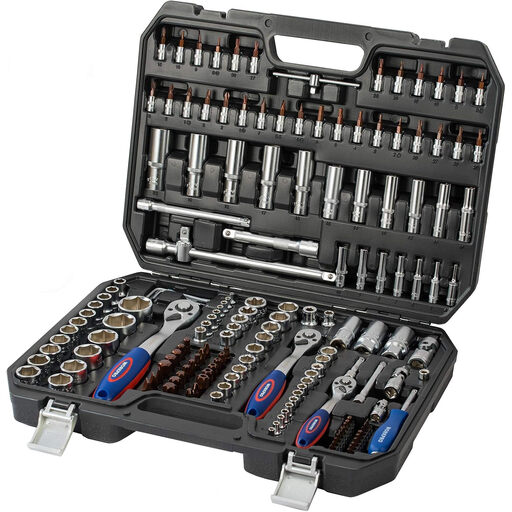
Why it suits this type of user: This professional tool set is designed for anyone who wants one organised case for car, motorcycle, bike and household maintenance.
The contents are listed by drive size and include deep sockets, Torx sockets, spark plug sockets, extension bars and universal joints. This makes it easier to check the set’s range.
172 pieces, three 72-tooth ratchets, Cr-V sockets and S2 bits according to the product description, plus a labelled storage case.
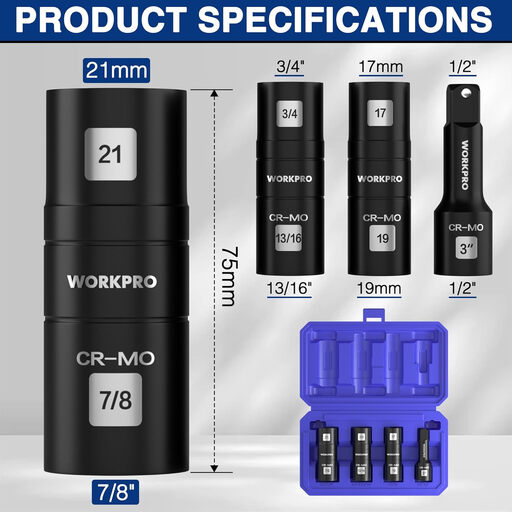
Why it suits this type of user: This compact set is a good fit for car owners and workshops that mainly work on wheel nuts, tyres and brake components.
The product name and description specify impact use and Cr-Mo steel. This makes its intended use clearer than that of a general-purpose ratchet set.
Six sizes: 17, 19 and 21 mm, plus three SAE sizes, an extension bar and a storage case.
We’ve put together a complete, up-to-date list of products that meet these strict selection criteria and current European safety regulations.
For general car repairs, a set with 1/4, 3/8 and 1/2 inch drives is a practical choice. Ideally, choose one with metric sockets, deep sockets, extension bars and a spark plug socket if you’ll be working on the engine. For wheel nuts with an impact wrench, you’ll need a separate impact socket set.
Cr-V steel is commonly used for hand tools. According to the product descriptions from the brands mentioned, the sockets are heat-treated and have a protective finish. Use the ratchet and sockets as intended, and don’t extend the ratchet with an extra pipe; doing so can damage the tool.
Clean and dry the sockets after use, especially if they’ve been in contact with oil or moisture. Put each piece back in its correct slot in the case. Before starting a job, check that the socket fits the bolt properly. For high torque, use the right tool, such as a torque wrench or a suitable impact socket.
