
Households keeping an eye on quantity
For anyone who wants to stock up for drinks and match the total quantity to what will actually be used.


A large bag suits a get-together where you’ll serve a good portion of it at once. For occasions spread over several days, individually packed portions are more convenient, as you can open a smaller bag each time. Match the total quantity to what you’ll use, and check the flavour, current allergen information and storage advice for the exact product.
For anyone who wants to stock up for drinks and match the total quantity to what will actually be used.
For anyone who won’t use everything at once and wants the amount in each opened bag to suit the occasion.
For anyone taking account of flavour preferences and allergens in the specific product variant.
Choose a pack based on how much you’ll serve at once and how often you want to open a bag. If someone has a known allergy, checking the current product information is essential, whatever the pack size.
A good fit when: you expect to serve a large portion of the contents at once; Jumbo, for example, lists a 500 g Cocktail bag.
Bear in mind: the bag contains more than a 300 g variant, and the two Jumbo products have separate product information.
A good fit when: you want to serve less at once; Jumbo, PLUS and ALDI list 300 g variants.
Bear in mind: flavours and ingredients vary by product, so compare the exact variant.
A good fit when: you want to serve snacks on different occasions; HANOS describes Duyvis Provençale as 20 bags of 45 g each.
Bear in mind: the box contains 900 g in total, even if you only open one bag at a time.
| What to consider | What should you look for? | Who is this important for? |
|---|---|---|
| Total quantity | Compare the net weight with the number of people and how much you want to serve during one get-together. | When I’m putting snacks out for a group, I want the quantity to suit what will be on the table. Around 36% of consumers prioritise the total quantity before use. |
| Portions after opening | Check how many individual bags there are and how many grams each one contains. | For get-togethers spread over several days, I’d rather open a smaller bag each time. Around 29% of consumers prioritise the quantity per occasion. |
| Flavour variant | Read the flavour name and product description for the exact variant; don’t assume the flavour based on the brand alone. | When choosing for guests, I want to pick a flavour that suits their preferences. Around 21% of consumers prioritise flavour. |
| Allergens and dietary needs | Check the ingredients, listed allergens and any warnings about possible traces on the current packaging. | If someone has a relevant allergy or dietary need, I check the specific variant. Around 14% of consumers say suitability for allergies or dietary needs is their main consideration. |
The name doesn’t tell you how much net product you get or how much you’ll open at a time.
Compare the net weight and think about how much you’ll use for the planned get-together.
The Netherlands Nutrition Centre recommends keeping opened snack nuts in a kitchen cupboard for 2–5 days.
For occasions spread over several days, choose a suitable bag size or individually sealed portions, and follow the storage advice on the packaging too.
PLUS labels its 300 g Borrelnoten Mild as vegetarian, even though the product contains milk, celery, wheat and peanuts, among other ingredients.
If there’s a relevant allergy, always check the ingredients and allergen information for the exact variant.
A box of individual portions can add up to a substantial amount: 20 bags of 45 g weigh 900 g in total.
Check both the contents of the whole box and the amount in each bag before you decide.
Duyvis offers snack nuts in a range of flavours and pack formats.
A supermarket range that includes AH Borrelnoten cocktail as a product variant.
Jumbo lists Cocktail snack nuts in bags of different weights.
Lidl’s range page lists Duyvis Borrelnootjes.
ALDI lists Trader Joe's snack nuts in several flavour variants.
PLUS lists Borrelnoten Mild in a 300 g bag.
This selection focuses on Duyvis snack nuts in 125 g and 275 g bags, for get-togethers where the quantity you need and the flavour variant both matter.
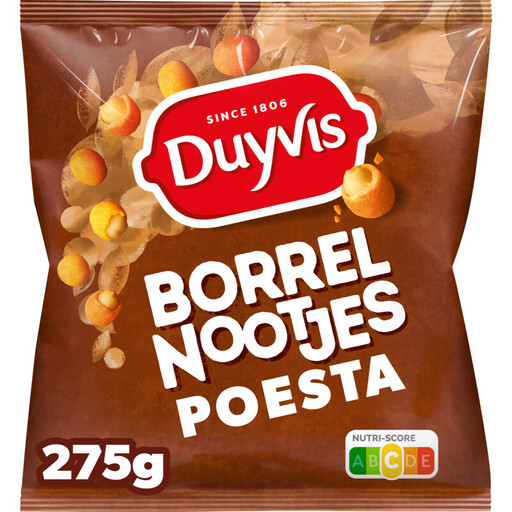 No image available
The 275 g bag may suit a smaller get-together; the product information describes a savoury, seasoned flavour.
Listed allergens: peanuts, milk, wheat and celery. May contain traces of soya, mustard and other nuts.
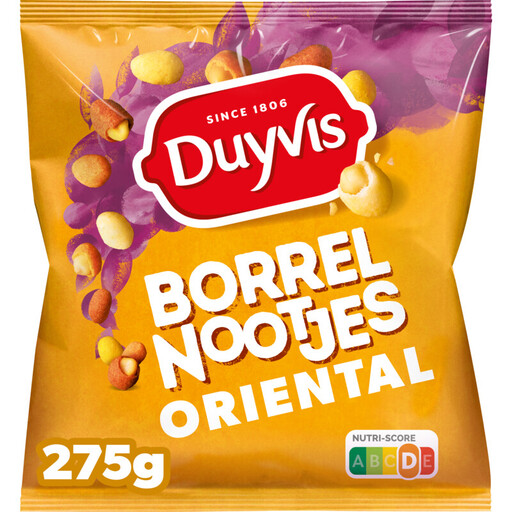 No image available
The 275 g bag is an option for a smaller get-together; the product description mentions a mild curry flavour.
Listed allergens: peanuts, gluten (wheat and barley) and soya. May contain milk, nuts and mustard.
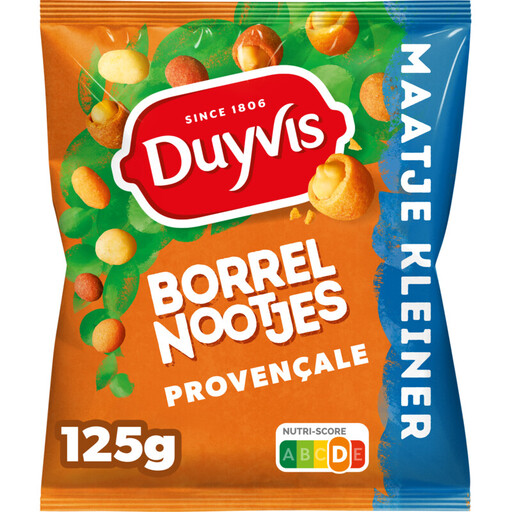 No image available
The 125 g bag may suit you if you’re after a smaller amount for a get-together; the product information mentions onion and garlic flavours.
Listed allergens: peanuts and wheat. May contain milk, other nuts, soya and mustard.
 No image available
The 275 g bag may suit a smaller get-together; the product description mentions onion and garlic flavours.
Listed allergens: peanuts and gluten (wheat). May contain milk, nuts, soya and mustard.
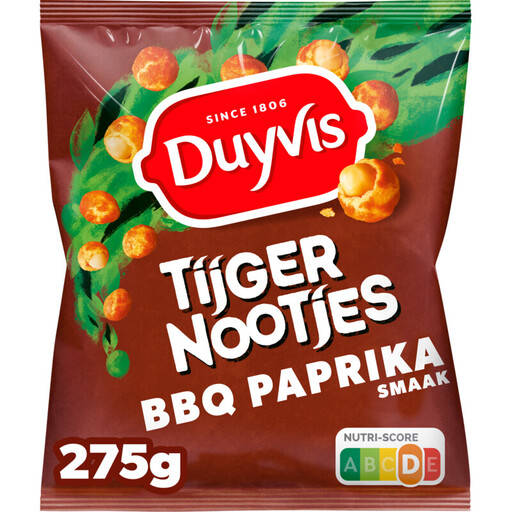 No image available
The 275 g bag may suit a get-together where you’re sharing snacks; the product description mentions BBQ and paprika flavours.
Listed allergens: peanuts and gluten (wheat). May contain milk, nuts, soya and mustard.
Look at both the total quantity and how much you’ll open at a time. A box of 20 bags of 45 g contains 900 g in total, so a multipack won’t automatically be the best fit for every get-together.
The Netherlands Nutrition Centre recommends keeping opened snack nuts in a kitchen cupboard for 2–5 days. For Duyvis Provençale portion packs, HANOS advises storing them in a cool, dry place, preferably in a light-proof, airtight container. Follow the instructions on the packaging too.
Don’t assume they’re suitable for young children. PLUS states that small children may choke on peanuts in its 300 g Borrelnoten Mild product.
Check the ingredients and any warnings about possible allergens on the packaging of the exact variant. According to the Netherlands Food and Consumer Product Safety Authority, relevant allergens must be clearly shown on the label. The European Commission explains that allergens present must be highlighted in the ingredients list.
Compare the product name and any batch or best-before details with the warning from the Netherlands Food and Consumer Product Safety Authority, and follow the instructions it provides.