
Vandaag of morgen in huis

Kwaliteit gegarandeerd

Welkomstaanbiedingen ontgrendelen: GRATIS bezorging | Tot 80% korting | Gratis 30 dagen JoyPlus-proefperiode
Download de app
Buying a smoke alarm seems simple: choose a model, attach it to the ceiling and you’re done. In practice, many households make the same mistakes. An alarm might be installed in the wrong place, lack suitable certification information or go unchecked for years.
For homeowners, tenants and families, three pitfalls are particularly important:
An optical smoke alarm uses a light sensor to detect smoke particles in its detection chamber. This is a common technology for homes. Also look for EN 14604. This European standard applies to smoke alarms for household use and sets requirements for areas including alarm behaviour, construction and documentation.
A claim such as “EN 14604 certified” should be verifiable in the product information or manual. Don’t treat the standard as a guarantee that every model will perform identically in every situation. Placement, maintenance and the condition of the device still matter.
Some models also list TÜV certification. If in doubt, check the relevant product documentation. A brand’s claim is no substitute for clear certification information.
An 85 dB smoke alarm produces a sound intended to be heard around the home. However, how clearly you hear it depends on the distance, doors, walls and background noise. One alarm may therefore not be enough in a multi-storey home.
Smoke alarms are generally best placed:
Test the alarm using the test button after installation. Some models should be tested weekly.
A built-in lithium battery designed to last 10 years reduces the need for battery changes. Check whether the battery can be replaced and what the manufacturer recommends at the end of the alarm’s service life.
An interconnected smoke alarm can be useful in a large home. If one alarm sounds, connected devices in other rooms can sound too. The Heiman models in this selection state that up to 40 alarms can be connected wirelessly. This is a manufacturer’s specification, so before buying, check that all the devices use the same system or model range.
A smoke alarm with a mute function can be temporarily silenced, for example if cooking fumes set it off. Use this function only briefly and remove the cause of the alarm. Never use the mute function to ignore an unknown or recurring alarm.
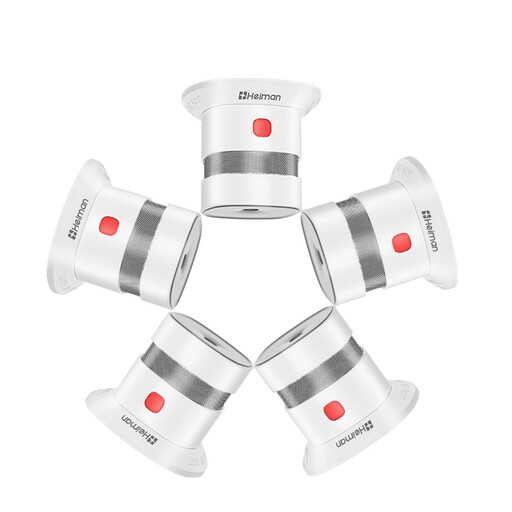
Why it suits this type of buyer: The five-pack is a practical choice for a flat, family home or multi-storey property. According to the product listing, each alarm has an optical sensor, an 85 dB alarm and a built-in battery designed to last 10 years.
The five-pack makes it easier to fit alarms on every floor, rather than installing just one and leaving other levels uncovered. The stated EN 14604 and TÜV certifications can be checked in the product information.
Pack of 5; optical sensor; 85 dB alarm; stated 10-year battery life.
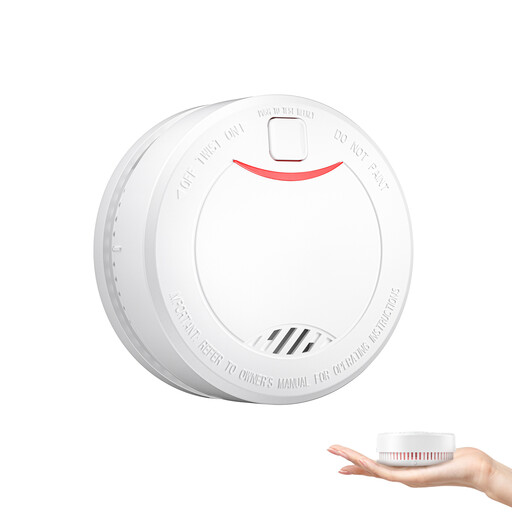
Why it suits this type of buyer: This model is aimed at buyers who want clear product specifications and mounting accessories. The product page lists photoelectric detection, DIN EN14604, 85 dB and a 10-year service life.
Listing the standard, detection technology and sound level makes it easier to compare models than relying on marketing claims alone.
Photoelectric detection; 85 dB alarm; DIN EN14604 listed; mounting accessories included according to the product information.
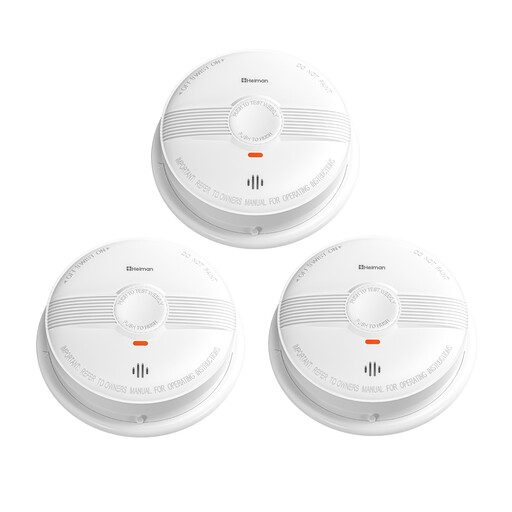
Why it suits this type of buyer: A good choice for a home with several rooms or floors where you want to connect alarms wirelessly. According to the product description, up to 40 devices can be connected by radio signal.
The radio specification and maximum number of alarms are stated clearly. The mute function can help with temporary cooking fumes or steam.
Pack of 3; wireless interconnection for up to 40 alarms according to the product page; 85 dB; 10-year battery; mute function.
We’ve put together a complete, up-to-date list of products that meet these strict selection criteria and the relevant European safety requirements.
A smoke alarm warns you about smoke from a fire. A CO alarm detects carbon monoxide, a different hazard that can result from fuel-burning appliances. These devices are not interchangeable.
For additional detection, some models list EN 50291 certification, including certain Heiman CO detectors. Always check the installation location and the manual. A Wi-Fi smoke alarm can send notifications to an app, but check whether you need Wi-Fi, an app account or any hubs. An alarm that only appears on a smartphone is no substitute for an audible alarm in your home.
Install at least one alarm on every floor and near sleeping areas. Larger homes may need extra alarms in hallways, studies, garages or storage rooms. Also follow Dutch fire safety regulations and the manufacturer’s instructions.
It varies by model. According to the product listing, a smoke alarm with a 10-year battery has a battery life or service life of around 10 years. Check the manual: some models need to be replaced completely after this period, even if they still respond to the test button.
With an alarm that has a built-in battery, you generally won’t need to buy separate batteries regularly. However, remember that you’ll need to replace the complete alarm at the end of its stated service life. Test the device regularly and carefully remove dust in line with the maintenance instructions.
