
Vandaag of morgen in huis

Kwaliteit gegarandeerd

Welkomstaanbiedingen ontgrendelen: GRATIS bezorging | Tot 80% korting | Gratis 30 dagen JoyPlus-proefperiode
Download de app
A solar-powered RGB outdoor light may seem easy to choose: pick a colour, position the light and let the sun do the rest. In practice, problems often arise because the solar panel is too small, the IP rating is unclear or the light output is intended mainly for ambience. If you are looking for smart outdoor lighting for a garden, balcony, patio or exterior wall, it is worth comparing the specifications with your intended use first.
Wattage is sometimes prominently displayed for solar outdoor lights. However, this figure does not directly tell you how much light you will receive. Also look at the luminous flux in lumens and the light distribution. A 200-lumen light is suitable for accent and ambient lighting, but it is not necessarily bright enough to illuminate an entire garden path.
Also pay attention to the difference between white light and RGB colours. On some models, the maximum light output applies mainly to white light, while coloured light may be less bright.
Always check the IP rating. IP44 means protection against splashing water, but not against immersion or prolonged exposure to heavy rain. According to the classification, IP65 offers greater protection against dust and water jets, but correct positioning is still important.
A solar wall light beneath a canopy is exposed to different conditions from a solar ground spotlight standing directly in the rain. Cable connections, the solar panel and the housing deserve just as much attention as the light itself.
Bluetooth Mesh lighting can be useful when you want to link several lights together. According to Aigostar’s product specifications, certain Bluetooth Mesh models can control more than 200 devices. This does not automatically mean that every phone, remote control or home layout will support the same controls.
Check the following before buying:
RGB modes are sufficient for atmospheric, colourful garden lighting, but for functional lighting the lumen rating is more important. An RGB+CCT light combines coloured illumination with adjustable white light. CCT refers to colour temperature, such as warm white at around 2700–3000 K and cooler white up to approximately 6500 K.
A solar pendant light with 100 or 200 lumens is suitable for a seating area or covered patio. For an entrance, exterior wall or larger patio, a wider light spread may be more practical. Also look at the beam angle. An angle of 120 degrees spreads the light widely, while focused lighting may be more suitable for a path, border or tree.
A rechargeable outdoor light does not work in the same way as a solar outdoor light. A model with a USB-rechargeable battery is more flexible when there is little sunlight, but you will need to charge it yourself. A solar light charges via its panel during the day and, according to the product description, switches on automatically when it gets dark.
Pay attention to the following details:
The stated operating time is a product specification and, in practice, depends on the brightness setting, temperature, shade and amount of sunlight.
For cordless outdoor lighting, ease of installation and cable length are important. Some solar wall lights have a separate panel with a cable, allowing you to position the light in the shade while placing the panel somewhere sunnier. A solar ground spotlight, on the other hand, requires a stable surface and sufficient space around the panel.
Also check the temperature limits and warnings. Do not position a light where it could easily be knocked over by children, pets or heavy foot traffic. An IP rating does not replace correct installation.
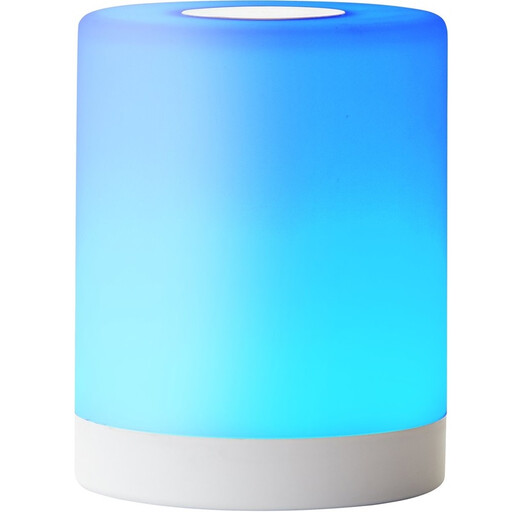
Why it suits this profile: This compact rechargeable outdoor light is ideal if you want to try flexible ambient lighting on a balcony, table or patio without installation.
The specification states 140 lumens and IP44. This makes it clear that it is decorative lighting with protection against splashing water, not a light for immersion or illuminating an entire area.
USB charging, integrated 18650 battery, RGB function, touch dimmer and warm white light at 3000 K.
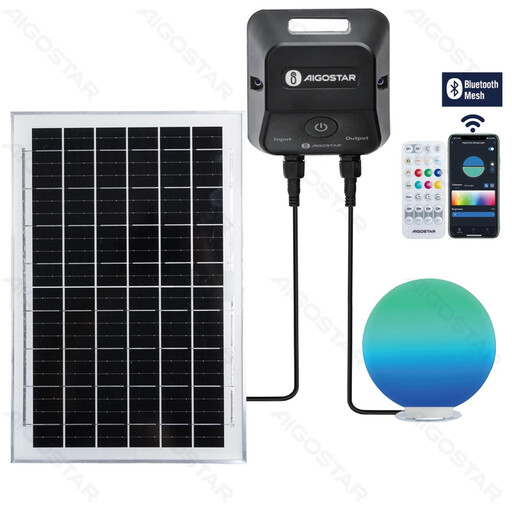
Why it suits this profile: This solar ground spotlight is well suited to garden owners who want to arrange borders, a front garden or pathway wirelessly, using several linked lights.
The product specification lists IP65, a beam angle of 120 degrees and a 350 × 235 mm solar panel. However, make sure the location receives sufficient sunlight.
RGBCCT lighting, brightness control, scheduling, on-off control and, according to Aigostar, Bluetooth Mesh connectivity for more than 200 devices.
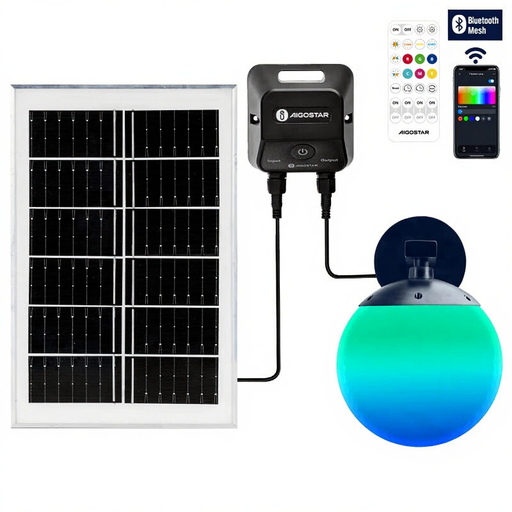
Why it suits this profile: This solar wall light is practical for an exterior wall, fence or entrance where there is no power cable but you still want a focused light accent.
According to the product information, the separate solar panel has a 5-metre cable. This allows you to position the light and panel in different places, provided the cable route remains suitable.
200 lumens, RGB plus adjustable white light from 2700–6500 K, automatic activation and a stated maximum battery life of 24 hours.
We have put together a complete, up-to-date list of products that fully meet these strict selection criteria and the applicable European safety regulations.
Yes, but performance can vary. Shorter days, cloudy skies, low sunlight and shade reduce the amount of energy received by the panel. Position the panel as openly as possible and keep it clean. Use a lower brightness setting if you need a longer operating time.
For decorative, colourful garden lighting, around 100 to 200 lumens per light is often a practical starting point. For a path or entrance, you should consider more than just lumens: positioning, light distribution and the distance between lights are also important. A ceiling light with 2700 lumens is a different type of solution from a small solar table lamp.
A solar outdoor light uses energy from its solar panel during the day, so it does not need a permanent mains connection. A rechargeable USB LED outdoor light does require charging from time to time. The actual running costs also depend on the battery, charging frequency and service life. Always check whether the battery is replaceable; the Brilliant light has an integrated LED and is listed with an 18650 lithium-ion battery.
