
Renter with a narrow laundry space
You want to know whether the machine will fit, with enough room for hoses, access and the door or lid to open. The Consumentenbond advises measuring this extra space too.


First, measure the entire space, including room for hoses and for the door or lid to open. A top-loader is best suited to a narrow space where there’s room above the machine; a shallow front-loader is an option if you have around 60 cm of width but limited depth. Choose the drum capacity and programmes to suit your usual uniform wash and the care labels, as the Consumentenbond advises.
You want to know whether the machine will fit, with enough room for hoses, access and the door or lid to open. The Consumentenbond advises measuring this extra space too.
You want to wash school clothes in good time and choose a drum capacity that suits the amount of laundry you usually have. Match the programme to the care label and load size.
You’re checking the existing water supply and waste connections, stable positioning and water protection. Also check whether installation would require any changes to the property.
Choose this option: if width is your main constraint and there’s room above the machine to open the lid.
Bear in mind: according to AEG, the AEG LTR7573A measures 903 × 397 × 599 mm; the Consumentenbond notes that a top-loader won’t fit under a worktop.
Choose this option: if you have around 60 cm of width but want to limit the machine’s depth.
Bear in mind: according to Beko, the Beko BM3WFU3741W measures 84,5 × 60 × 49,6 cm externally; allow extra space for hoses and the open door.
Choose this option: if the available space can accommodate the machine’s width and depth, the door opening and the connections.
Bear in mind: according to Bosch, the Bosch WGE02406NL measures 848 × 598 × 588 mm; check that there’s enough room for installation too.
| What to consider | What should you check? | Who should give this more weight? |
|---|---|---|
| Will the machine fit? | Measure the width, height and depth, as well as the access route, hose clearance and room for the door or lid to open. | I want to be sure the machine will fit through the access route and can be opened in its intended position; for around 36% of consumers, available space is their main concern when buying. |
| Regular uniform washes | If needed, weigh a typical load and check the care labels and permitted load size for each programme. | When school clothes pile up, I want to get the washing done in time without choosing a drum that I rarely fill. Around 29% of consumers put their laundry routine first. |
| Connections and positioning | Check the water supply, waste outlet, earthed socket, level floor and the model’s installation instructions. | I want to connect the machine without making unnecessary changes to the property, while reducing the risk of leaks or vibration; around 21% of consumers are most concerned about connections and preventing damage. |
| Consumption with regular washing | Compare energy and water figures on the same EU label basis, and check the eco programme and capacity. | If the machine runs frequently, I want to be able to assess its stated consumption on a like-for-like basis. Around 14% of consumers put running costs first. |
Hoses and an open door or lid need extra room. So a machine may seem to fit on paper but still be awkward to use in the intended spot.
Measure the full space, the route to it and the clearance needed to open the machine before choosing a model.
The lid needs to open upwards, and the top of the machine can’t be used as a fixed work surface. The Consumentenbond therefore advises that a top-loader isn’t suitable for placing under a worktop.
Choose a top-loader only if there’s enough clear space above it. With a front-loader, check the door opening and connections too.
EU label figures for washing machines are based on the eco 40–60 programme. They don’t represent the consumption of every other programme; Milieu Centraal also explains that the eco programme is the basis for the label information.
Compare label figures on the same basis, and choose your everyday programme to suit the laundry and care label.
ACM ConsuWijzer distinguishes between a commercial manufacturer’s warranty and your statutory rights if a product doesn’t perform as you could reasonably expect under normal use.
Keep your proof of purchase and contact the retailer if the machine develops a fault too soon.
The AEG LTR7573A is a 7 kg top-loader for spaces where width is limited.
The BM3WFU3741W is a 7 kg front-loader with a stated cabinet depth of 49,6 cm.
The WGE02406NL is a standard 7 kg front-loader for a space that can accommodate its full depth.
The TDLRBX6252BSEU is a 6 kg top-loader and an example of a model for a narrow space.
This selection features freestanding front-loaders with a range of drum capacities. Check the full external dimensions of the exact model, including room for hoses and the door to open.
 No image available
An option if you’re looking for a front-loader with an 8 kg capacity; choose a drum size that suits the amount of laundry you usually have.
The product name lists 1400 RPM. The quick cycle is described as being for lightly soiled laundry, so it hasn’t been confirmed as suitable for a full uniform wash.
 No image available
A 7 kg front-loader to consider if both drum capacity and limited depth matter to you.
The product name lists a depth of 400 mm. The quick cycle is described as being for small, lightly soiled loads, so it hasn’t been confirmed as suitable for a full uniform wash.
 No image available
A 6 kg front-loader for anyone looking for a smaller drum capacity and taking the available depth into account.
The product name lists a depth of 45 cm and a B energy rating. According to the product name, the quick cycle takes 15 minutes; the description limits it to small, lightly soiled loads.
 No image available
A 7 kg front-loader for anyone looking to weigh the stated capacity against the amount of laundry they usually have.
The product name lists 15 programmes. The quick wash is described as being for lightly soiled clothes, so it hasn’t been confirmed as suitable for a full uniform wash.
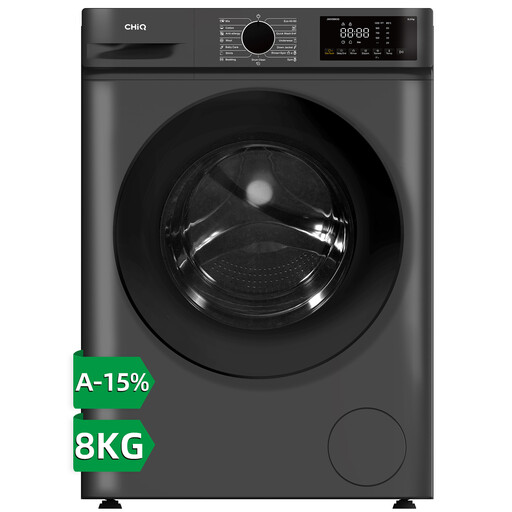 No image available
An 8 kg front-loader to compare if you’re considering a larger drum; choose this capacity only if it suits your usual load size.
The product name lists the colour as Dark Grey.
Not just to install a freestanding machine. According to the Rijksoverheid, you don’t need permission for a change that can be reversed without much expense, but you do for a renovation. Discuss any permanent changes to the water supply, waste outlet or property with your landlord beforehand.
Follow the instructions for your exact model. Check that the floor is level and stable, remove the transit bolts, and connect the water supply and waste outlet according to the installation instructions. Use a suitable earthed socket.
No. Choose a programme based on the care label, fabric and how soiled the clothes are. A specialist programme isn’t automatically suitable for every uniform; Milieu Centraal recommends the eco programme for everyday laundry.
With normal use, you can contact the retailer under the guidance of ACM ConsuWijzer if the machine doesn’t perform as you could reasonably expect. Your statutory claim isn’t automatically limited to a fixed two-year period; the outcome depends on the product and the circumstances.
According to the Rijksoverheid, you can take an old appliance to, among other places, the shop or online retailer where you buy a new, similar appliance. Check separately how collection or taking away the old appliance is arranged with your order.