Start with the material and the photo you want to create: choose adjustable white light, then use the direction of the light and, if needed, diffusion to control how the surface and shape appear. A compact panel suits a small, portable setup; a larger panel or second light source can give you more options, but also requires space, suitable mounting and consideration of the power supply. Kunstwerkt explains how reflections can emphasise volume in three-dimensional work, while stated CRI and lux values alone cannot guarantee how your sculpture will look in a photo.
Which type of light is right for you?
For makers working with colour-sensitive pieces
If you photograph painted or glazed sculptures for a portfolio, you’ll want the material and finish to remain recognisable. Kunstwerkt discusses reflections in art photography, while Canon Europe highlights the importance of a consistent shooting setup.
For makers of reliefs and glossy forms
When photographing curves and textures, you’ll want to control distracting glare without eliminating every reflection. Kunstwerkt notes that reflections can actually emphasise volume in three-dimensional work.
For makers with limited workspace
If you photograph small pieces on a table, your light, tripod and power supply need to fit comfortably into your workspace. A fixed setup can help you frame a series of photos consistently, as Canon Europe explains.
What should you look for in an LED panel?
| What to consider |
What should you check? |
Who should prioritise this? |
| Colour and finish |
Check the adjustable white-light range and the model-specific CRI rating. If possible, take photos without other light sources that have a different colour cast. |
If I’m photographing painted or glazed pieces, I want to preserve the look of the finish and avoid unwanted colour casts. Around 31% of consumers put colour and material at the top of their list. |
| Shape, texture and reflections |
Check whether you can direct the panel and whether a diffuser is included with the version you’re considering. |
When photographing reliefs or glossy curves, I want to be able to move distracting highlights without eliminating all reflections. Around 31% of consumers prioritise bringing out shape and texture. |
| Size and setup |
Compare the panel dimensions and mounting options, and check the space available on your table. See whether a tripod is included with the version you’re considering. |
If I need a compact, repeatable tabletop setup, the light must fit alongside my work and be easy to set up. Around 23% of consumers prioritise their workspace and setup. |
| Power and what’s included |
For each version, check the adapter, battery type, charging options and which mounts or diffuser are included. |
If I take photos in different locations without access to mains power, I want to know exactly what power supply I’ll need. Power and portability are the main priorities for around 15% of consumers. |
Common buying mistakes
-
Diffusing away every reflection
Reflections can help define the curves of a three-dimensional piece. Very flat lighting can make its volume less clear.
Take a test shot and adjust the direction of the light first. Use diffusion when a harsh highlight obscures details.
-
Relying on the CRI or lux figure alone
CRI is a product specification. Lux values for different lights cannot be compared directly unless the distance and measuring conditions are the same.
Check the measuring conditions for the exact model and assess a test image of your material and setup.
-
Assuming a tripod and battery are included
The contents of the NEEWER NL660 vary by version. NEEWER lists an adapter for the specified kit, but NP-F batteries are not included.
Check what’s included with the exact version and what power supply you’ll need before ordering.
Your chosen setup may require a separate tripod or compatible battery.
Brands and models to consider
NEEWER
The NL-116AI is a compact tabletop model, while the NL660 is a larger, adjustable bi-colour panel. They are different solutions, not interchangeable versions.
- NEEWER says the NL-116AI has a built-in battery; one version is sold with a mini tripod.
- An adapter and diffuser are listed for the NL660, but the tripod depends on the version and NP-F batteries are not included. Light and colour figures are manufacturer specifications, not independent tests of sculpture photography.
amaran
The P60x is an adjustable bi-colour panel for a more spacious setup, where you can plan the mounting and power supply separately.
- amaran lists a colour temperature of 3200–6500 K and a CRI of ≥95 for the P60x.
- The lux values are manufacturer averages measured at the stated distances. Don’t compare them directly with figures measured under different conditions.
Godox
The P260C Pro is a bi-colour panel with a built-in diffuser and several power options. It’s designed for setups where soft lighting and flexibility matter.
- Godox lists a range of 2800–6500 K and an average CRI/TLCI of ≥98 for this model.
- The description of softer light is a manufacturer claim; it doesn’t establish how a specific glossy sculpture will look.
Ulanzi
The VL49 RGB is a small, rechargeable light for adding local fill or creating a portable setup; it isn’t necessarily powerful enough to light an entire sculpture as the main light.
- Ulanzi lists a 2000 mAh battery, a magnetic back and a maximum of 800 lux at 0.5 m as manufacturer specifications.
- Check the exact model: the VL49 RGB is different from the separate VL49 without RGB and the VL120 versions.
Photo lights on Joybuy
These Joybuy picks are photo lights for product photography. The COLBOR models are COB studio lights and the Ulanzi models are compact video lights, so they’re not the same as a selection of LED panels.
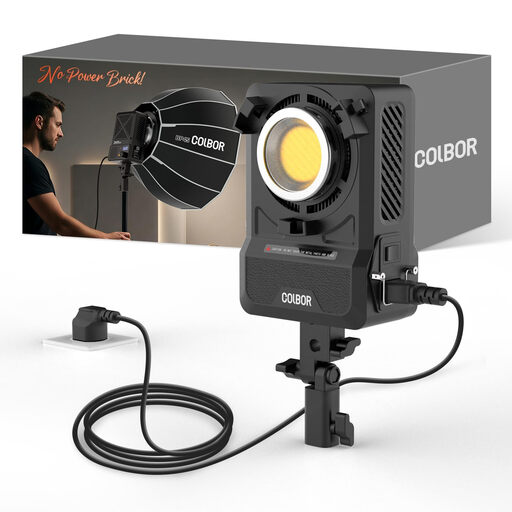 No image available
COLBOR 200W Bi-Colour COB Studio Light, 2700K–7000K
A COB studio light for product photography when you want to attach light modifiers; this is not an LED panel.
The product name lists 2700 K–7000 K. The description mentions a Bowens mount, brightness and colour temperature controls, CRI and TLCI 96+, and a built-in power adapter.
Joybuy
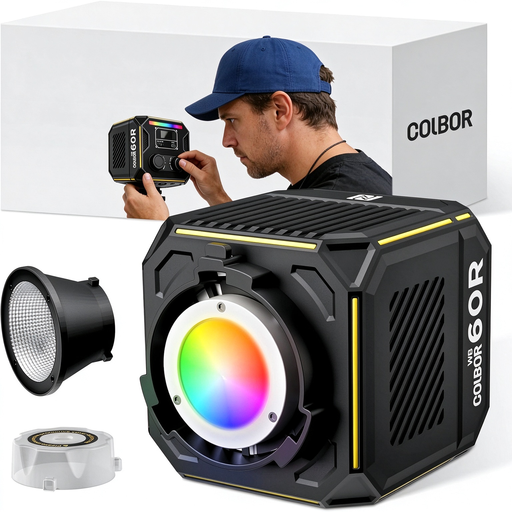 No image available
COLBOR 60W Portable RGBCW COB Light, 59Wh
This portable COB light could suit product photography in different locations, but it isn’t an LED panel.
The product name lists a 59 Wh battery and 2700 K–6500 K bi-colour plus full colour; the description lists CRI 96+. According to the description, activating the battery requires a 60 W PD charger with a 20 V/3 A output; a USB-C-to-USB-C cable is listed.
Joybuy
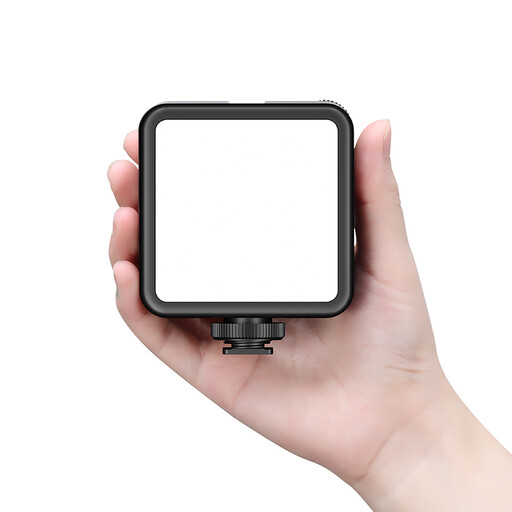 No image available
Ulanzi VL81 Rechargeable LED Video Light Black
A compact, rechargeable video light for product photography with a portable setup; it isn’t an LED panel.
The description lists an adjustable colour temperature of 3200–5600 K and a cold shoe mount.
Joybuy
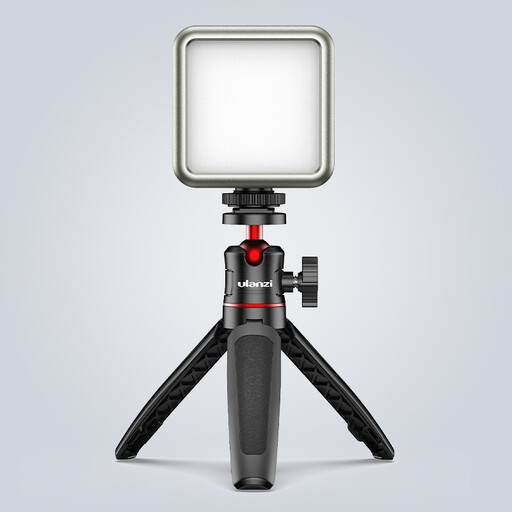 No image available
Ulanzi VL49 RGB Video Light, 2000 mAh
This compact RGB camera light can provide local fill in a portable tabletop setup, but it isn’t necessarily powerful enough to light an entire sculpture as the main light.
The product title lists a range of 2500 K–9500 K, a 2000 mAh battery and dimming. Ulanzi lists 2500–9000 K for the VL49 RGB; check the specification for the exact version.
Joybuy
Frequently asked questions
Should you eliminate all the shine from a sculpture?
No. Kunstwerkt explains that reflections can bring out curves in three-dimensional work. Move the light or add diffusion when a highlight obscures important details.
How can you keep a series of portfolio photos consistent?
Use the same background and camera setup, check the focus and avoid light sources with different colour casts. Canon Europe explains how a tripod can help keep your framing consistent; plan your setup around the largest piece in the series.
Does an LED panel usually include a battery or tripod?
It depends on the model and version. NEEWER lists an adapter for the NL660, but no NP-F battery is included; the mini tripod comes with a specific version of the NL-116AI. Check what’s included with the kit you choose.
What does CE mean for an electric photo panel in the Netherlands?
CE marking forms part of the applicable conformity process for electrical equipment, as Business.gov.nl explains. CE is not an independent quality mark and does not prove accurate colour reproduction. Check the product information and details of the included power supply for the exact model.
What warranty and cooling-off period apply to an online purchase as a consumer?
In the Netherlands, there is no fixed general period for the statutory warranty: a product must meet what you can reasonably expect from it, in addition to any commercial warranty. Business.gov.nl explains that a typical online consumer purchase generally comes with a 14-day cooling-off period from the day after delivery; check the applicable exceptions and returns information.


