
Small households buying fresh food
You want to keep carrot sticks and other everyday foods chilled, without setting aside space for a freezer compartment you won’t use. The Netherlands Nutrition Centre advises keeping cut vegetables in the fridge.


For a small household that mainly stores fresh food and carrot sticks, a compact tabletop fridge without a freezer compartment may be enough. Choose a fridge-freezer if you’ll actually use the freezer space. Consider the usable fridge capacity, whether there’s room for a sealed container and the annual energy consumption. The Netherlands Nutrition Centre advises storing cut vegetables in a sealed container in the fridge and setting the temperature to 4 °C. Check the actual temperature with a thermometer.
You want to keep carrot sticks and other everyday foods chilled, without setting aside space for a freezer compartment you won’t use. The Netherlands Nutrition Centre advises keeping cut vegetables in the fridge.
You need freezer space as well as room for chilled vegetables. So, compare the fridge and freezer capacities separately, as the Consumers’ Association advises when comparing types of fridge.
The space available and room to open the door will help determine whether a tabletop fridge is practical. Measure the space and check the dimensions of the exact model.
Start by considering where the fridge will go and how much food you want to chill at once. Then decide whether you also need freezer space. For cut vegetables, the Netherlands Nutrition Centre advises setting the fridge to 4 °C and checking the temperature with a thermometer.
| What to consider | What should you check? | Who is this important for? |
|---|---|---|
| Storing carrot sticks | Check whether there’s room for a sealed container and use a thermometer to see if the fridge reaches 4 °C. | If you want to keep cut vegetables chilled, it’s important to use a sealed container and check the temperature. Around 30% of consumers say this is their main concern when buying a fridge. |
| Fridge capacity and layout | Compare the net fridge capacity and check whether there’s room for containers and everyday groceries. Check the freezer capacity separately. | If you store everyday groceries as well as carrot sticks, you’ll want to know how much space is actually available for chilled food. Around 30% of consumers focus mainly on capacity and layout. |
| Dimensions and positioning | Measure the available space and check the height, width, depth, door clearance and installation requirements. | If your kitchen is short on space, the fridge and its open door need to fit in the intended spot. For around 20% of consumers, available space is their main concern when buying. |
| Energy consumption and noise | Compare the annual consumption in kWh for models with enough fridge space. Also consider the noise level if the fridge will be near a living area. | If you want to take energy consumption into account, compare appliances with a capacity that suits your needs. Around 20% of consumers give energy consumption and running costs top priority. |
With a fridge-freezer, the total capacity includes the freezer compartment. Those litres aren’t available for chilled groceries.
Compare the net fridge capacity separately with the amount of food you want to store.
A salad drawer is no substitute for sealed packaging or checking the fridge temperature. The Netherlands Nutrition Centre advises storing cut vegetables in a sealed container and setting the fridge to 4 °C.
Use a sealed container and check the temperature with a fridge thermometer.
The energy rating alone doesn’t tell you how much electricity an appliance uses each year. Milieu Centraal also advises checking the annual consumption in kWh. A fridge that’s too large can use more electricity than necessary.
First choose a suitable capacity, then compare the stated annual consumption.
The appliance uses electricity continuously. The cost depends on your own rate per kWh.
An incorrect height or cooling-system description could lead you to choose the wrong model for the space available or the way you plan to use it.
Check the exact model number and the key features in the manufacturer’s specifications.
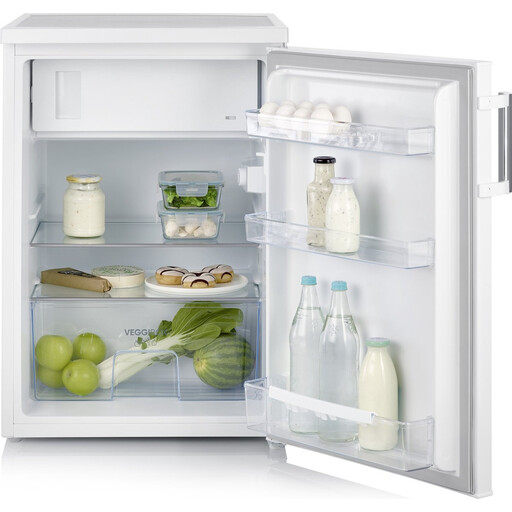
The KTR15NWEB is a tabletop fridge without a freezer compartment, for anyone who doesn’t need a separate freezer.
The Rd 1400 Pure is a compact tabletop fridge without a freezer compartment.
The KV1430 is a fridge-freezer for anyone who wants freezer space as well as room in the fridge.
The RS9152WN is a slim tabletop fridge without a separate freezer compartment.
Below are compact tabletop fridges, both without a freezer compartment and with a separate freezer compartment. For models with a freezer compartment, check the fridge and freezer capacities separately.
 No image available
A tabletop fridge without a freezer compartment may suit a small amount of chilled groceries if you don’t need freezer space in this appliance.
The product name states energy rating E.
 No image available
This model with a freezer compartment is an option if you need freezer space as well as room for chilled groceries.
The product name states a total capacity of 109 litres and energy rating C. Some of the total capacity is taken up by the freezer compartment and isn’t available for chilled groceries.
 No image available
A fridge without a freezer compartment may suit you if you want to store chilled groceries and don’t need freezer space in the same appliance.
The product name states a width of 54 cm and energy rating E.
 No image available
This tabletop model with a freezer compartment is for anyone who wants to freeze a small amount of food as well as store chilled groceries.
The product name states a total capacity of 120 l and energy rating C. The total capacity includes 13 l of freezer space, which isn’t available for chilled groceries.
 No image available
This compact 90-litre fridge may suit your limited storage needs. For carrot sticks, check whether the fridge itself can be set to 4 °C and whether there’s room for a sealed container.
The product name states energy rating E and a chiller box.
For opened products in the pre-cut vegetables category, the Netherlands Nutrition Centre advises keeping them in the fridge for two days. Store raw vegetables in a well-sealed container; home-cut vegetables should also be kept in the fridge. This timeframe isn’t a guarantee of how long every homemade container of carrot sticks will keep.
The Netherlands Nutrition Centre advises setting your fridge to 4 °C and checking the actual temperature with a fridge thermometer. Place the thermometer in the middle of the bottom shelf, leave it there for half a day or overnight, and adjust the fridge if needed.
Compare the annual kWh figures on the energy labels of models that both offer enough fridge space. Multiply the difference in annual consumption by your own electricity rate per kWh to work out the difference in electricity costs.
If a product is faulty, you have a statutory guarantee from the seller in the Netherlands; a manufacturer’s warranty doesn’t limit this right. Online purchases usually come with a 14-day cooling-off period. There isn’t a fixed number of years for the statutory guarantee that applies to every fridge.
The EU energy label for fridges uses a scale from A to G and shows, among other things, annual energy consumption, fridge and freezer capacity, and noise level. The old plus-rating classes have not been used for this product category since 2021.