
Vandaag of morgen in huis

Kwaliteit gegarandeerd

Welkomstaanbiedingen ontgrendelen: GRATIS bezorging | Tot 80% korting | Gratis 30 dagen JoyPlus-proefperiode
Download de app
A small fridge may seem straightforward to choose: measure the available space, compare the capacity and order a model that fits. In practice, problems often only arise after delivery. The door opens the wrong way, bottles do not fit in the door shelf or the freezer compartment turns out to be suitable only for short-term storage.
As Joybuy Product Recommendation Officer, I filter the most important product specifications and turn them into practical buying advice. This helps you quickly see which small fridge is right for a student room, studio flat, office, hotel room or small kitchen.
A fridge with a capacity of 88 or 92 litres may appear sufficient on paper. However, the usable space also depends on the internal layout. So check:
A tabletop fridge with a well-designed interior can be more practical than a larger model with fixed shelves.
Do not just check the width, height and depth of the available space. You also need to allow room for ventilation and for the door to open fully. A fridge needs clear space around it to dissipate heat. Follow the manufacturer’s installation instructions; a model that fits exactly between two cupboards may still not be suitable.
For an under-counter fridge, also check the height of the worktop, plinth and hinge side. A fridge with a reversible door gives you more flexibility, but the door must be reversed according to the instructions.
Not every small freezer compartment is designed for storing food for long periods. Some compact models have only a small compartment for temporarily storing products that have already been frozen. Check the star rating, freezing capacity and separate freezer capacity.
For one person or a student room, a mini fridge of around 40 to 50 litres is mainly suitable for drinks, snacks and a few fresh products. A compact fridge with a capacity of 80 to 100 litres provides more room for everyday shopping. For a household or as an additional fridge, 100 to 130 litres may be more practical.
Always compare the actual product dimensions. A 92-litre model may, for example, be 47.4 cm wide, 44.7 cm deep and 83.1 cm high. The available space must be larger than these dimensions to allow for ventilation and the door to open.
Since the European energy label was revised, fridges have been rated from A to G. Do not just compare the letter; pay particular attention to the stated annual energy consumption in kWh. A difference of several dozen kWh per year can become significant over time.
Actual consumption depends, among other things, on the ambient temperature, ventilation, temperature setting and how often the door is opened. You should therefore treat brands’ energy-saving claims as manufacturer information, not as a guarantee for your particular circumstances.
The noise level is important for a fridge in an office, bedroom or open-plan kitchen. Many compact models in this selection state a noise level of approximately 37 to 41 dB. The stated figure is a standardised product specification; the noise you experience may change when the compressor switches on or if the floor is not completely level.

Why it suits this profile: A well-organised model for a student room, studio flat or office. The fridge is 48 cm wide and has three adjustable glass shelves, a salad drawer and three door shelves.
The net capacity and dimensions are clearly stated, as is the fact that there is no freezer compartment. This means you will not accidentally buy a model with a smaller freezer section than expected.
Energy label E, 90 kWh per year, 39 dB and a reversible door.

Why it suits this profile: Suitable for anyone looking for a slim fridge for a small kitchen, office or hotel room, with a practical interior layout.
It is 47.4 cm wide and has a reversible door. The chill compartment is not presented as a full-size freezer.
92-litre capacity, 39 dB, energy label E, adjustable glass shelves and a salad drawer.
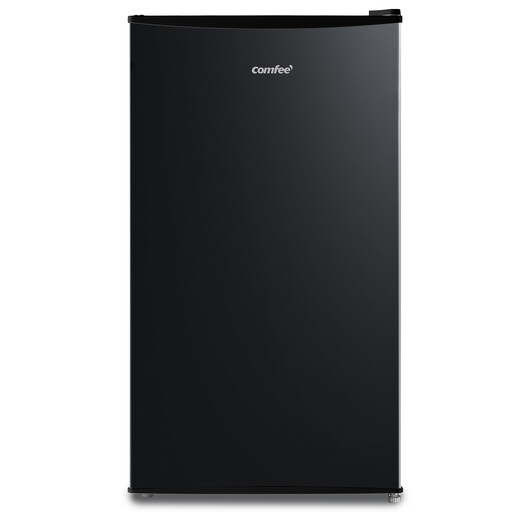
Why it suits this profile: An option for a student room, holiday home or small kitchen where a separate freezer section is needed.
The product specification states that the freezer compartment has a capacity of 12 litres, a four-star rating and a freezing capacity of up to 2 kg per 24 hours.
39 dB, energy label E, adjustable temperature and a reversible door.
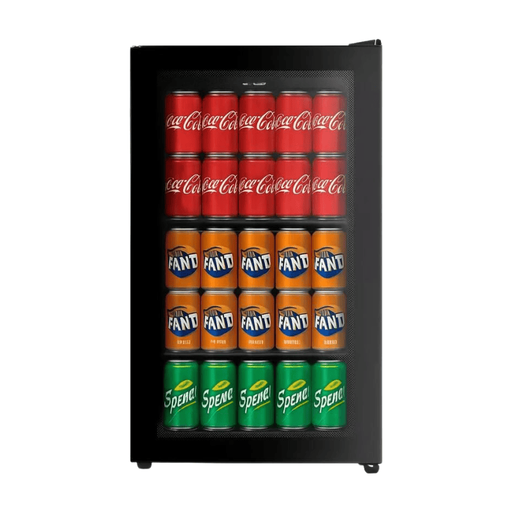
Why it suits this profile: The glass door and interior lighting make this model suitable for storing drinks in an office, bar, treatment room or hospitality venue.
The manufacturer states the required ventilation, door-opening clearance and a climate class of 10 to 38 °C. Check these details when positioning the fridge.
Three adjustable shelves, 81 kWh per year, energy label E and a reversible door.
We have put together a complete, up-to-date list of products that fully meet these strict selection criteria and the applicable European safety regulations.
An energy label tells you about standardised consumption, but using energy efficiently also starts with adequate ventilation, a good door seal and an appropriate temperature setting.
It can be, provided the noise level and dimensions are suitable. Models producing around 37 to 40 dB are often chosen for bedrooms or open-plan living spaces. Bear in mind that the compressor may be audible when it switches on at certain times.
For drinks and snacks only, 40 to 50 litres may be enough. For everyday shopping, 80 to 100 litres is usually more practical. If you also want a freezer compartment, salad drawer and several door shelves, it is worth comparing the interior layout as well as the stated capacity.
Use the stated annual consumption in kWh and multiply it by your current electricity tariff. According to the product specification, a model using 90 kWh per year consumes less energy than one using 140 kWh, but actual consumption may vary depending on the ambient temperature, ventilation and usage.
