
Storyteller with an audience
You show images to people from your workspace. Consider where they will be sitting and what audio solution you will need during the session.


Choose a fixed monitor if it will usually stay on your desk and everyone needs to view images together. A portable model takes up less permanent space, but offers a smaller viewing area. Also check how much room you have, how the monitor connects to your laptop and how you plan to play audio.
You show images to people from your workspace. Consider where they will be sitting and what audio solution you will need during the session.
You regularly work with text and images, and want a screen that fits comfortably in the available space and can be adjusted if needed.
You want to put the screen away after use or take it somewhere else, and are happy to choose a smaller viewing area to do so.
First decide whether the screen will stay in one place or needs to be put away after use. Then measure your workspace and check that the viewing experience, connections and audio will suit your session.
| Consideration | What should you check? | Who is this important for? |
|---|---|---|
| Viewing images together | Measure the viewing distance and available space. Check the screen size and how you will play audio during the session. | If I’m showing images to others, I want them to be able to follow along from their seats and hear the audio. Around 33% of consumers give watching together their highest priority. |
| Working at a small desk | Measure the space for both the screen and its stand. Check whether the stand is adjustable and whether the resolution suits your work. | If I work with text and images every day, I want to position the screen comfortably without letting it dominate my limited workspace. Around 27% of consumers prioritise a permanent, compact workspace. |
| Connecting a laptop | Check whether your laptop port supports video output, how much charging power you need and whether the cable is suitable. | If I want to keep my desk tidy, I need to know whether my laptop supports video and power through the connection I’ve chosen. Around 20% of consumers give a simple laptop connection their highest priority. |
| Putting the screen away or moving it | Check the screen size, stand, connections and power options. Consider whether everyone will be able to read the smaller image from their seats. | If I want to clear my workspace after a session or take the screen with me, I may be willing to accept a smaller viewing area. Around 20% of consumers prioritise being able to put the screen away or move it. |
A USB-C monitor will only simplify your setup if your laptop, cable and monitor all support the video and power functions you need.
Check your laptop port, cable and the charging power required for the exact monitor model.
You may need a different cable, an adapter or a separate laptop power supply.
The stand and cables take up space too, so the screen may need more room on your desk than its diagonal measurement alone suggests.
Measure the available space and check the overall and stand dimensions of the model you have in mind. Also consider where everyone will be sitting.
The portable models in this comparison are 14 and 15.6 inches; the fixed models are 23.8 inches. Whether the smaller image is easy for your group to read will also depend on the viewing distance.
Before choosing between easy storage and a larger shared image, work out how far away people will be sitting when they need to read text and view images.
The Dell Pro Plus P2425DE is a fixed 23.8-inch QHD monitor with a USB-C hub.
The LG 24BA850-B combines a fixed 23.8-inch Full HD screen with features for work and presentations.
The Philips 24E1N1300A/00 is a fixed 23.8-inch Full HD monitor with USB-C.
The ASUS ZenScreen MB16AHV is a 15.6-inch portable screen for a workspace that needs to be cleared after use.
The Lenovo ThinkVision M14d is a portable 14-inch screen for a compact, moveable workspace.
These fixed, compact monitors are suited to a workspace where you leave the screen in place. Check the connections, power requirements and available space for each model.
 No image available
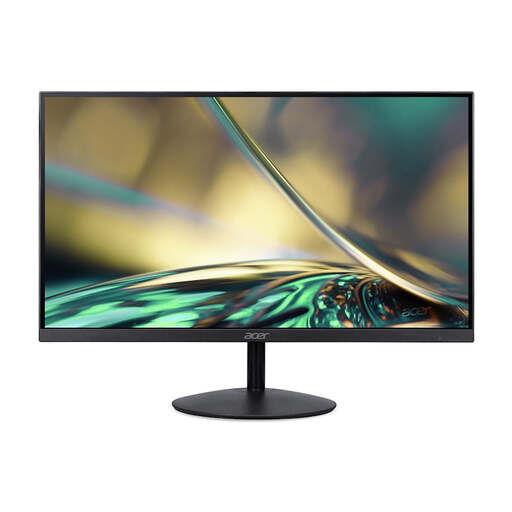
A fixed monitor of around 24 inches for everyday work and showing images to people from different viewing positions.
The product information lists Full HD, a VA panel, a 178° viewing angle, 100 Hz, 1 ms and HDMI and VGA connections. The power adapter must be purchased separately.
 No image available
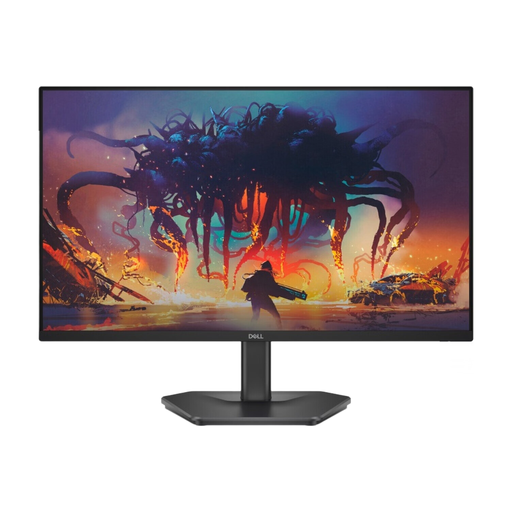
A fixed 24-inch monitor for viewing content at a workspace where others may be watching too.
The product information lists Full HD, an IPS panel, AMD FreeSync, wide viewing angles and 200 Hz. Place the monitor on a stable surface or mount it securely; the description says it is top-heavy.
 No image available
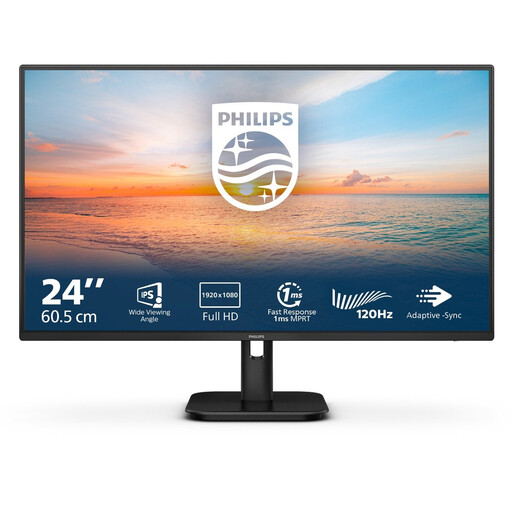
A fixed monitor for viewing content at a workspace where you also want to be able to play audio.
The product information lists a 23.8-inch IPS screen, Full HD, 100 Hz, built-in speakers and HDMI and VGA connections.
 No image available
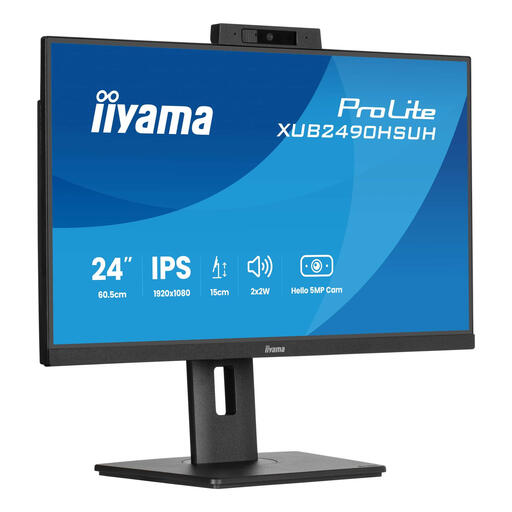
A fixed monitor for a workspace where you want to show images and need a built-in camera and microphone.
The product information lists Full HD, built-in speakers, HDMI, DisplayPort and a USB hub. The stand offers 150 mm of height adjustment, pivot, swivel and tilt.
 No image available
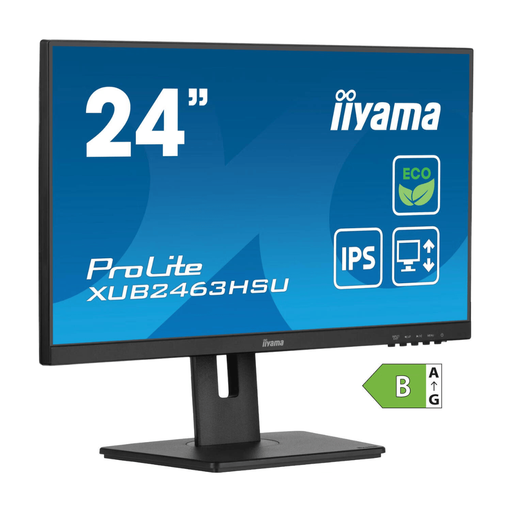
A fixed monitor for everyday desk work and showing images to others.
The product information lists a Full HD IPS screen, built-in speakers, a stand with 150 mm of height adjustment and a 100 Hz refresh rate.
Not with every monitor. LG lists speakers for the 24BA850-B. For other models, check whether they have built-in audio and whether your laptop sends audio to the output you want to use.
No. For the Philips 24E1N1300A/00, Philips describes USB-C for video, data and power when used with a compatible device; Dell lists USB-C power delivery for the P2425DE. Before relying on a single cable, check that your laptop port supports video, that it can provide the charging power you need and that the cable is suitable.
Position the screen so you can adjust it easily and avoid distracting reflections. Arboportaal sets out specific workplace requirements for employees who work with a screen for more than 2 hours a day; these requirements do not automatically apply to every private buyer.
ACM ConsuWijzer states that a typical online product purchase comes with a statutory 14-day cooling-off period after delivery, with some exceptions. There is no fixed statutory warranty period in the Netherlands: what matters is what you could reasonably expect from the product under normal use.
According to the European Commission, computer monitors are covered by the rules for electronic displays, and their energy label uses a scale from A to G. Compare the label for the exact model; it won’t tell you whether the screen will be easy for everyone in your group to see from their seats.