Who is this buying guide for?

Student with a small design desk

You want to view portfolios without the screen and stand taking over your workspace. Compare the dimensions with the stand and check which adjustment options will suit your desk. ASUS lists these details for the PA248QV, while BenQ gives the stand depth, among other measurements, for the PD2705U.

Student assessing digital colour

You want to know the colour gamut and calibration claims for the exact monitor, without assuming that this means a digital image will match a print. ASUS, BenQ and LG publish colour specifications for the models discussed here.

Student working from a laptop

You switch between studying and reviewing portfolios, and want the connection, charging power and screen position to suit your laptop and workspace. BenQ and LG list USB-C features for specific models; check that the connection you need is supported.

What should you consider when buying?

Consideration What to look for Who is it most relevant to?
Assessing colour Check the colour mode and stated colour gamut for the exact model. Don’t treat factory calibration as proof that the screen will look the same as a print. When reviewing digital portfolios, I want to know whether the colour settings suit my work, without treating a specification as proof of print accuracy. Around 29% of consumers put colour assessment first.
Desk space Measure the available width and depth, then compare them with the dimensions including the stand. Also check whether the height adjustment or VESA mounting you want is supported. At a small desk, I want to leave room for other work, so both the screen and stand need to fit. Around 29% of consumers prioritise desk space.
Viewing fine detail Compare 1920 × 1200 with 3840 × 2160 for your files and laptop. Also consider whether text remains comfortable to read at your preferred scaling setting. For fine lines and portfolio details, I want enough pixels, even if that means choosing a larger screen. Around 24% of consumers prioritise detail.
Connecting a laptop Check that your laptop supports video over the port you want to use, how much charging power it needs and which cable is suitable. USB-C alone doesn’t guarantee both a picture and enough charging power. With a laptop, I want to know in advance whether one cable can provide a picture and suitable charging power. Otherwise, I’ll allow for another connection or a separate power supply. Around 18% of consumers prioritise the laptop connection.

Which buying pitfalls can you avoid?

  • Measuring only the screen diagonal

    The monitor stand takes up space too. The ASUS PA248QV and BenQ PD2705U we looked at have different stated dimensions, so the screen diagonal alone doesn’t tell you how much room you’ll need.

    Before choosing, measure the free width and depth of your desk and compare them with the monitor’s dimensions, including the stand.

  • Treating a colour gamut as a guarantee of print accuracy

    The stated sRGB and DCI-P3 gamuts and calibration details apply to specific models. On their own, they don’t tell you how your complete screen-to-print workflow will perform.

    First decide whether you’ll be assessing digital portfolios or prints, then check the colour mode and calibration of the setup you use.

  • Assuming USB-C always provides both a picture and enough power

    To display video over USB-C, your laptop must support video through that connection; the charging power must also be suitable for your laptop. BenQ lists 65 W Power Delivery for the PD2705U. LG states that the 27UP850K-W supports up to 96 W and specifies a cable requirement for correct operation.

    Before buying, check your laptop’s video output and charging requirements, the monitor port and the right cable.

    Depending on the connection you choose, you may need a suitable cable or your laptop may still need a separate power supply.

  • Assuming there’s a fixed two-year statutory warranty in the Netherlands

    The Government of the Netherlands states that there is no fixed statutory warranty period in the country. A manufacturer’s warranty and your legal rights against the seller are not the same thing.

    Keep your proof of purchase and contact the seller if a product is faulty.

Which brands are worth considering?

ASUS

The ProArt PA248QV we looked at is a 24.1-inch option for a smaller desk and digital design work.

  • For this model, ASUS lists 1920 × 1200, 100% sRGB, factory calibration and an adjustable stand.
  • The listed video inputs are HDMI, DisplayPort and VGA; don’t assume this version supports USB-C video. The colour specifications don’t guarantee a match with a print.

BenQ

BenQ says the DesignVue PD2705U we looked at combines a 27-inch 4K screen with design-focused colour modes and USB-C.

  • For this version, BenQ lists 99% sRGB, a factory calibration report and 65 W Power Delivery over USB-C.
  • The stated stand depth is 256,8 mm. A factory report isn’t an independent measurement of the individual monitor you use.

LG

The UltraFine 27UP850K-W we looked at is a 27-inch 4K option with USB-C for connecting a compatible laptop.

  • LG lists up to 96 W charging over USB-C and an adjustable stand.
  • The stated typical DCI-P3 gamut isn’t the same as measured colour accuracy. LG also specifies a cable requirement for USB-C to work correctly.

Dell

The UltraSharp U2723QE we looked at is an example of a 27-inch 4K monitor with USB-C for a more comprehensive laptop setup.

  • For this model, Dell lists USB-C video with up to 90 W power delivery and an adjustable stand.
  • These features apply to the U2723QE and don’t, in themselves, tell you whether other models are available or whether this one will suit a small desk.

Philips

The 24E1N3300A/00 we looked at is a 23.8-inch Full HD option with USB-C for a compatible device.

  • Philips lists USB-C for video, data and power to a compatible device.
  • Full HD has fewer pixels than the 1920 × 1200 and 4K models discussed here. The stated specifications don’t, on their own, prove that this model is suitable for colour-critical design work.

Joybuy monitors for portfolios

These Joybuy picks range from compact Full HD screens to 24.1- and 27-inch models for viewing digital portfolios in a limited workspace.
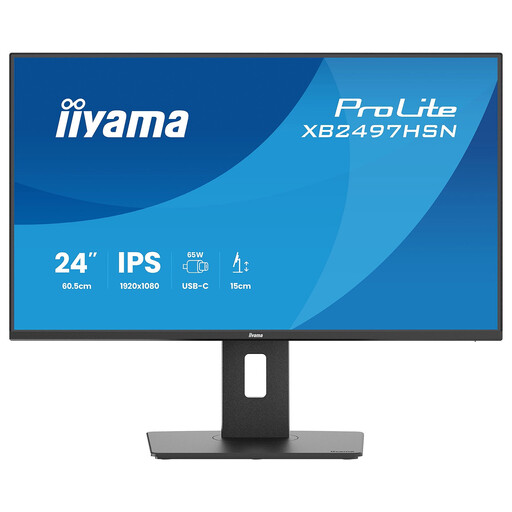
iiyama ProLite XB2497HSN-B1 monitor

iiyama ProLite XB2497HSN-B1

An option to consider if you’re looking for a compact screen for a small workspace.

The product name lists 24 inches, Full HD, 100 Hz and an IPS panel.

View at Joybuy

LG UltraGear 24G414B-B monitor

LG UltraGear 24G414B-B

A compact screen to include in your comparison for a student room.

The product name lists 24 inches, Full HD and an IPS panel.

View at Joybuy
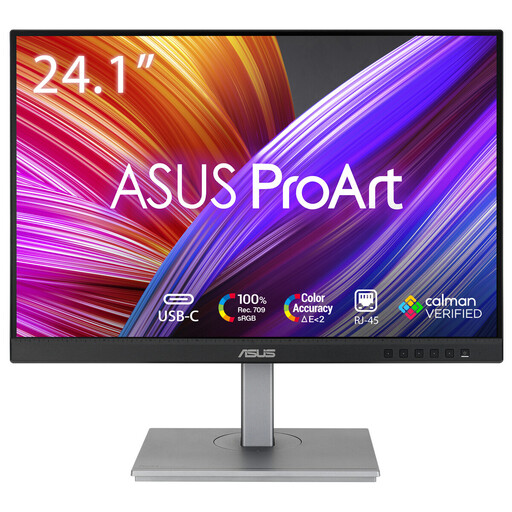
ASUS ProArt PA248CNV monitor

ASUS ProArt PA248CNV

A 24.1-inch model to compare if you view design portfolios at a compact desk.

The product name lists 1920 × 1200 pixels and Full HD+ resolution.

View at Joybuy

Philips 27E1N1800AE/00 monitor

Philips 27E1N1800AE/00

A larger screen to consider if you have room for 27 inches on your desk.

The product name lists 4K UHD, IPS, 3840 × 2160 pixels, 60 Hz, 4 ms, HDMI, DisplayPort and a height-adjustable stand.

View at Joybuy

Dell Plus S2725QC monitor

Dell Plus S2725QC

A 27-inch option to compare if you want a larger screen for fine detail and have enough desk space.

The product name lists 3840 × 2160 pixels and 4K Ultra HD.

View at Joybuy

Frequently asked questions

How can you set up a monitor practically in a small room?

First, measure the space needed for both the screen and the stand. Then adjust the screen position and lighting to suit your workspace, and minimise distracting reflections. The Dutch Working Conditions Portal (Arboportaal) highlights poor legibility and ambient light as considerations when working with screens. The specific legal workplace duties on that page apply to employers and employees.

Can any USB-C laptop display a picture and charge through a single cable?

No, simply having a USB-C port isn’t enough. Check whether the laptop supports video through that connection, how much charging power it needs and which cable is required. For the PD2705U, BenQ lists DisplayPort Alt Mode and 65 W Power Delivery; for the 27UP850K-W, LG lists up to 96 W and specifies a cable requirement.

What should you check when buying online and considering the warranty in the Netherlands?

Before ordering, check the total price and any delivery charges. According to the Government of the Netherlands, online purchases from a business are often covered by a 14-day cooling-off period. There’s no fixed statutory warranty period in the Netherlands; contact the seller if a product is faulty.

Does an energy label tell you anything about a monitor’s colour quality?

No, an energy class isn’t a measure of colour quality. The European Commission states that electronic displays, including computer monitors, have energy labels with classes from A to G. Check the energy label or product information sheet for the exact version to find its energy class.
