
Baking one small cake
You’re baking for a small group and mainly want to know whether your own cake tin will fit in the oven. For a published recipe serving four, Laura’s Bakery uses a round 15 cm tin.


For small chocolate cakes, start by measuring the diameter and height of your baking tin, then check the oven’s usable internal dimensions. Capacity in litres alone won’t tell you whether your tin will fit. A compact freestanding oven with fan and conventional heat gives you a choice of cooking modes, while a larger oven makes sense mainly if you also regularly cook larger dishes. Choose an air fryer oven only if your tin fits and you’re happy to adapt the recipe and cooking time to your appliance.
You’re baking for a small group and mainly want to know whether your own cake tin will fit in the oven. For a published recipe serving four, Laura’s Bakery uses a round 15 cm tin.
You want to choose between fan and conventional heat for your cake, rather than relying on a single automatic baking setting. The Consumentenbond describes both oven settings for a range of dishes, including cakes.
You’re looking for an appliance for small bakes and perhaps other dishes too. That means the external dimensions and the clearance needed for heat to escape are important.
| What to consider | What to look for when buying | Who is this important for? |
|---|---|---|
| Will the cake tin fit? | Measure the tin, including its rim, and compare it with the usable internal dimensions, shelf height and placement instructions for the exact model. | If you mainly use one small cake tin, you’ll want to be sure it fits and has enough room around it. Around 36% of consumers give tin fit their top priority. |
| Choice of oven setting | Check which settings are available individually and whether you can set the temperature and time manually. Follow the recipe and the instruction manual. | If you want to choose the setting for your recipe, the oven’s available settings are crucial. Around 29% of consumers put this choice first. |
| Space and energy use | Compare the external dimensions and the required clearance. To assess energy use, compare consumption for similar cooking tasks rather than looking at wattage alone. | If you bake small portions and have limited worktop space, you won’t want to choose more oven capacity than you need. Around 21% of consumers prioritise finding a suitable spot and avoiding an unnecessarily large appliance. |
| Controls and servicing | Check the timer, included accessories, removable parts, and the servicing and warranty terms. | If you bake regularly, easy operation and cleaning, along with clear guidance in the event of a fault, can make a big difference. Around 14% of consumers give these practical considerations top priority. |
The capacity in litres won’t tell you whether your tin will fit in the oven or how much room there’ll be around it. A published recipe serving four uses a round 15 cm tin.
Measure your own tin and check the internal dimensions, shelf position and instruction manual for the exact model.
A Joybuy listing for the Severin TO 2052 gives 12 litres and 1500 W in the title, but 9 litres and 800 W in the description. The figures don’t match for the same version.
Before choosing, compare the full model number and specifications with the manufacturer’s information.
According to the Rijksoverheid, the Netherlands has no fixed statutory warranty period. Your legal rights apply alongside any commercial warranty.
Check what an included or extended manufacturer’s warranty adds, and make sure you also understand your rights if a product is faulty.
The OV207B is an example of a compact 20-litre freestanding fan oven for anyone who also wants to use conventional heat.
The TO 2068 is a freestanding oven with a capacity of around 20 litres, featuring convection and conventional heat, which can be used separately or together.
The 182065 Aerofryer Oven is an alternative if you want to air-fry as well as bake a small cake.
The OV-3640 is a larger freestanding fan oven for anyone who cooks larger dishes as well as cakes.
This Joybuy selection includes freestanding ovens for baking, from compact models to larger versions. For each model, check the usable internal dimensions and the space available for your cake tin.
 No image available
A compact oven to consider if you bake small cakes; check that your tin fits in the usable oven space.
 No image available
A mini oven to compare if you bake small batches; measure your tin and check this model’s internal space first.
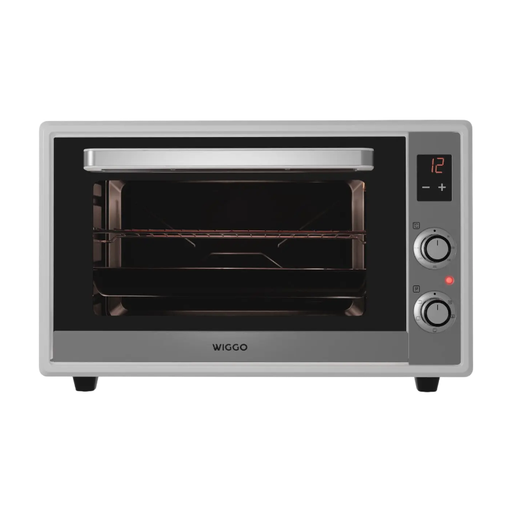 No image available
A larger oven to consider if you want to cook bigger dishes as well as small cakes.
The product name lists a capacity of 65 litres and a power rating of 2000 W. Compare its external dimensions and placement instructions with the space available.
 No image available
This larger version is an option if you regularly cook other or larger dishes as well as small cakes.
The product name lists 45 litres, 2000 W and the colour white. Check that its size suits your worktop and how you’ll use it.
 No image available
An oven with an integrated hob to compare if you’d also use that combination for other types of cooking.
The product name lists 45 litres, 60 cm and 3534 W. Check that both the appliance and hob suit your available space and needs.
No, conventional heat can also work well for cakes. The Consumentenbond recommends this setting for sponge cakes and other cakes; fan heat circulates the air and is often used at around 20 °C lower than conventional heat. Don’t treat this as a fixed conversion for every recipe or oven.
Follow the placement and cleaning instructions in your model’s manual. The Brandweer stresses that heat must be able to escape from around ovens and other appliances; check the relevant manual for the required clearance.
No, the stated power rating isn’t the same as the electricity used for each baking session. Milieu Centraal recommends comparing consumption per use or per year, and choosing a size that suits how you’ll use the oven.
According to the Rijksoverheid, the seller must provide an appropriate solution if a product is faulty. The Netherlands has no fixed statutory warranty period; a manufacturer’s or extended warranty is an extra and doesn’t replace your legal rights.
The Nederlandse Voedsel- en Warenautoriteit states that electrical products must carry a CE marking. Check the marking and product information for the item you’re considering; this requirement alone doesn’t confirm that a specific model has been individually tested or approved.