Who is a small bread maker suitable for?

Baking one small loaf

If you’re baking for a small household, focus on the machine’s smallest loaf setting. The stated minimums for the models mentioned range from around 400 to 650 g. Panasonic and the other manufacturers list these settings for their models.

Planning a weekend breakfast

If you want to prepare the ingredients in advance and have the bread ready around breakfast time, compare both the timer and the duration of the programme you plan to use. Panasonic and Inventum list timers of up to 13 hours.

Mixing things up at home

If you sometimes bake a larger loaf or try a different recipe, check which loaf weights and programmes are actually available on the model. For example, DOMO lists 500, 750 and 1000 g settings for the B3978.

What should you look for when choosing one?

What to consider What should you check? Who is this important for?
Smallest loaf weight Check the smallest official weight setting and the recipe for it. A high maximum weight tells you nothing about the minimum loaf size. If I mainly want to bake one modest loaf for the weekend, I want to avoid making more than we can eat. Around 40% of consumers prioritise the smallest loaf weight.
Having the loaf ready on time Check the timer and the duration of the specific baking programme so you know when the loaf will be ready. If I want to plan the baking in advance, the start time needs to work with our weekend breakfast. Around 30% of consumers prioritise timing.
Other recipes and loaf sizes Compare the supported loaf weights and programmes. Also check whether you add extra ingredients manually or automatically. If I sometimes bake a different size loaf or recipe, I want to know which settings I can actually use. Around 20% of consumers prioritise that flexibility.
Cleaning and running costs Check how to clean the bread pan. When comparing machines, also take ingredients, electricity and any replacement parts into account. If I only use the machine occasionally, I want to know how much maintenance it involves and which running costs I need to factor in. Around 10% of consumers make this their main priority.

Common buying mistakes

  • Looking only at the maximum loaf weight

    For one weekend loaf, the smallest official setting is what matters. According to their manufacturers, the models covered here start at different weights, from around 400 to 700 g.

    Check the smallest setting and the recipe that goes with it. Decide in advance whether you’re happy to freeze any leftovers; the Netherlands Nutrition Centre lists freezing as one way to store bread.

  • Assuming a gluten-free programme prevents cross-contamination

    A programme on the machine won’t automatically stop gluten getting into your bread through ingredients or baking equipment. The Netherlands Nutrition Centre warns that even a crumb containing gluten can cause symptoms for people with coeliac disease.

    Check the ingredients and make sure the equipment you use is free from gluten contamination.

  • Assuming home baking is automatically cheaper if you only bake occasionally

    Costs depend on factors such as the ingredients and how often you bake. So a general claim about savings won’t tell you what one weekend loaf will cost you.

    For your own usage, compare the cost of making the same-sized loaf and include electricity, maintenance and any replacement parts as well as ingredients.

  • Confusing an extra warranty with your statutory rights

    A commercial warranty doesn’t automatically replace your statutory rights. The Dutch government doesn’t set a fixed statutory warranty period; what you can reasonably expect from a product also matters.

    Compare the terms of any extra cover with your existing rights, and contact the seller if there’s a fault.

Brands to compare

Panasonic

The SD-PN100KXE is a mini bread maker for anyone looking for a loaf size of around 400 g.

  • Panasonic lists 18 programmes, including four gluten-free programmes, and a 13-hour timer.
  • The stated dimensions are 255 × 307 × 290 mm. Check that it will fit on your worktop and that around 400 g is enough for your portions.

Princess

According to the model information, the 152007 is designed for loaf weights of 500 to 750 g.

  • Princess lists 19 programmes and a timer.
  • The compatible kneading blade is listed as a part for model 152007. Check whether it’s included with your machine or needs to be bought separately.

DOMO

According to DOMO, both the B3978 and B3971 have settings for 500, 750 and 1000 g.

  • DOMO lists a DIY programme for the B3978. For the B3971, the brand lists an ingredients dispenser.
  • The dispenser is included with the B3971, not the B3978. Check the full model number before choosing a machine for this feature.

Inventum

The BM55 is worth considering if its smallest loaf setting of 650 g suits your portions.

  • Inventum lists settings for 650 and 800 g, 12 programmes and a signal to let you know when to add ingredients manually.
  • Inventum recommends washing the bread pan by hand. Its smallest setting is larger than those on the models mentioned with minimums of around 400 or 500 g.

Rommelsbacher

The BA 550 could be a good fit if a minimum loaf weight of 700 g is acceptable and you want ingredients added automatically.

  • Rommelsbacher lists an automatic ingredient dispenser, 13 programmes and settings for 700 and 900 g.
  • Its smallest stated loaf setting is larger than those on the options mentioned with minimums of around 400 or 500 g. Compare that portion with how much you’ll eat over the weekend.

Bread makers at Joybuy

This Joybuy selection includes adjustable bread makers from 500 g upwards, as well as models with a higher minimum loaf weight. Check that the stated minimum for each model suits your weekend portions.

Tefal Pain Doré PF2101 bread maker

Tefal Pain Doré PF2101

An option if you want an adjustable loaf weight and a timer to schedule your baking.

The product description lists loaf weights of 500, 750 and 1000 g, 12 programmes, three crust settings and a timer of up to 15 hours.

Joybuy

Tefal PF250135 bread maker

Tefal PF250135

An adjustable option if you want to bake from 500 g and an automatic dispenser is important to you.

The description lists 700 W, 20 programmes, three weight settings with a minimum of 500 g and a timer of up to 15 hours. It also mentions gluten-free options and a removable non-stick bread pan.

Joybuy

Tefal PF251835 bread maker

Tefal PF251835

A model to compare if you want to make dough as well as bread and schedule the start in advance.

The product name lists 610 W, while the description mentions 12 programmes, a delayed start and a keep-warm function. It also lists low-salt and gluten-free programmes.

Joybuy

Tefal PF610138 bread maker

Tefal PF610138

This model is worth comparing if you also want to bake larger loaves; its smallest stated setting is 750 g.

The product name lists 1600 W. The description mentions 16 automatic programmes, loaf weights from 750 g to 1.5 kg, a delayed start and a viewing window.

Joybuy
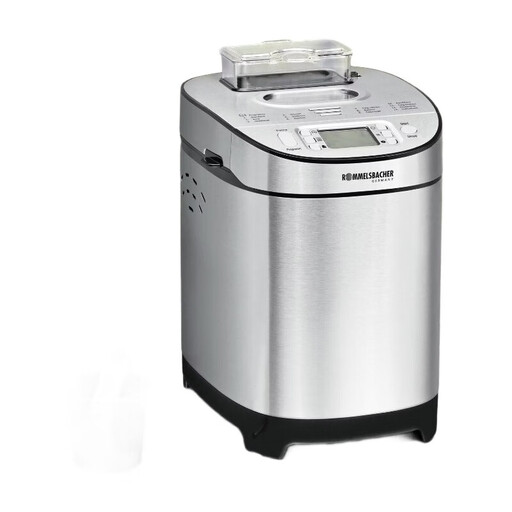
Rommelsbacher BA 550 bread maker

Rommelsbacher BA 550

An option if a loaf weight of 700 g or more suits you and you want nuts or other extras dispensed automatically.

The product description lists settings for 700 and 900 g, 13 programmes, an automatic ingredient dispenser and a 13-hour timer.

Joybuy

Frequently asked questions

Can I simply halve a recipe for a large loaf?

Use a supported loaf weight and the recipe for that setting as your guide, rather than relying on the maximum capacity alone. According to their manufacturers, the models covered here start at around 400, 500, 650 or 700 g. There’s no guarantee that an arbitrary halved recipe will turn out well.

What can I do with bread left over at the weekend?

You can freeze bread. The Netherlands Nutrition Centre advises against storing it in the fridge, as this dries it out.

How do I clean a bread maker with a non-stick pan?

Follow the instructions for your chosen model. Inventum recommends washing the BM55’s bread pan by hand and avoiding ingredients that could damage the non-stick coating. This advice doesn’t automatically apply to every other model.

Does a gluten-free programme make the bread suitable for someone with coeliac disease?

No. A programme alone doesn’t rule out cross-contamination. The Netherlands Nutrition Centre warns that even a crumb containing gluten can cause symptoms. Check the ingredients and prevent contamination from the equipment you use.

Who should I contact if my bread maker develops a fault?

If you’re in the Netherlands and there’s a fault, contact the seller. The Dutch government says there’s no fixed statutory warranty period and that the seller must provide a solution, depending on what you can reasonably expect from the product.
