
If you usually make one serving
You usually make one small berry smoothie and want to know whether the cup is a practical size for it.


For a single small berry smoothie, a personal blender with a cup sized to suit your portion is a sensible first choice; a large jug isn’t automatically more convenient. If you often use frozen berries, check whether the manufacturer recommends this use for the exact model, then weigh that against how easy it is to clean and take with you. The Consumentenbond describes both small blending cups you can take with you and standard blenders for smoothies; manufacturer specifications aren’t a comparative blending test.
You usually make one small berry smoothie and want to know whether the cup is a practical size for it.
You often use berries from the freezer and are looking for a model whose manufacturer explicitly describes this use, without treating wattage as a blending test.
Your choice mainly depends on how you clean the parts or whether you want to take your smoothie with you. These are different reasons to compare the cup and lid.
First decide whether you mainly want to blend frozen berries or take your smoothie with you afterwards. Then compare the usable cup capacity and the cleaning instructions for the exact model.
| What to consider | What to check before buying | Who might value this more? |
|---|---|---|
| A cup for one serving | Compare the usable filling capacity with your recipe and check whether a drinking lid is included. | I usually make one small berry smoothie and want a cup that suits it without having to pour it into another container unnecessarily; around 33% of consumers prioritise a suitable serving size. |
| Frozen berries | Look for information specific to the model about frozen ingredients and follow its instructions for use. | If I often use berries from the freezer, I want to know whether the manufacturer recommends this for the model I’ve chosen; around 27% of consumers prioritise suitability for frozen ingredients. |
| Cleaning | Check which parts can be removed and are dishwasher-safe. | If I blend often, I want to be able to clean the cup, blade and seal without any uncertainty; around 20% of consumers prioritise their cleaning routine. |
| Taking it with you or blending on the go | Decide where you want to blend and check whether a drinking lid is included; choose a rechargeable battery only if you also want to blend away from a socket. | I want to take my smoothie with me or make it somewhere without a power socket; around 20% of consumers prioritise this kind of portable use. |
The stated motor power is a specification, not a measured result for your quantity of berries and liquid.
Check whether the manufacturer mentions frozen ingredients for the exact model and follow its instructions for use. Treat claims about a smooth result as manufacturer claims.
The capacity when blending may differ from the maximum capacity without the blade fitted.
Compare the usable capacity with your recipe and check which cup and blade are compatible with the model before ordering an extra part.
A travel cup lets you take a smoothie made at home with you; a cordless blender lets you blend away from a power socket and needs to be charged.
Choose a cordless model only if you actually want to blend somewhere without a power socket. If you blend at home, a suitably sized cup with a drinking lid may be enough.
The VitaPower Serie 2 MMB2111S is a personal blender for people who often use frozen fruit.
The Blend & Go HR2670/01 is designed for compact blending in a portable cup.
The Original NB603DG and Flex NBP013BL are separate personal blender options; the Flex is designed for use without a power socket.
The PowerBlend 1 JB1051BK combines a jug with an included smoothie-to-go bottle.
These Joybuy products are designed for small smoothie portions, with differences in cup size, portability and listed features.
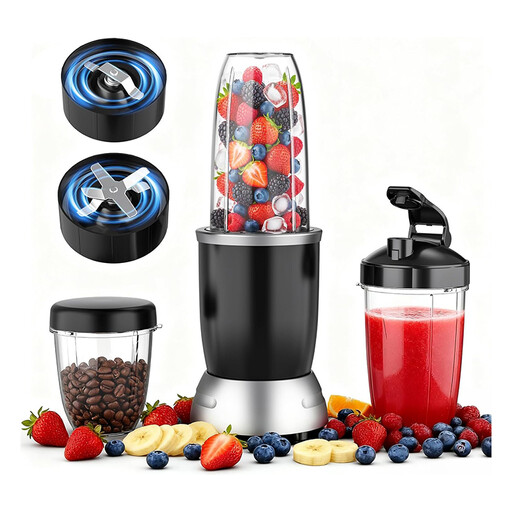 No image available
The product name lists a blending function and three travel mugs, which may be useful if you want to take your smoothie with you.
The product name also lists a 1200 W motor. This is a specification, not a comparative blending test.
 No image available
This mini blender may suit a small portion; check the usable capacity for your own recipe.
The product name lists 0.6 l, 350 W and ice crushing. These details alone don’t determine the result when making berry smoothies.
 No image available
Compare the stated capacity with the amount you want to make and check that the cup is suitable for your recipe.
The product name lists a glass jug and 250 W. If taking your smoothie with you matters, check whether the version you’ve chosen includes a drinking spout lid.
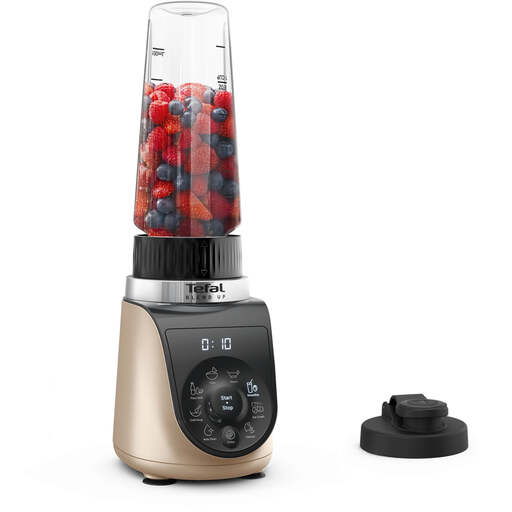 No image available
The product name positions this as a personal smoothie blender. Check which cup is included and read the instructions for using it with frozen berries.
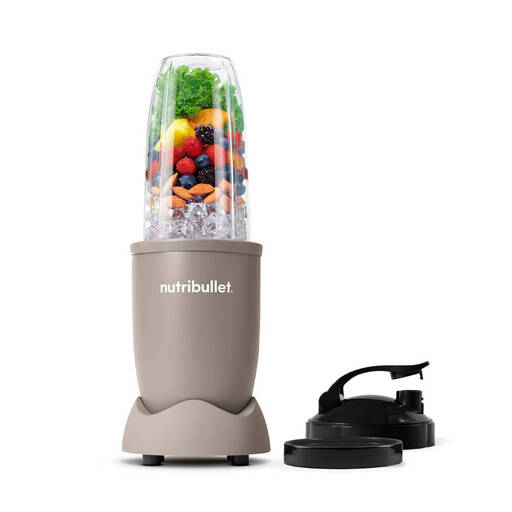 No image available
The product name lists a 700 ml cup and a to-go lid; compare the capacity with your portion and consider whether you want to take your smoothie with you.
The product name also lists 900 W and included accessories. For frozen berries, check the instructions for this exact version.
Compare your usual ingredients and desired quantity with the usable filling capacity, rather than relying on a capacity label alone. For example, Bosch distinguishes between the usable capacity when blending and the maximum capacity without the blade for a separate to-go cup.
This varies by model and part. For the Original NB603DG, nutribullet says the cup can go on the top rack and the blade should be rinsed with soap and water; Bosch lists dishwasher-safe parts for the MMB2111S. Follow the manual for your exact model.
There are safety requirements for materials that come into contact with food. The NVWA states that producers and importers are responsible for placing safe products on the market, and that products aren’t all approved in advance. Before a CE mark can be applied, you must first establish which European product rules apply to the electrical appliance.
In the Netherlands, the retailer is responsible for the statutory guarantee. According to the Authority for Consumers and Markets, the retailer must offer an appropriate free solution if the product doesn’t meet what you could reasonably expect during normal use; a manufacturer’s guarantee doesn’t replace this right.
According to Milieu Centraal, you can return an old electrical appliance free of charge when buying a new, similar appliance, including when you buy online. There are also collection points for small appliances; check whether your appliance fits within the dimensions of the collection bin.