
Vandaag of morgen in huis

Kwaliteit gegarandeerd

Welkomstaanbiedingen ontgrendelen: GRATIS bezorging | Tot 80% korting | Gratis 30 dagen JoyPlus-proefperiode
Download de app
A slow juicer can seem like an appealing way to make fresh fruit and vegetable juices, but marketing claims don’t always tell the whole story. A wide feed chute, for example, is useful, but says nothing about the capacity of the juice container or how easy the machine is to clean. Terms such as ‘quiet’, ‘powerful’ and ‘cold press’ should also be checked against the product specifications.
For UK households, these are the three main pitfalls to watch out for:
A slow juicer typically presses ingredients at a low speed using a pressing mechanism. A centrifugal juicer works differently: it grates ingredients and separates the juice using a spinning sieve. An electric juicer with a high wattage may therefore be designed for different uses from a cold press juicer.
Don’t just look at the product title. Check:
For example, the WOOX MX0289 is specified for a maximum of 10 minutes’ continuous use, followed by a 20-minute cooling period. This is important if you want to make juice for several people at once.
A juicer with a wide feed chute means less chopping. The WOOX MX0289 has a feed chute measuring up to 130 mm. The Bosch MES4000 has an 84 mm feed chute. A wide opening is particularly useful for apples, pears and chunks of vegetables, but always check the permitted sizes and preparation instructions.
The container capacity determines how often you’ll need to stop:
A large container isn’t automatically more convenient if it means the machine takes up more space or is harder to clean.
A juicer that’s easy to clean has removable parts, an accessible filter or juicing chamber, and clear care instructions. Check whether the parts are dishwasher-safe and whether the motor base must only be wiped clean with a damp cloth.
Noise levels are only comparable if they’ve been measured in the same way. The WOOX MX0289 has a stated noise level of less than 72 dB. The noise level of the Bosch MES4000 isn’t specified, so don’t make assumptions based on the product name alone.
Also look for:
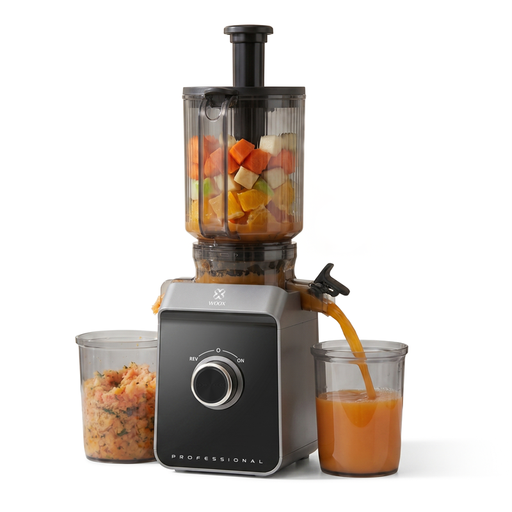
Why it suits this profile: This compact model has a 150 W motor, a wide feed chute measuring up to 130 mm, and a juice cup with markings up to 600 ml. It’s a good fit for beginners who regularly make one or two glasses of juice.
The specifications list removable, washable parts and overheat protection. Do bear in mind that continuous use is limited to 10 minutes.
150 W motor, wide feed chute, 836 ml pulp container and a stated noise level of less than 72 dB.
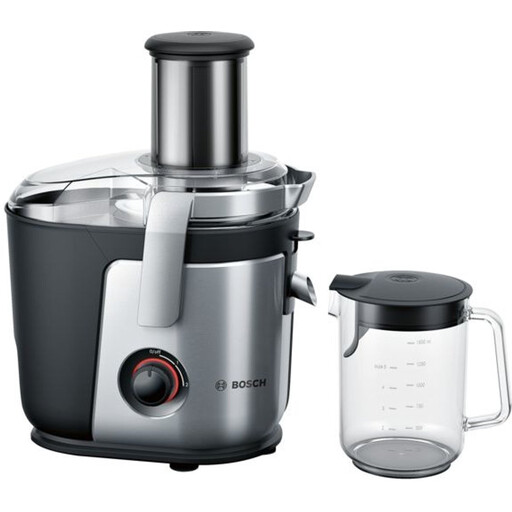
Why it suits this profile: The Bosch MES4000 is a powerful electric juicer for households that want to make larger quantities of juice and process both soft and hard ingredients.
The 84 mm feed chute reduces the amount of chopping needed. The product specifications also list removable, dishwasher-safe parts.
1000 W power, two speeds, a 1.5-litre juice jug and a 3-litre pulp container.
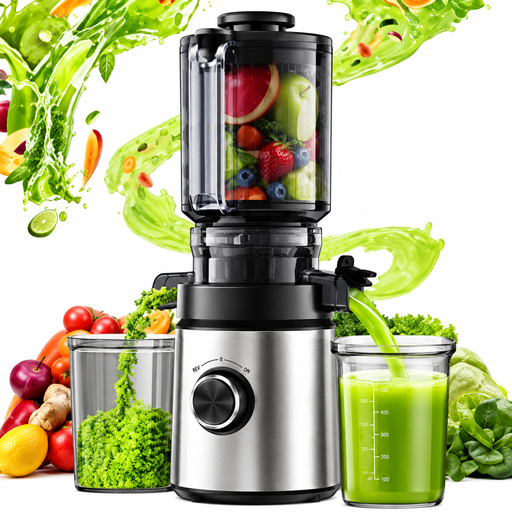
Why it suits this profile: The product title lists a 2-litre capacity, a 130 mm feed chute and two glasses. This makes it a good option for families who want to prepare several servings.
The wide feed chute can reduce the amount of chopping needed. Before buying, check the full details on materials, cleaning, running time and safety.
According to the product title: 2-litre capacity, 130 mm XL feed chute and two glasses included.
We’ve put together a complete, up-to-date list of products that meet these strict selection criteria and current European safety regulations.
Yes, models in this category are generally designed for fruit and vegetables, but the ingredients you can use vary from one appliance to another. Cut long, fibrous vegetables as instructed in the manual and remove any hard stones. For example, the WOOX MX0289 is not suitable for frozen fruit, ice cubes, sugar cane or coconut.
Its lifespan depends on how it’s used and maintained, as well as the availability of replacement parts. Clean removable parts after every use, avoid overloading the machine and stick to the maximum continuous running time. Let the motor cool down when instructed to do so in the manual.
Energy use depends on the motor’s wattage and how long you use the machine. A 150 W appliance uses less power per hour than a 1000 W model, but the actual cost depends on how long you run the machine. So compare the wattage with the amount of juice you want to make in each session.
