
Vandaag of morgen in huis

Kwaliteit gegarandeerd

Welkomstaanbiedingen ontgrendelen: GRATIS bezorging | Tot 80% korting | Gratis 30 dagen JoyPlus-proefperiode
Download de app
A slow juicer can be a useful addition to households that want to make their own juice regularly. However, not every appliance called a slow juicer, juice extractor or cold press juicer is suitable for the same ingredients. Choosing the wrong one can mean lots of chopping, a tricky clean-up or an appliance that barely gets used after a few weeks.
So don’t just look at the wattage or marketing terms such as “professional”. Focus on the feed chute, capacity, cleaning, permitted ingredients and how the appliance works.
A juicer with a wide feed chute can cut down on preparation, but always check its actual diameter. An 8 cm opening is practical for chunks of apple, cucumber and carrot. A 13 cm opening could save you even more preparation time, but it doesn’t mean that every ingredient can go in whole and uncut.
Hard stones, skins, stalks and fibrous pieces often need to be removed or cut smaller first. Always follow the instructions in the manual.
A 1,000-watt electric juicer may be suitable for making juice quickly, but its power rating tells you little about noise levels, the juice jug, filter type or cleaning. A slow juicer typically uses a slower pressing method, while a centrifugal juice extractor works with a spinning sieve.
These points also matter for everyday use:
A juicer that’s easy to clean should ideally have few separate parts, smooth surfaces and a filter you can reach with a brush. Check whether “easy to clean” means the parts are dishwasher-safe, or simply that they can be removed.
Also be aware of the difference between a BPA-free juicer and a general food-safe construction. BPA-free means that, according to the product information, the material in question does not contain bisphenol A. It doesn’t automatically tell you anything about the appliance’s other features.
A large juice jug or generous pressing chamber is practical for families. According to its product specifications, the WOOX MX0289 has a 1.8-litre pressing chamber, a juice jug marked up to 600 ml and an 836 ml pulp container. The Philips HR1919/70 has an 8 cm feed chute. As well as checking the capacity, look at the appliance’s dimensions: a tall juicer may not fit easily beneath your kitchen cupboards.
A quiet juicer is handy in an open-plan kitchen or when you’re making juice early in the morning. You can only compare models if an official decibel rating is provided. The WOOX MX0289 is listed as having a noise level of less than 72 dB. That’s a product specification, not a guarantee that every user will find the appliance quiet.
Check the maximum operating time too. According to the WOOX information, the appliance must not run continuously for more than 10 minutes, after which the motor needs to cool down for 20 minutes. This matters if you want to make several litres of juice in one go.
A slow juicer for fruit and vegetables is designed to process ingredients using a pressing or auger system. A centrifugal juicer, such as the Braun MultiJuice 7, uses a spinning sieve and is designed for quick juicing.
A citrus press is a separate category. The 40-watt Aigostar is designed for citrus fruit, has a 700 ml capacity and, according to its safety information, must not be used for hard fruit. So don’t use a citrus press as a substitute for a slow juicer if you also want to process carrots, celery or leafy greens.
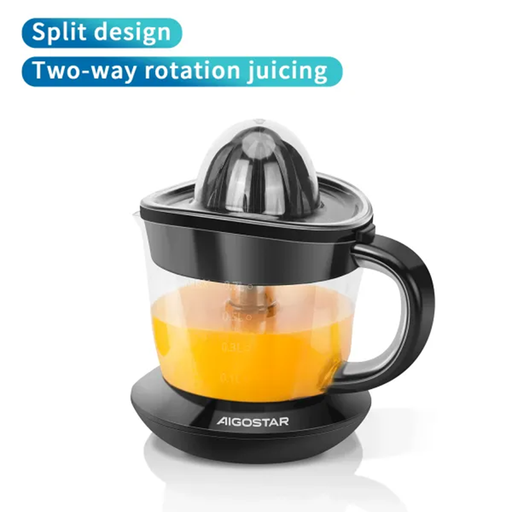
Why it suits this profile: This compact appliance is designed for citrus fruit and has a 700 ml capacity, enough for several glasses of orange or grapefruit juice.
The product information makes it clear that this is a citrus press and isn’t designed for hard fruit. You’ll know in advance which ingredients are suitable.
40 watts, 700 ml capacity, two directions of rotation and two juicing cones. The parts are removable, and the material is described as BPA-free.
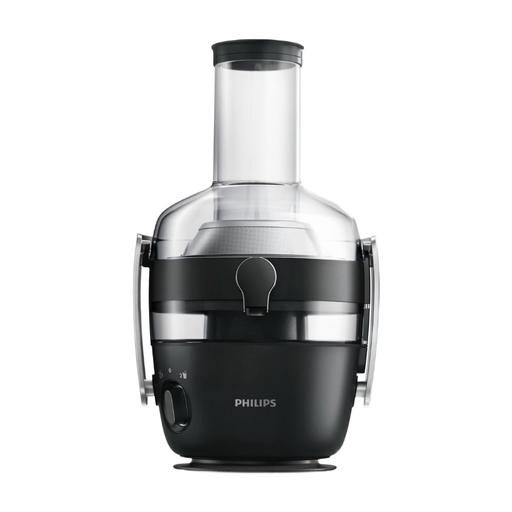
Why it suits this profile: This electric juicer combines an 8 cm feed chute with a 1,000-watt motor and features designed for everyday use.
The QuickClean and pre-rinse functions are clearly described. The removable parts are also dishwasher-safe, according to the product information.
8 cm feed chute, 1,000 watts, adjustable texture according to Philips’ product information, drip stop and BPA-free plastic.

Why it suits this profile: The wide feed chute and large pulp container are practical for households that regularly make juice from a variety of fruit and vegetables.
The product specifications state that it has a 130 mm opening, overheat protection and a maximum continuous operating time of 10 minutes.
150 watts, 1.8-litre pressing chamber, 836 ml pulp container, stated noise level below 72 dB and BPA-free materials according to the product information.
We’ve put together a complete, up-to-date list of products that meet these strict selection criteria and the applicable European safety regulations.
It depends on the model. Check whether the manufacturer says the appliance is suitable for hard and fibrous ingredients. Cut carrots and long fibres, such as celery, into smaller pieces as instructed in the manual. A citrus press isn’t suitable for this.
Its lifespan depends on how it’s used and maintained, as well as the permitted operating time per session. Rinse the parts after use, avoid overloading the appliance and don’t use ingredients that the manual says aren’t suitable. A motor with overheat protection can provide extra protection, but it doesn’t replace proper use.
Electricity consumption depends on the power rating and how long the appliance is used. A 150-watt appliance running for 10 minutes uses approximately 0.025 kWh in theory. A 1,000-watt model uses approximately 0.167 kWh over the same period. In practice, breaks, preparation and cleaning also contribute to the overall use.
