
Cook with a narrow worktop
You make small batches of stock and want to know whether the appliance, its handles and the open lid will fit in the space available.


A compact slow cooker is a sensible starting point for small batches of vegetable stock. If you want to make larger quantities, you could also compare a bigger model. Before buying, measure the space available, allowing room to open the lid, and check the manual for how much veg and water the cooking pot can hold. The stated pot capacity doesn’t automatically tell you how much stock you’ll end up with.
You make small batches of stock and want to know whether the appliance, its handles and the open lid will fit in the space available.
You want to make and store more stock in one go. Usable pot space and room for the veg and water matter more to you than finding the smallest possible appliance.
You want to do more than slow cook, so you’re comparing a standalone slow cooker with an appliance that combines several functions.
First decide how much stock you want to make at a time and how much space you have. Then compare the filling instructions and controls of the models that fit your needs.
| What to consider | What should you check? | Who is this important for? |
|---|---|---|
| Will the appliance fit on your worktop? | Measure the available space, allowing room around the appliance and above the lid. Compare these measurements with the external dimensions of the exact model. | If your worktop is narrow, you’ll also want to be able to open the lid without moving anything. Around 36% of consumers give finding a suitable spot the highest priority. |
| How much stock will you make at a time? | Decide how much you want to make, then compare this with the maximum fill level and the space taken up by the veg and water together. | If you want to save portions for later, the amount you can make in one go matters. Around 29% of consumers prioritise batch size. |
| Do the controls suit your routine? | Check the cooking settings and whether the model has a timer if you need one. The keep-warm setting is not the same as setting a cooking time. | If you want to fit cooking around your daily routine, the settings and timer are important. Around 21% of consumers focus mainly on cooking-time controls. |
| Cleaning and other functions | Check which parts are removable and which extra functions you’ll actually use. | If you have limited cupboard space or want one appliance for different cooking tasks, ease of cleaning and versatility matter. Around 14% of consumers give these factors the highest priority. |
The percentages shown represent the share of consumers with each of these priorities when choosing a slow cooker for making vegetable stock in a narrow kitchen.
Veg and herbs take up space too, and the yield from a recipe is not the same as the capacity of the pot.
Compare your recipe with the maximum fill level for the exact model, not just the stated pot capacity.
A smaller usable batch may mean cooking more often or needing extra storage containers.
Even a model described as compact takes up space once you account for its body, handles and lid.
Measure the space and check the full external dimensions before choosing a model.
A keep-warm setting doesn’t tell you how long the appliance will cook for. For example, Tristar describes the VS-3915 as having a keep-warm function but no timer.
Check the controls on the exact model and read the manual if setting a cooking time is important for your routine.
Russell Hobbs lists both a 2-litre and a 3.5-litre slow cooker, giving you two pot capacities to compare within the same brand.
The Tristar VS-3915 is a standalone slow cooker with a stated pot capacity of 3.5 litres.
A Dutch retailer describes a 2.8-litre rice cooker that can also slow cook and steam.
Tefal describes the All-in-One CY505E as a multi-cooker with a slow-cook programme and a stated capacity of 6 litres.
These products are suited to slow-cooking vegetable stock, with options for medium-sized batches and appliances that offer other cooking functions too. Before buying, check the model’s external dimensions and filling instructions.
 No image available
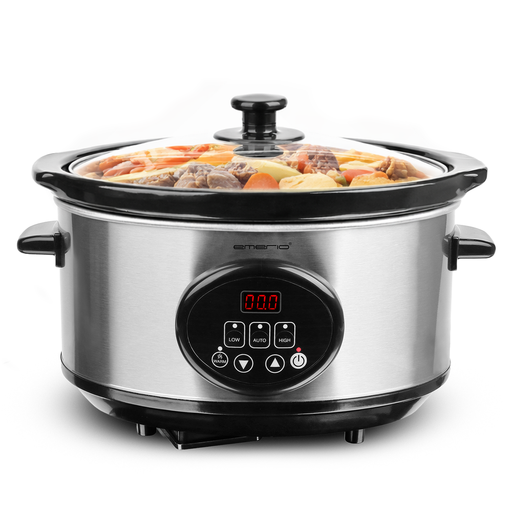
An option to compare if you want to make a medium-sized batch; check that its external dimensions will fit on your worktop.
Joybuy lists a 3.5-litre capacity, a digital display and a keep-warm function.
 No image available
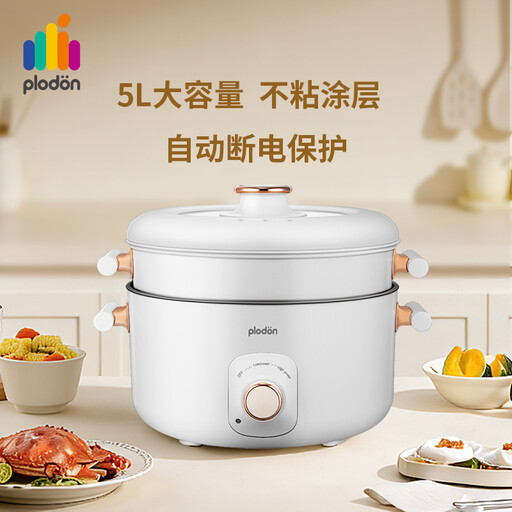
An option if you want other cooking functions as well as slow cooking; check whether the appliance and included steamer will fit in your kitchen.
The Joybuy listing gives a rating of 1200 W, a capacity of 5 litres, a steamer and dual heat control.
 No image available
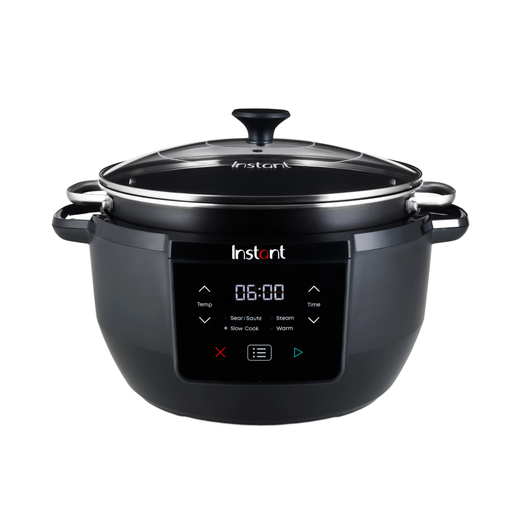
A larger pot to compare if you want to make more stock at a time; measure the space available first.
Joybuy lists a 7.1-litre capacity, slow cooking, sautéing and steaming; the product name states that it serves 10.
 No image available
A smaller model to compare if you mainly want to make modest batches; check its physical dimensions against the space on your worktop.
The Joybuy listing gives a rating of 1000 W, a capacity of 2.6 litres and three manual heat settings.
 No image available
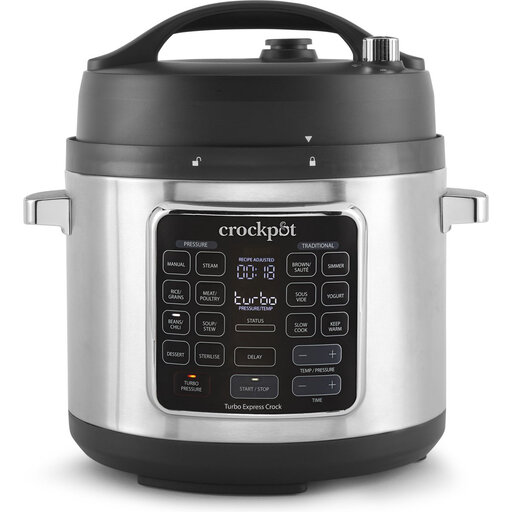
A larger slow cooker to compare if you want to make a bigger batch; check the available worktop space.
The Joybuy listing gives a capacity of 5.6 litres and three settings.
A published recipe from Eetspiratie uses five hours on the low setting to make stock from vegetable scraps. This is one recipe example; the time needed can depend on the quantity, ingredients and slow cooker.
Cool the stock quickly, then cover and put it in the fridge or freezer within two hours. The Netherlands Nutrition Centre advises keeping leftovers in the fridge for no more than two days. If necessary, divide a large quantity between suitable containers to help it cool more quickly.
Yes. The Netherlands Food and Consumer Product Safety Authority states that CE marking is compulsory for the electrical consumer products discussed, including kitchen appliances. A CE mark is not an independent quality test and, on its own, does not prove that a specific appliance meets every requirement.
No. According to ACM ConsuWijzer, you may also be entitled to a statutory guarantee if a product breaks sooner than you could reasonably expect under normal use. In that case, the retailer is responsible for offering an appropriate solution. Your statutory rights depend on the product and the circumstances, not on a fixed guarantee period in years.