
Cook with limited kitchen space
If you make small portions and want to put the appliance away after use, a compact pot may be more practical than a larger one. Russell Hobbs lists the Compact Home as having a 2-litre capacity.


You don’t need a slow cooker just to heat beans: the Netherlands Nutrition Centre advises heating tinned pulses according to the instructions on the label. A slow cooker can be useful for a more substantial stew, though. If you’re considering one, think about portion sizes, available space and controls – and don’t use it to slowly reheat chilled leftovers.
If you make small portions and want to put the appliance away after use, a compact pot may be more practical than a larger one. Russell Hobbs lists the Compact Home as having a 2-litre capacity.
If you regularly cook for several housemates, consider both the pot capacity and where the appliance will sit and be stored. Tristar lists the VS-3915 as having a 3.5-litre pot.
Planning the cooking time can be useful when you’re making a stew. For leftovers, it’s still important to store them safely and reheat them thoroughly later; a timer doesn’t replace this.
First decide whether you want to heat tinned beans or make complete stews as well. Then compare the number of portions you need with the worktop and storage space available. Only then choose between manual controls and a timer.
| What to consider | What to look for | Who might this matter more to? |
|---|---|---|
| Space and portions | Compare the pot capacity with the meals you usually make, and check the external dimensions and storage space required for the model you’re considering. | If I make small portions in a shared kitchen, I don’t want an appliance that takes up unnecessary space. Space and portion size are the main reason for around 36% of consumers. |
| Cooking and leftovers | Heat tinned beans according to the label. Chill leftovers promptly and reheat them thoroughly later; the Netherlands Nutrition Centre advises heating leftovers until steaming hot. | I want to know whether slow cooking adds anything and how to handle leftovers safely. Cooking method and food safety come first for around 29% of consumers. |
| Planning the cooking time | Check whether the model you choose actually has a timer, and distinguish between a cooking timer and a keep-warm setting. | If housemates use the kitchen at different times, I want to be able to plan the cooking time. This feature is the main reason for buying for around 21% of consumers. |
| Cleaning | Check the instructions for the pot, lid and electrical base separately. Tristar warns against immersing the base, cable or plug in water. | After sharing the appliance, I want the pot to be easy to clean and to know which parts can get wet. Cleaning is the main priority for around 14% of consumers. |
According to the Netherlands Nutrition Centre, tinned pulses have already been heated sufficiently. So if you only want to heat them up, an extra appliance may be unnecessary.
First decide whether you just want to heat something up or make a more substantial stew.
If you only want to heat food, a slow cooker could be an extra appliance that you have to put away after use.
Slow reheating can keep leftovers at unsafe temperatures for too long. The Netherlands Nutrition Centre advises reheating leftovers until steaming hot throughout; the USDA advises against reheating food in a slow cooker.
Chill leftovers promptly and reheat them thoroughly later using a suitable method. Don’t use the keep-warm setting instead of chilling or reheating.
The examples listed range from 2 to 4.5 litres in capacity. This figure doesn’t tell you how much worktop or cupboard space the appliance itself will take up.
Measure the space available and check the external dimensions of the specific model.
The Dutch product information lists the Compact Home 25570-56, a slow cooker with a stated capacity of 2 litres.
The Dutch manufacturer describes the manual 3.5-litre VS-3915 and the digital 4.5-litre VS-3920.
The British manufacturer lists the 2.4-litre CSC061X with a digital timer and the 3.5-litre CSC060X with a hinged lid.
This selection includes slow cookers for anyone who wants to make a stew as well as heat tinned beans. Check that the specific model has the required CE marking: the Government of the Netherlands states that it is required for electrical products placed on the EU market.
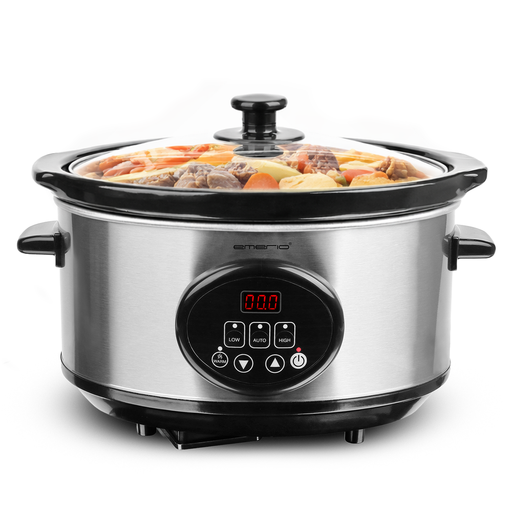 No image available
An option to consider if you want to make a stew for several housemates.
The product name lists a capacity of 3.5 L, a digital display and a keep-warm function.
 No image available
Consider this larger model if you want to prepare a stew for several people.
The product name lists a capacity of 7.1 L, 10 portions and slow cooking, sautéing and steaming functions. According to the product information, the inner pot must not be used on a hob or in an oven.
 No image available
A compact capacity may suit you if you mainly make small stews and want manual controls.
The product name lists a capacity of 2.6 L, 1,000 W and three manual heat settings.
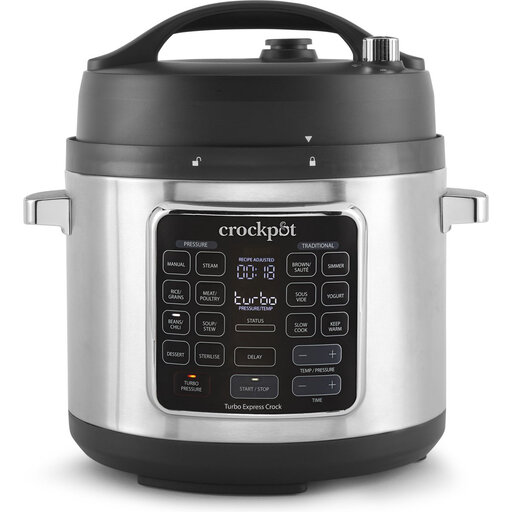 No image available
A larger pot can come in handy if you regularly make stews for several people.
The product name lists a capacity of 5.6 L and three settings.
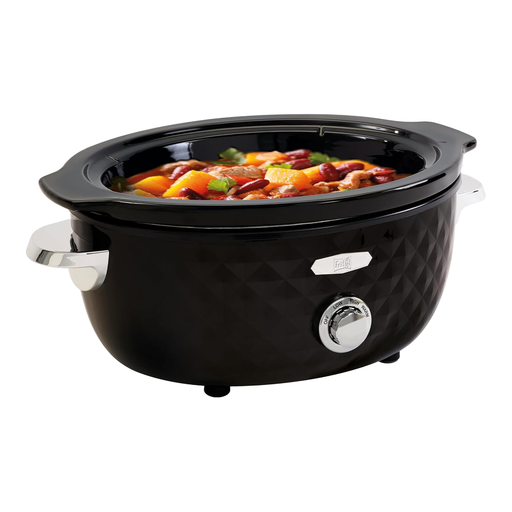 No image available
The stated capacity is suited to anyone making a stew for one to four people.
The product name lists a ceramic pot, four heat settings and 150 W. According to the product information, the pot must not be used on a hob or in an oven.
No, you don’t need to cook tinned beans for hours. The Netherlands Nutrition Centre advises heating tinned pulses according to the instructions on the label. A slow cooker is mainly worth considering if you want to make a more substantial stew.
It’s best not to use a slow cooker for this. The Netherlands Nutrition Centre advises reheating leftovers until steaming hot throughout, and the USDA recommends not reheating leftovers in a slow cooker.
Don’t leave leftovers out of the fridge for more than two hours. The Netherlands Nutrition Centre advises keeping cooked food in the fridge for no more than two days.
Check that the model you want to buy has the relevant CE marking, and read the safety instructions. The Government of the Netherlands lists CE marking as a requirement for electrical products placed on the EU market. Information about a model doesn’t automatically prove that the marking is present on the one you’re buying.
Report the fault to the retailer, who is responsible for supplying a product that works as it should. The Government of the Netherlands states that there is no fixed statutory guarantee period in the Netherlands; your rights also depend on the fault and what you could reasonably expect from the product.